Power Switch Design Between Two Negative Voltage Sources (-5V and -2.7V)

Thread Starter

TuPham

Joined Oct 25, 2024
1
I am designing a power switch that toggles between two negative voltage sources, specifically -5V and -2.7V, controlled by a 5V signal. I need the switch to select one of these sources based on the 5V control signal, while preventing any conflicts or backfeeding between the sources.

Could you recommend a suitable approach or circuit for this purpose? Suggestions on component choices, especially for MOSFETs or relays, and any necessary protection elements would be very helpful.

Thank you!
 

DickCappels

Joined Aug 21, 2008
10,661
Before getting too far into the design, how much current do you need out of the supplies, What is the range of voltages allowed out of the switch?
 

Shadow123

Joined Jul 25, 2024
14
I am designing a power switch that toggles between two negative voltage sources, specifically -5V and -2.7V, controlled by a 5V signal. I need the switch to select one of these sources based on the 5V control signal, while preventing any conflicts or backfeeding between the sources.

Could you recommend a suitable approach or circuit for this purpose? Suggestions on component choices, especially for MOSFETs or relays, and any necessary protection elements would be very helpful.

Thank you!
You can use N-channel MOSFETs to switch the negative voltages. Use one MOSFET for each voltage and control them with the 5V signal.
 

crutschow

Joined Mar 14, 2008
38,316
You can use N-channel MOSFETs to switch the negative voltages. Use one MOSFET for each voltage and control them with the 5V signal.
That's fine as far as it goes.
The critical detail is, how do you propose the 5V signal control the MOSFETs that are connected to a negative voltage?
 
Last edited:

Shadow123

Joined Jul 25, 2024
14
That's fine as far as it goes.
The critical detail is, how do you propose the 5V signal control the MOSFETs that are connected to a negative voltage?
We can use 74HC04 to invert the 5V control signal. Then use the inverter's output to control the first MOSFET while using direct control signal to control the second.
 
Last edited:

MisterBill2

Joined Jan 23, 2018
27,159
I would add that it should be a relay that is not polarity sensitive. There are a few electromechanical relays made for five volt DC operation. An added benefit is that the relay will not be polarity sensitive, neither coil nor contacts.
So that would be the very simplest method. Of course, those relays are not rated for a whole lot of current. And the required current handling ability was not mentioned. The 5 volt relays I have seen were only rated a few amps.
SOME TIMES it works much better to not use the more modern scheme. Relays are still used a whole lot, because in many situations nothing else will be nearly as cost effective.
 
Last edited:

crutschow

Joined Mar 14, 2008
38,316
We can use 74HC04 to invert the 5V control signal. Then use the inverter's output to control the first MOSFET while using direct control signal to control the second.
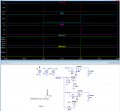
Sorry, we can't just use a plus 5V signal to control an N-MOSFET connected to a negative voltage, which thus requires a negative referenced voltage to get the proper Vgs control voltages.

That can be done with a voltage level-shifter for the control signal (example circuit below using a PNP BJT).

1729964020794.png
 
Last edited:

MisterBill2

Joined Jan 23, 2018
27,159
11 components instead of one component that will function correctly the very first time. And continue to function correctly over a wide temperature range. and not exhibit any drift.
 

MisterBill2

Joined Jan 23, 2018
27,159
What requires 11 components?
The circuit shown in post #11 requires 11 components by my count. That is a lot more complex than a single relay, and will occupy more room. AND that circuit may require a bit of adjustment. Also, ANY electronic scheme will need to reside in some sort of package to keep it functional, and provide stable mounting for all of those parts.
 

crutschow

Joined Mar 14, 2008
38,316
The circuit shown in post #11 requires 11 components by my count.
I count 9, not including the sim load resistances, but who's counting? :rolleyes:

But if you read all the posts you would see that circuit was to show Shadow123 how to use a MOSFET to do the switching which he suggested, not that it was necessarily better than using a relay.
not exhibit any drift.
AND that circuit may require a bit of adjustment.
It's a MOSFET switch.
How would it drift or require an "adjustment"?
 

crutschow

Joined Mar 14, 2008
38,316
And as to whether a relay is a better approach then using MOSFET switches depends upon if the power consumption and number of rated operations of a relay is adequate for the system requirements, which were not stated.
 

BobTPH

Joined Jun 5, 2013
11,463
And as to whether a relay is a better approach then using MOSFET switches depends upon if the power consumption and number of rated operations of a relay is adequate for the system requirements, which were not stated.
Not to mention switching frequency.
 

crutschow

Joined Mar 14, 2008
38,316
Back to post #1: "component choices, especially for MOSFETs or relays," A part of the TS initial request.
Yes, it was an "or" request for those two possible approaches.
It's not clear that the TS is aware of a relays limitations as it pertains to his particular (unknown) application.
 
Last edited:
Top