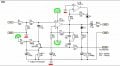
I have just started building circuits last year and mostly stripboards, so these are still things that I don't know: where do you connect the points marked by red underlines and green half circles in this schematic?
The symbols marked with red represent circuit ground. Technically it represents earth ground. Circuit ground is represented by a triangle outline. They and the 2 +15V symbols are what are referred to as connect-by-name; they simplify schematics.
The +15V, -15V, and ground are power supply connections.
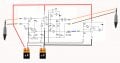
The +15 and -15 are power supply points. The operational amplifier uses a dual supply, a + and - supply. I see ron already provided an image so I won't say anymore.
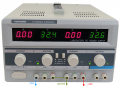
That schematic requires a power supply with three output posts, -15V, +15V, and ground.
[too slow!]
Depending on what you're doing, this circuit might work with two 9V batteries connected in series. "Ground" would be where the two batteries connect. Or two 12V batteries.
It is best practice if the schematic of a circuit is uncluttered and clear to read.
It's a common practice to take power and ground points and label them as such rather than draw wires connecting them. For the purpose of wiring the circuit all such equivalently labelled points should be connected together.
There can be a big difference between "common" and "ground". I have seen some drawings that used different symbols for power common and chassis ground to avoid noise issues. Of course the drawing also had a note explaining that.
Somedrawings that use the ground symbol extensively have them all at one lower level across the the drawing. That makes it very easy to understand and follow. Unfortunately that is not very common.
To answer the question posed in post #1, quite often the "ground" (common) strip is at the "bottom" and the power connections would be at the opposite edge, (top). This allows the most space for the usual power filter capacitors to be placed. Electrically it usually does not matter, BUT it is often convenient.
Thanks for the comment of everyone. To summarize, should the connections look like this? And what I still don't understand is: this is a limiter guitar effect circuit. Such pedals that I disassembled had a metal spring that was soldered on the circuit board and was touching the metal box of the effect. Where is that route in this schematic or where should that be?
Thanks for the comment of everyone. To summarize, should the connections look like this? And what I still don't understand is: this is a limiter guitar effect circuit. Such pedals that I disassembled had a metal spring that was soldered on the circuit board and was touching the metal box of the effect. Where is that route in this schematic or where should that be?
Thank you for your picture of your understanding. That is also my understanding. I am open to being corrected, but I think the spring touching the metal box would be electrically connected to your gray line (ground)
Thank you for your picture of your understanding. That is also my understanding. I am open to being corrected, but I think the spring touching the metal box would be electrically connected to your gray line (ground)
At the place where this circuit was recommended, I got this reply whether the drawing is correct or not:
" Yes and no. The gnd should be pads on the circuit board that connect to the sleeves and the dc jack neg. "
What does that mean? I don't understand this. How do the pads connect to both the sleeves and the dc jack?
At the place where this circuit was recommended, I got this reply whether the drawing is correct or not:
" Yes and no. The gnd should be pads on the circuit board that connect to the sleeves and the dc jack neg. "
What does that mean? I don't understand this. How do the pads connect to both the sleeves and the dc jack?
That's less than clear but in my opinion the "sleeves" and the long portion of the DC jack is the same thing. It's all connected to the shielding of the cables and represents system common, often called ground although it may not be technically connected to earth ground.
That's less than clear but in my opinion the "sleeves" and the long portion of the DC jack is the same thing. It's all connected to the shielding of the cables and represents system common, often called ground although it may not be technically connected to earth ground.
I seem to understand what that guy might have referred to. That on the factory PCB the connections are already manufactured in the PCB, and I just need to connect 1 pad point to the corresponding jack or psu plug point. Funny that I did not ask from him about how it goes on the PBC but how it goes on the drawing
However regarding the PSU I was recommended to use a normal 2 pin 14V PSU with a dedicated splitter/converter, that takes the 24v +/GND and converts it to 15V+ GND 15V-.
At the place where this circuit was recommended, I got this reply whether the drawing is correct or not:
" Yes and no. The gnd should be pads on the circuit board that connect to the sleeves and the dc jack neg. "
What does that mean? I don't understand this. How do the pads connect to both the sleeves and the dc jack?
The circuit board should have a solder point for the zero volts (gray line or brown line are both 'ground') and the socket the plugs go into (screwed into the case, should have either a wire or metal connection to the case). The metal case + the jack holding the plug's sleeve + the zero volts solder pad on circuit board should all be electrically connected. Touching metal to metal or wires.
The circuit board should have a solder point for the zero volts (gray line or brown line are both 'ground') and the socket the plugs go into (screwed into the case, should have either a wire or metal connection to the case). The metal case + the jack holding the plug's sleeve + the zero volts solder pad on circuit board should all be electrically connected. Touching metal to metal or wires.
Sorry, I was wrong. I was told the connection of the gnd to the metal housing is not needed when you build this circuit with metal jack sockets. Then the gnd will connect from their body to the metal casing.
This is my opinion about the metal spring touching the metal enclosure: I see that as a cheap alternative to providing a solid connection between the circuit common and the case.
As for the supply positive or negative, not all pedal electronics use a negative side "grounded to the case".
Consider that especially if the internal circuit inside the pedal is battery powered, there is no other connection between any outside circuit except the input and output connections. If the connector "common side" are adequately anchored to the case, then any external noise voltages are restricted to the system common.

 Facebook
 Google
 GitHub
 Linkedin