Facebook
 Google
 GitHub
 Linkedin

Hello All About Circuits forum,
Working on a project that uses a signal from a PIR sensor (AM312)
to send a signal to an Arduino which sends and output to a
transistor that turns on power to an LED.
But could not get it to work and because the out put from
the Arduino looked normal it was suspected that the issue
was with or near the transistor.
So simplified the circuit by eliminating the Arduino and just
sending a signal from the PIR to the transistor to the LED.
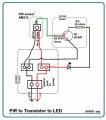
This circuit does not work.
So started testing. (Of all the things that have assimilated in
working with electronics, the most useful knowledge has come
from learning about testing. Use to be the circuit was constructed,
then powered up and if it didn't work [usually] I was stuck.
The only next step was to rebuild the circuit from scratch
and hope it worked the next time. If it didn't the second
or third time one starts getting into the idea about
doing the same thing over and over and expecting a different
result.)
Test 1. Built circuit according to PIR to Transistor to LED 200620
Result: Not working
1.1 Checked power at power board. Result +5.1v
1.2 Checked power at power input to PIR. Result +5.1v
1.3 Checked power at PIR output during PIR signal high. Result +3.2v
1.4 Checked PIR output at Control board during PIR signal high. Result +3.2v
1.5 Checked PIR output at Q1 side of R1 during PIR signal high. Result +3.2v
Test 2. Substitute BC557 at Q1 for BC547 (Rationale: Wanted to sub same transistor,
BC547 for existing to prove component not issue but had no more BC547s
so had to use BC557)
Result: Not working.
2.1 Checked PIR output at Q1 side of R1 during PIR signal high. Result +3.2v
Test 3. Substitute PN2222 for BC557 at Q1 (Rationale: Sub similar transistor)
Result: Not working.
3.1 Checked PIR output at Q1 side of R1 during PIR signal high. Result +3.2v
Test 4. Substitute 10 ohm for 25 ohm R8. (Rationale: Reduce resistance at transistor to
LED ground)
Result: Not working.
4.1 Checked PIR output at Q1 side of R1 during PIR signal high. Result +3.2v
Test 5. Substitute jumper wire for R8. (Rationale: Reduce resistance at transistor to
LED ground)
Result: Not working.
5.1 Checked PIR output at Q1 side of R1 during PIR signal high. Result +3.2v
Test 6. Substitute 220 ohm ar R1 for 470 ohm resistor . Replace R8 25 ohm for jumper wire.
Result: Working. That is, the LED is on for a period expected from the known good
high cycle of the PIR.
Test 7. Substitute 470 ohm ar R1 for 220 ohm resistor.
Result: Not working.
7.1 Checked PIR output at Q1 side of R1 during PIR signal high. Result +3.2v
Test 8. Substitute BC547 at Q1 for PN2222.
Result: Working,
Test 9. Substitute BD43R at Q1 for BC547. (Rationale: When the Arduino is refactored
in want Q1 to operate 18 LEDs so will need transistor with max collector current 4 amps)
Result: Working.
So the conclusion is from Test 6 is the the value of R1 was too high.
Next step is to put the Arudino between the sensor and the transistor. The output of the
Arduno is +5v, max 40mA. The output of the AM312 is 3 v but not sure the current is
understood. the data sheet
https://forum.mysensors.org/topic/3658/pir-am312
says the max current is max high output is -10 mA. How can minus milliamps be a high signal?
Thanks.
Allen in Dallas
Working on a project that uses a signal from a PIR sensor (AM312)
to send a signal to an Arduino which sends and output to a
transistor that turns on power to an LED.
But could not get it to work and because the out put from
the Arduino looked normal it was suspected that the issue
was with or near the transistor.
So simplified the circuit by eliminating the Arduino and just
sending a signal from the PIR to the transistor to the LED.
This circuit does not work.
So started testing. (Of all the things that have assimilated in
working with electronics, the most useful knowledge has come
from learning about testing. Use to be the circuit was constructed,
then powered up and if it didn't work [usually] I was stuck.
The only next step was to rebuild the circuit from scratch
and hope it worked the next time. If it didn't the second
or third time one starts getting into the idea about
doing the same thing over and over and expecting a different
result.)
Test 1. Built circuit according to PIR to Transistor to LED 200620
Result: Not working
1.1 Checked power at power board. Result +5.1v
1.2 Checked power at power input to PIR. Result +5.1v
1.3 Checked power at PIR output during PIR signal high. Result +3.2v
1.4 Checked PIR output at Control board during PIR signal high. Result +3.2v
1.5 Checked PIR output at Q1 side of R1 during PIR signal high. Result +3.2v
Test 2. Substitute BC557 at Q1 for BC547 (Rationale: Wanted to sub same transistor,
BC547 for existing to prove component not issue but had no more BC547s
so had to use BC557)
Result: Not working.
2.1 Checked PIR output at Q1 side of R1 during PIR signal high. Result +3.2v
Test 3. Substitute PN2222 for BC557 at Q1 (Rationale: Sub similar transistor)
Result: Not working.
3.1 Checked PIR output at Q1 side of R1 during PIR signal high. Result +3.2v
Test 4. Substitute 10 ohm for 25 ohm R8. (Rationale: Reduce resistance at transistor to
LED ground)
Result: Not working.
4.1 Checked PIR output at Q1 side of R1 during PIR signal high. Result +3.2v
Test 5. Substitute jumper wire for R8. (Rationale: Reduce resistance at transistor to
LED ground)
Result: Not working.
5.1 Checked PIR output at Q1 side of R1 during PIR signal high. Result +3.2v
Test 6. Substitute 220 ohm ar R1 for 470 ohm resistor . Replace R8 25 ohm for jumper wire.
Result: Working. That is, the LED is on for a period expected from the known good
high cycle of the PIR.
Test 7. Substitute 470 ohm ar R1 for 220 ohm resistor.
Result: Not working.
7.1 Checked PIR output at Q1 side of R1 during PIR signal high. Result +3.2v
Test 8. Substitute BC547 at Q1 for PN2222.
Result: Working,
Test 9. Substitute BD43R at Q1 for BC547. (Rationale: When the Arduino is refactored
in want Q1 to operate 18 LEDs so will need transistor with max collector current 4 amps)
Result: Working.
So the conclusion is from Test 6 is the the value of R1 was too high.
Next step is to put the Arudino between the sensor and the transistor. The output of the
Arduno is +5v, max 40mA. The output of the AM312 is 3 v but not sure the current is
understood. the data sheet
https://forum.mysensors.org/topic/3658/pir-am312
says the max current is max high output is -10 mA. How can minus milliamps be a high signal?
Thanks.
Allen in Dallas