Facebook
 Google
 GitHub
 Linkedin

hi Danko,
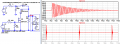
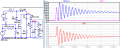
Some earlier marine echo sounders, circa 1970's, used a similar method to your circuit.
A paper type capacitor was charged to a high voltage, 2uF to 8uF, 200Vdc to 800Vdc, depending upon the transducer rating and the echo depth required.
The charged capacitor was momentarily connected across the transducer, this caused the transducer to 'ring' at its resonant frequency, it sounds crude but it worked.
Later sounders generated a stream of narrow period pulses at the resonant frequency of the transducers, this gave a much better control of the power output and duration of the transmit period.
A typical power supply would be 12V or 24V batteries, the transmitter stepped up this available voltage to approx 200Vpk drive pulses.
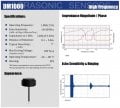
The information we have about the TS's 1MHz transducer is limited, he also wants to power the system from a 5V battery supply.
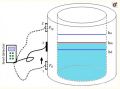
Transmitting acoustic power at 1MHz through the base of a metal drum and detecting a clean echo from the internal water/air interface and back thru the drum base to the transducer is going to be problematic IMO.
My advice to the TS is to get some empirical trial data with the transducer fixed to the container base.
Use his second transducer as a receiver only, with its face in contact with the internal water surface , to determine the strength/quality of the TX pulse at the internal water surface.
E
Some earlier marine echo sounders, circa 1970's, used a similar method to your circuit.
A paper type capacitor was charged to a high voltage, 2uF to 8uF, 200Vdc to 800Vdc, depending upon the transducer rating and the echo depth required.
The charged capacitor was momentarily connected across the transducer, this caused the transducer to 'ring' at its resonant frequency, it sounds crude but it worked.
Later sounders generated a stream of narrow period pulses at the resonant frequency of the transducers, this gave a much better control of the power output and duration of the transmit period.
A typical power supply would be 12V or 24V batteries, the transmitter stepped up this available voltage to approx 200Vpk drive pulses.
The information we have about the TS's 1MHz transducer is limited, he also wants to power the system from a 5V battery supply.
Transmitting acoustic power at 1MHz through the base of a metal drum and detecting a clean echo from the internal water/air interface and back thru the drum base to the transducer is going to be problematic IMO.
My advice to the TS is to get some empirical trial data with the transducer fixed to the container base.
Use his second transducer as a receiver only, with its face in contact with the internal water surface , to determine the strength/quality of the TX pulse at the internal water surface.
E