Piezo Transducer Driver Circuit

ericgibbs

Joined Jan 29, 2010
21,448
hi Danko,
Some earlier marine echo sounders, circa 1970's, used a similar method to your circuit.
A paper type capacitor was charged to a high voltage, 2uF to 8uF, 200Vdc to 800Vdc, depending upon the transducer rating and the echo depth required.

The charged capacitor was momentarily connected across the transducer, this caused the transducer to 'ring' at its resonant frequency, it sounds crude but it worked.

Later sounders generated a stream of narrow period pulses at the resonant frequency of the transducers, this gave a much better control of the power output and duration of the transmit period.

A typical power supply would be 12V or 24V batteries, the transmitter stepped up this available voltage to approx 200Vpk drive pulses.

The information we have about the TS's 1MHz transducer is limited, he also wants to power the system from a 5V battery supply.

Transmitting acoustic power at 1MHz through the base of a metal drum and detecting a clean echo from the internal water/air interface and back thru the drum base to the transducer is going to be problematic IMO.

My advice to the TS is to get some empirical trial data with the transducer fixed to the container base.
Use his second transducer as a receiver only, with its face in contact with the internal water surface , to determine the strength/quality of the TX pulse at the internal water surface.

E
 

Danko

Joined Nov 22, 2017
2,169
Hi Yacub,
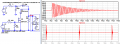
Model of IRFP264 is built in file piezo+IRFP264_model.asc

Hi Eric,
Generating piezo pulses at predetermined frequency is not good practice.
Real resonant frequency of piezo always is different from nominal,
because of temperature, contacted medium properties, etc,
therefore piezo will have maximal sensitive to echo, when probing signal was
transmitted in free oscillation mode (shock excitation).
In echo location first 1-2 periods of wave are important only, they should have
maximum possible amplitude (shock excitation).
TS problem about liquid level inside sealed metal container is very complicated.
For example see article:
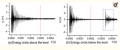
A Liquid Level Measurement Technique Outside a Sealed Metal Container Based on Ultrasonic Impedance and Echo Energy
EDIT:

Added diagram and file piezo_enh.asc,
where in piezo model added C2 - static capacitance.
piezo.PNG
 

Attachments

Last edited:

ericgibbs

Joined Jan 29, 2010
21,448
Generating piezo pulses at predetermined frequency is not good practice.
Real resonant frequency of piezo always is different from nominal,
because of temperature, contacted medium properties, etc,
therefore piezo will have maximal sensitive to echo, when probing signal was
transmitted in free oscillation mode (shock excitation).
hi Danko,
We are obviously not going to agree on this method, shock oscillation of sounder transducers went out of fashion about 40 years ago.
However, I suggest the TS tries your method, I like to believe that I always have an open mind on how a project should be realised.

Eric.

BTW:
If you check my profile you will see that echo sounders were one the many surveying products I successfully designed and manufactured for a number of years.
 

Danko

Joined Nov 22, 2017
2,169
Hi Eric,
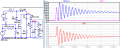
In final simulation below
piezo model is improved,
now not affected by outer components.
1MHz is clean, stable,
power of signal is big enough.
-----------------------------------------------
Thank you for technically and logically
informative discussion:
old time, old glory etc.
Danko
upload_2019-4-1_4-58-10.png
 

Attachments

Last edited:

MisterBill2

Joined Jan 23, 2018
27,584
I know that there are circuits that oscillate at the resonant frequency of the piezo-electric device. Some of them are amazingly similar to crystal oscillators used in may types of electronic circuits. That sort of arrangement would always be driving the device at it's resonant frequency, even as that frequency wandered up and down. I am amazed that nobody else came up with that thought. Modeling a circuit will give accurate results, possibly, when the model is accurate. The rest of the times modeling just gives results of how that model works. IFF you are lucky, the model results are close to what actually may happen in a real circuit, or at least close enough to be useful.
I use the term "IFF" in the logic sense here, it is not a typo.
 

cmartinez

Joined Jan 17, 2007
8,768
Hello, everyone. Pardon for the intrusion, but I find this thread extremely interesting. I just want to ask a couple of questions, and then maybe make a suggestion.

This is the transducer being used by the TS:

Dataheet DM1000.jpg

This is what I'm understanding so far:
  • The TS wants to measure the level of liquid inside a metal container.
  • To accomplish that, he wants to use a transducer inside the container, directly above the liquid. Let's say that it's mounted on the container's lid.
  • This is what I might have wrong, so please correct me if I'm saying something stupid: The transducer works as a sonar of sorts. It mechanically vibrates after being strongly excited by an electric pulse (or pulses), and then the resulting echo is picked by the same transducer, the acoustic energy exciting the piezo element inside the transducer and thus producing a very small electric signal, which is later amplified for proper detection.
  • The time elapsed between the excitation pulse and the echo detection determines the distance between the transducer and the liquid's surface.

Are my previous observations correct?

If they are, here's my question/suggestion:
  • The TS has stated that he has no problem detecting an echo inside a plastic container, but a metal container has proved to be a challenge due to the physics involved. Perhaps the metal container itself is absorbing the acoustic energy which is supposed to be detected by the transducer.
  • Key question: Why not build a small parabolic reflector (which could be made of plastic) in front of the transducer, with the latter at its focal point, so that all of the acoustic energy "pinged" by the transducer is focused in a beam, and its latter detection made much more sensitive by the same reflector?
  • The transducer, of course, would be mounted upwards with the parable pointing downwards.

Something like this:

upload_2019-3-31_18-41-16.png

I beg everyone's pardon if what I'm suggesting is stupid or does not apply to the problem being discussed. I'm just trying to help/learn best as I can.
 

MisterBill2

Joined Jan 23, 2018
27,584
I am still wondering why there does not seem to be any echo detected with the steel container but there is an echo detected with the plastic container. So now a question: Are the sizes different? And what about the mounting arrangement? Is that different? The echo from the water in a steel container should be stronger than with a plastic container because the steel is a much less absorbant material. So the echo should be stronger. And if the circuit is actually working with the plastic container then it should be better with the steel container. Thus I believe that the problem is not in the driver or the detector, but rather in the connections or in the mounting. So the first step is to verify that it is actually working as it appears to be, in the plastic container. Detecting different levels would be a good start, and easy to do.
"When actions fail, try thinking again." The failure is not reasonable, thus the cause is also probably not reasonable.
 

cmartinez

Joined Jan 17, 2007
8,768
In any case, maybe there's something that the TS could attach to the tank to make it's behaviour change? Say, gluing or attaching a thick steel rod or square profile running lengthwise on the side opposite to the sensor? Maybe that way the tendency of the vibrations to cancel each other would change?
 

cmartinez

Joined Jan 17, 2007
8,768
Easiest way:
Subtract weight of empty standard container
from weight of sealed standard container with liquid.
Using load cells, yes. I've done it before, and it works far more accurately. Although it's a bit more expensive than the use of a transducer, the way I see it.
 

ericgibbs

Joined Jan 29, 2010
21,448
hi,
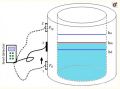
As I understand the TS's project is:

He has a metal container [ similar to a beer keg] which holds water, he wants to mount the transducer on the outside base of the metal container, the active face of the transducer in contact with the containers metal base.

He expects the 1MHz ultrasonic pulse to pass thru the metal base, travel though the water and reflect from the water to air interface, then back down to base of the container.

So, the air/water reflected echo travels back down thru the water and then thru the metal base and is detected by the transducer.

By measuring the double path length of the pulse time, the depth/height of the water in the container can be calculated.

IMO I do not think think this is a viable way of measuring the water depth in a metal container, weighing the container or or using an above mounted ultrasonic transducer would be a better option.

E
 

Alec_t

Joined Sep 17, 2013
15,121
I agree with all of Eric's post above, except that I think mounting the transducer above the liquid (i.e on the outer top surface of the container) would introduce even greater energy losses in the overall path, due to acoustic impedance mismatches.
With the transducer on top, the path is piezo/metal/vapour/liquid/vapour/metal/piezo. The metal/vapour interface would be very lossy.
With the transducer on the bottom, the path is piezo/metal/liquid/vapour/liquid/metal/piezo. The metal/liquid interface would be less lossy than a metal/vapour one.
 

ericgibbs

Joined Jan 29, 2010
21,448
hi alec,
I understand from the TS, its an open top container, there would be nothing in between the transducer and the water except the air path.
That would and does work in tidal height applications.
E
 

MisterBill2

Joined Jan 23, 2018
27,584
hi alec,
I understand from the TS, its an open top container, there would be nothing in between the transducer and the water except the air path.
That would and does work in tidal height applications.
E
EG has stated what is given very early in the thread. start at post #1 to understand. Looking down at the liquid from above without going through a wall. It is possible that with the much larger diameter the sound wave is spread out so that an echo is much less and does not appear on the scope. But I am also reminded of a research project that I was part of several years ago in which another researcher in another part of the world got some fantastic results. As is done in scientific research, I duplicated his setup but was unable to produce the same results, until my ground connection to the piezo transducer became disconnected. Suddenly my signal levels exactly matched the published results. Also, the transmission velocity through the media became instantanious! We were seeing the transmit pulse capacitively coupled, not the signal from the transmitted acoustic wave. This is my reason for claiming that the connections needed to be examined very closely, because an alternate unintended signal path can deliver results that are not intended, even though they appear to be.
So I am suggesting now to use a second transducer to sense the acoustic signal as it is transmitted, to verify that the amplitudes are similar using both the plastic and the metal containers.
 

Thread Starter

h.yakub

Joined Mar 11, 2019
97
Hi All,
1. I am using Ultrasound gel as the coupling medium between the transducer and the metal surface.
2. The metal container has a closed sealed top, so I cannot arrange a parabolic reflector at the top surface.
3. I have tried using Transmitter and receiver separately but still, getting no echo on metal container (though I haven't tried it on plastic bottles).
4. There is a Huge size difference between the plastic bottle and the metal container (So please don't get confused by it), the plastic bottles are the general plastic water bottles.
5. I have two different kinds of transducers both of them has resonant frequency of 1 MHz, but there capacitance, resistance and inductance are different. Transducer A has following parameters (3300pF, 3 Ohms @ resonant frequency), while Transducer B (2200pF, 25 Ohms @ r esonant frequency).
So far, I have tried the circuits posted by you guys (Eric.G, Danko, MasterBills, Alec, C.martinez). I will share results soon..stay tuned, and still anyone has a confusion please let me know...
Thank You :)
 

MisterBill2

Joined Jan 23, 2018
27,584
Hi All,
1. I am using Ultrasound gel as the coupling medium between the transducer and the metal surface.
2. The metal container has a closed sealed top, so I cannot arrange a parabolic reflector at the top surface.
3. I have tried using Transmitter and receiver separately but still, getting no echo on metal container (though I haven't tried it on plastic bottles).
4. There is a Huge size difference between the plastic bottle and the metal container (So please don't get confused by it), the plastic bottles are the general plastic water bottles.
5. I have two different kinds of transducers both of them has resonant frequency of 1 MHz, but there capacitance, resistance and inductance are different. Transducer A has following parameters (3300pF, 3 Ohms @ resonant frequency), while Transducer B (2200pF, 25 Ohms @ r esonant frequency).
So far, I have tried the circuits posted by you guys (Eric.G, Danko, MasterBills, Alec, C.martinez). I will share results soon..stay tuned, and still anyone has a confusion please let me know...
Thank You :)
Item #2 makes a great deal of difference! My original understanding was that the transducer was looking down at the surface of the water in the metal container. Now I understand that is not the case, that the signal must first drive the material of the container which in turn drives the air above the surface of the water, and then the return echo must vibrate the container material thus driving the detector.That is not how industrial ultrasonic level detectors work. The probe on those devices penetrates the top of the container so that there is nothing in the way of the ultrasonic energy. While in theory it is possible to make the system as desired provide adequate results, it is not reasonable to expect it to happen without a whole lot more effort and expense. So I suggest an alternate approach if there is not a way to give the probe a direct view of the water surface. That would be to use an insulated capacitive probe that enters the container through the same top opening, presuming that there is such an opening. It could also enter through a bottom opening if that were the only one available. The probe would sense the level of the water as a difference in capacitance between the insulated probe and the conductive container material, which the capacitance would affect the frequency of an oscillator. measuring the frequency of the oscillator is straightforward and easily done, and would provide a high resolution analog of the fluid height in the container..

AND, from the description of the container size, it may be the water tank of a water pump well system installed for home use. At that point I offer a caution, which is that those tanks include a diaphram to separate the water from the air, and so the challenge becomes different. One more reason for the TS to give all the details with the initial questions.
 

cmartinez

Joined Jan 17, 2007
8,768
And here I thought that my previous assessment was unnecessary and way off the mark. :rolleyes:

It seems that there's more to this project than meets the eye.
 
Top