That's ok, Apple is asking vendors for a camera with even more adjustable depth of field. New ultra-sensitive low-light and high speed sensors coupled with new high precision polishing/shaping technology of small lenses is making your iPhone very close to a "professional" camera.
Unfortunately, physics is against tiny lenses and sensors. The diffraction and poor light gathering is not something that can be changed. Lenses have hard physical limits, and advances in sensor technology are also going to translate to larger sensors which will do better.
The phone cameras have gotten amazingly good, and computational photography offers a lot of possibility for the future (included multi-camera arrays and interpolation) but a "professional" camera will always, necessarily, be very different than a phone camera.
All that said, it is definitely the case that a good phone camera can get you really nice images if it is used within its limits and the ability to shoot RAW on the phones extends that. In one way you are correct, viewing the output of the two cameras at social media size few people could distinguish between the two, so practically speaking most people will not benefit from a "professional" camera because they can't use it to take better photos and the can't tell if they did.
Unfortunately, physics is against tiny lenses and sensors. The diffraction and poor light gathering is not something that can be changed. Lenses have hard physical limits, and advances in sensor technology are also going to translate to larger sensors which will do better.
The phone cameras have gotten amazingly good, and computational photography offers a lot of possibility for the future (included multi-camera arrays and interpolation) but a "professional" camera will always, necessarily, be very different than a phone camera.
All that said, it is definitely the case that a good phone camera can get you really nice images if it is used within its limits and the ability to shoot RAW on the phones extends that. In one way you are correct, viewing the output of the two cameras at social media size few people could distinguish between the two, so practically speaking most people will not benefit from a "professional" camera because they can't use it to take better photos and the can't tell if they did.
Forst, I said "very close" to a professional camera.
Now I learn that "Close" means close to someone who doesn't own a $5000 camera with a $10000 lens. But "close" is a terrible exaggeration to someone who does own a $5000 camera with a $10000 lens.
Forst, I said "very close" to a professional camera.
Now I learn that "Close" means close to someone who doesn't own a $5000 camera with a $10000 lens. But "close" is a terrible exaggeration to someone who does own a $5000 camera with a $10000 lens.
You were and are wrong. What you replied to, was @djsfantasi who was commenting on a wide landscape shot reproduced at large size. In that context there will always be a material difference between a camera with a tiny sensor and one with a much larger sensor. That’s physics, not bias.
As I said, if you are talking about displaying an image at the small size of instagram or the like, the average person will not detect differences, and even the well informed might have trouble if the lighting is good and the distance to the subject is not great. But that’s not what you said, and it has nothing to do with me.
You were and are wrong. What you replied to, was @djsfantasi who was commenting on a wide landscape shot reproduced at large size. In that context there will always be a material difference between a camera with a tiny sensor and one with a much larger sensor. That’s physics, not bias.
As I said, if you are talking about displaying an image at the small size of instagram or the like, the average person will not detect differences, and even the well informed might have trouble if the lighting is good and the distance to the subject is not great. But that’s not what you said, and it has nothing to do with me.
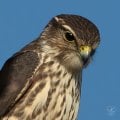
A Merlin. Merlins are a kind of falcon, on the small side. An unusual visitor here, classified as "uncommon"—so not quite rare but still a nice sighting. This is the second I have seen, with one last year. Why they choose to migrate through sometimes I don't know but it's possible this is the same one, I have no way to tell definitively from last years photo.
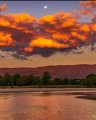
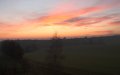
Taken by a friend, sunset at Nono in Córdoba, my province, 40 Km away from where I was born (Villa Dolores) the whole located in the area called Traslasierra (behind the hill).
So lately, AI has really had an impact on photography. Topaz Labs make AI-powered tools for post processing based on TensorFlow. They have sharpening, noise reduction, making, and upscaling products. The last, upscaling is a very important tool for a professional needing to be able to use material that is just too small.
Thie image of a Merlin below started as a brutal 300 x 300P crop from a 21MP Full Frame sensor (Canon 1DX Mark II). Why crop like that? Well when you are shooting birds cropping is the rule not the exception. Birds are small and even very long lenses may fill only a small part of the frame.
That crop represents about 0.4285% of the pixels in the sensor, vanishingly small. Gigapixel AI was able to scale the tiny, ~1.4285 × 10⁻⁵ piece of the sensor data into a very nice photo, very usable at the four times resolution increase.
Below are the 300x300P version at its native size, the same version sized to 1200 x 1200P, and the upscaled 1200 x 1200P version. Because of how the website lay out the screen the larger photos may be geometrically distorted. If you look at the upscaled one in a separate window you will see how closely it matches the 300 x 300P version.
So lately, AI has really had an impact on photography. Topaz Labs make AI-powered tools for post processing based on TensorFlow. They have sharpening, noise reduction, making, and upscaling products. The last, upscaling is a very important tool for a professional needing to be able to use material that is just too small.
Thie image of a Merlin below started as a brutal 300 x 300P crop from a 21MP Full Frame sensor (Canon 1DX Mark II). Why crop like that? Well when you are shooting birds cropping is the rule not the exception. Birds are small and even very long lenses may fill only a small part of the frame.
That crop represents about 0.4285% of the pixels in the sensor, vanishingly small. Gigapixel AI was able to scale the tiny, ~1.4285 × 10⁻⁵ piece of the sensor data into a very nice photo, very usable at the four times resolution increase.
Below are the 300x300P version at its native size, the same version sized to 1200 x 1200P, and the upscaled 1200 x 1200P version. Because of how the website lay out the screen the larger photos may be geometrically distorted. If you look at the upscaled one in a separate window you will see how closely it matches the 300 x 300P version.
A couple of photos from Mackinac Island, on Lake Huron from back in 2017 (before the event, don't mention the event).
The Mackinac Bridge, from Mackinac Island on a chilly October day.
Crossing the Straits of Mackinac with a span of just short of 5 miles, the bridge is "the longest suspension bridge between anchorages in the western hemisphere".
The bridge connects the upper and lower peninsulas of Michigan, formerly served by ferries. It is so long that some people can't bring themselves to drive across it and you can pay a driver to take your car across (with you in it, of course).
On windy days, the bridge can be closed to HPVs (High Profile Vehicles) and on very bad days, even cars. Icing can also close the brigdge.
The Ferry Chippewa Unloads at Dawn
...with the first run from the mainland bringing supplies for the businesses that depend on the ferry service to keep stocked.
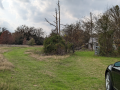
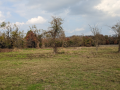
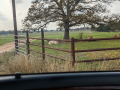
Clearing the land to reduce the number of wild hogs. It's a mixed blessing as hunters pay us to hunt the damn things on the land (a few hundred acres total).
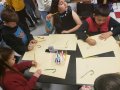
What my kid (bottom left) draws vs other kids draw.
Out of at least 50 kids in there, all but 5 traced their candy canes as a starting point for colorful Christmas-y scenes (I think that's what they were instructed to do), 4 of them just scribbled in what seemed like defiance, and she used her candy cane as a ruler to make a 3D perspective box which later became a present with a bow.

 Facebook
 Google
 GitHub
 Linkedin