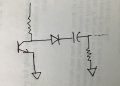
Depends upon exactly how you connect the diode, which wasn't clear in your post,
Certainly you can't put in in series with the capacitor.
Post a schematic of what you intend.
Depends upon exactly how you connect the diode, which wasn't clear in your post,
Certainly you can't put in in series with the capacitor.
Post a schematic of what you intend.
As I stated, that's a no-no.
Note that the positive part of the signal will charge up the capacitor to the peak signal value.
After that no signal will pass since there's no path for the capacitor to discharge.
Ok, thanks. Few more questions.
1. Would a 1uF with 1K be a good idea?
2. Need I replace all the caps in the circuit (especially the last one. Btw, that last one needs a series resistor too, right? Just for excess of caution?) or just the first one?
3. Are we dead sure its this cap to blame for the dying transistor? I'd like it if I don't have to wait another few days/weeks to be sure there was no other problem.
Hi John,
What was the post-mortem of the 'died' transistor, was it short circuit or open circuit?
Also, what were the symptoms of the the failure, did you scope the output of the transistor under running and failed conditions?
E
Footnote:
I have taken the emitter and photo-transistor apart and set them in a way that they are continuously facing each othe
If you place a piece of card between the emitter and detector, so blocking the IR beam, does the transistor still fail after it has been running for some time even with it blanked off?
If not, then try powering On and Off the +5V to the project.
Ok, thanks. Few more questions.
1. Would a 1uF with 1K be a good idea?
2. Need I replace all the caps in the circuit (especially the last one. Btw, that last one needs a series resistor too, right? Just for excess of caution?) or just the first one?
3. Are we dead sure its this cap to blame for the dying transistor? I'd like it if I don't have to wait another few days/weeks to be sure there was no other problem.
We don’t know for sure. You have to try different things.
We don’t see a reason for the photo transistor in the original circuit to fail.
1. We can only make a guess that the photo transistor is failing because the charge on the capacitor has to be dumped through the transistor. Putting 1kΩ in series with 1μF is a starting point. You need to view the signal on an oscilloscope to see how the frequency response will be affected.
2. No. We are only fixing one problem.
3. Only trying different things and testing will tell.
Hi John, @JohnSnow16041992
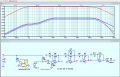
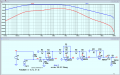
This LTSpice simulation shows the response of your amplifier sections.
The final response at o5 is awful.
Also, the overall Gain is -18db !
E
Hi John, @JohnSnow16041992
This LTSpice simulation shows the response of your amplifier sections.
The final response at o5 is awful.
Also, the overall Gain is -18db !
E
Please translate this for me. What is awful about it? Are we getting an insight into what is causing the transistor kill?
Maybe I can get rid of the last amplifier, but the first three are unavoidable. Also you forgot to add the 100k to GND after C3, maybe that improves the simulation? Also these amplifier are not powered between V and GND, they are powered between V and -V.
Hi Ericc, I really can't see how the application is relevant. I am telling you with surety that it is the photo transistor going bad. I have been doing this for some time now, replacing my photo transistors each time it goes bad. The new ones functions well as expected for a few days before the output goes bad again (expected signal amplitudes weaken, some noise comes in, delay in reaction is also seen) and I have to replace it with another new piece and voila it works fine again (for a few days). I'll try changing the cap and placing the current limiting resistor this time.
It is a sorry mistake when someone seeking a solution to a problem is reluctant to reveal the big picture. More often than not, the solution lies in modifying the approach to the problem in the first place.
If you are using this to detect an object between the LED and the detector, the circuit is ridiculously complicated. The photo transistor would put out a valid logic signal with no additional components! The resistor might need adjustment to get the right levels.
I don’t buy the capacitor discharge theory. The datasheet shows only milliamp level currents with Vce of 5V. And reverse (Vec) of 5V is right at the max allowed so I can’t see it destroying the transistor. The 10K would protect from all but the most egregious power supply glitch. So I think there must be something going on the we don’t know about.
Hi guys, I still don't see how application is relevant when I've already shared the whole circuit, but if you guys think it helps, its a heart beat detector for animals for a research project I am doing. The signal is 5Hz, both the phototransistor and the diode are in contact with the flesh. The signal is clearly visible when the photo transistor is new and doing ok. The power is coming from a 5V linear regulator giving out 4.9V, the pull up for the photo transistor actually measured at 9.96K, the -ve voltage for the amplifiers is being taken from a TC7660.
If you are using this to detect an object between the LED and the detector, the circuit is ridiculously complicated. The photo transistor would put out a valid logic signal with no additional components! The resistor might need adjustment to get the right levels.
I don’t buy the capacitor discharge theory. The datasheet shows only milliamp level currents with Vce of 5V. And reverse (Vec) of 5V is right at the max allowed so I can’t see it destroying the transistor. The 10K would protect from all but the most egregious power supply glitch. So I think there must be something going on the we don’t know about.

 Facebook
 Google
 GitHub
 Linkedin