PCB Drilling Solutions

jpanhalt

Joined Jan 18, 2008
11,087
Actually, it's the other way around. The ring of copper around the hole to be drilled helps to center and align the bit properly, if the hand holding the chuck is relaxed... afterwards you just push downward... A press won't allow you to do this... the copper ring would have to be perfectly centered under the bit (and it seldom is, with that technique)... this exerts a side load on the bit that will make it wobble and possibly break.
Sorry to be late. Just saw your post.

If you use Eagle, there is a user language program (ULP) called drill-aid.ulp. You can set the diameter of the hole in the copper smaller than the specified drill bit, which makes centering even easier.

John
 

cmartinez

Joined Jan 17, 2007
8,762
Sorry to be late. Just saw your post.

If you use Eagle, there is a user language program (ULP) called drill-aid.ulp. You can set the diameter of the hole in the copper smaller than the specified drill bit, which makes centering even easier.

John
I use AutoCAD for all my designs... but maybe that's a subject better left to a new thread...
 

cmartinez

Joined Jan 17, 2007
8,762
FYI about dremels. I have been looking for a new rotary tool off & on for a months now, done lots of review reviewing.. As of December, there were lots of bad reviews on Amazon for the Dremel 3000 & 4000; now they're all over 4 stars... fishy. Anyway, the black & Decker RTX sells for half the price (or less) and has better reviews.
this:

it fits dremels, B&D, and just about everything else. The dremel flex shaft also fits the B&D amd just about everything else.

I get my bits from precisebits.com

I never tried drilling PCBs with the dremel, but I will after reading this thread. I totally get where cmartinez is coming from about the copper pad helping position the bit while free-handing. I did my drilling on the drill press, and I always ended up locking my quill and feeding the PCB up into the bit by hand. using two hands, this method would get me through at least a couple of boards before breaking a bit, but still way too much breakage. If I didn't do it this way (let the bit center itself by freehand) and fed the quill down into the PCB then my holes would all be off-center. If you use Eagle, there's a script you can run that will make the drill centers smaller and round; that way your bit centers better, and if using the toner transfer method, you can leave the toner on until after drilling, and the toner buildup helps in addition to the copper.
Once you get the hang of it, you have no idea of how fast you can drill PCBs with my method. I've clocked myself at faster than 2 holes per second... which allows me to process a PCB with hundreds of holes in a few minutes.
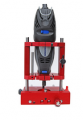
Remember, the key is hanging the Dremel on the wall or on a high stand, and using the flexshaft to drill the holes.
EDIT: I always leave the toner on... I even solder the components with the toner on, which will simply melt away and float atop the solder. This way my boards stay protected against moisture.
 
Last edited:

jpanhalt

Joined Jan 18, 2008
11,087
I use AutoCAD for all my designs... but maybe that's a subject better left to a new thread...
Presumably you can change the hole size. A smaller hole helps to center a drill. That is basically all the Eagle ULP does, but by using a different and uncommon layer, it doesn't screw up the Gerbers. Of course, there is no need to create a center-punch effect for commercial boards anyway.

John
 

cmartinez

Joined Jan 17, 2007
8,762
Presumably you can change the hole size. A smaller hole helps to center a drill. That is basically all the Eagle ULP does, but by using a different and uncommon layer, it doesn't screw up the Gerbers. Of course, there is no need to create a center-punch effect for commercial boards anyway.

John
Yeah I know... I use parametrics in all my designs, meaning that with a click of a mouse I can change the diameters of all holes in a board. I've been using AutoCAD for 30 years, and I can program it in LISP, DIESEL, VBA, .NET and ARX... not to brag, of course... :cool:
 

spinnaker

Joined Oct 29, 2009
7,830
FYI about dremels. I have been looking for a new rotary tool off & on for a months now, done lots of review reviewing.. As of December, there were lots of bad reviews on Amazon for the Dremel 3000 & 4000; now they're all over 4 stars... fishy. Anyway, the black & Decker RTX sells for half the price (or less) and has better reviews.
this:

it fits dremels, B&D, and just about everything else. The dremel flex shaft also fits the B&D amd just about everything else.

I get my bits from precisebits.com

I never tried drilling PCBs with the dremel, but I will after reading this thread. I totally get where cmartinez is coming from about the copper pad helping position the bit while free-handing. I did my drilling on the drill press, and I always ended up locking my quill and feeding the PCB up into the bit by hand. using two hands, this method would get me through at least a couple of boards before breaking a bit, but still way too much breakage. If I didn't do it this way (let the bit center itself by freehand) and fed the quill down into the PCB then my holes would all be off-center. If you use Eagle, there's a script you can run that will make the drill centers smaller and round; that way your bit centers better, and if using the toner transfer method, you can leave the toner on until after drilling, and the toner buildup helps in addition to the copper.


I have a 3000 and so far I am very happy as well with the press.
 

strantor

Joined Oct 3, 2010
6,875
I have a 3000 and so far I am very happy as well with the press.
How long have you had it? I used to have a Dremel as well a few years ago (don't remember the model) and it was great. I lost it and replaced it with a Craftsman rotary tool, and then another Craftsman, and now the Black & Decker. I can't vouch for the B&D yet, but I can say that the Craftsman rotary tools are cheap junk. Anyway, the bad Dremel reviews I was reading were the more recent ones. I read lots of "I've been using Dremels for 10 years and the quality was great. Just bought this one and it failed within a week."

Now that I think about it, there could be a few explanations for the bad reviews, and their disappearance:
  • Maybe Dremel released a bad batch and enough people complained that they did a recall and refunded everybody's money, with a gift certificate to make them change the review.
  • Maybe a fraudulent seller was peddling counterfeit Chinese Dremel Clones through Amazon, Amazon found out and ended it, and sorted out the bad reviews.
  • Maybe a competitor launched a smear campaign and Amazon found out and sorted out the reviews
  • Maybe I'm losing touch with reality and dreamed the whole thing up. (similar things have happened)
 

spinnaker

Joined Oct 29, 2009
7,830
I have had it just a few months, I have only done a couple of boards but so far no issues.

The press gets a bad rap because people don't know to adjust it.
 

jpanhalt

Joined Jan 18, 2008
11,087
I have had various Dremels for more than 60 years, including many hand held units. I would have to look at my cache, but I think I currently have 4 or 5 hand held units, including one of the more modern Model 4000. The 4000 is similar in looks and construction to the 3000, but has feedback to give constant speed.

1) Older Dremels had a narrower nose and got into tighter spaces easier. They had fine threads on the plastic snout and attachments for them do not fit the newer coarse threaded units.
2) I usually remove the finger protector on the new units. When I want to do my fingernails, I use my more accurate Dumore die grinder. ;)
3) Spindle run out on all Dremels is worse than on a real die grinder. That is life. They cost 1/10 the price. Ball bearing models help. They are not built for 1/4" carbide cutters.
4) What I really like about the 4000 is the on/off switch is separate from the speed selection switch and speed is constant. Not a single one of the earlier models maintains constant speed. I wish I had that on all models. I have had it for a few years now and it has not failed. I think one problem some people have is over tightening the chuck. I would recommend the 4000 over the 3000 (with which I have no experience) for that reason, if the price difference is not too great for you. Either is better than the single-switch models.

John

Edit: Let me add a very useful accessory. I have a Bishop Cochran router jig for my older Dremels (http://www.bishopcochran.com/). I am sure I paid a lot less than the current price. It is very accurate for doing inlay and other woodworking. I wish mine fit the Model 3000/4000 tools like this one:

upload_2015-1-23_18-18-46.png
 
Last edited:
Top