Parallel circuit equivalency

Thread Starter

Lavochkin

Joined Oct 30, 2016
5
New member, not an electronic professional. I am attempting to build a simple LM386 guitar amplifier and have a question re going from a schematic to real life component layout.

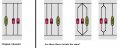
Does component order matter in a parallel circuit? I searched the forum, but did not get a hit, perhaps I did not use the same language as previous posters. I checked the AAC ebook, Ch 5 on parallel circuits, and there was a diagram of four resistors in parallel. On each side of the resistors was the notation "These points are electrically common". Am I correct in understanding that if I swapped R1 and R3 the circuit is the same? Do this apply to other components (not just resistors)?

In the amp I am planning to build, it is a capacitor and diode clipping circuit. See attachment....

TIA!
Matt
Parallel circuit equivalency.jpg
 

dl324

Joined Mar 30, 2015
18,326
Welcome to AAC!

When a schematic makes a point of showing a "single point" connection, it communicates intent to minimize loops.

The same effect could also be obtained using bus bars.
 

hp1729

Joined Nov 23, 2015
2,304
New member, not an electronic professional. I am attempting to build a simple LM386 guitar amplifier and have a question re going from a schematic to real life component layout.

Does component order matter in a parallel circuit? I searched the forum, but did not get a hit, perhaps I did not use the same language as previous posters. I checked the AAC ebook, Ch 5 on parallel circuits, and there was a diagram of four resistors in parallel. On each side of the resistors was the notation "These points are electrically common". Am I correct in understanding that if I swapped R1 and R3 the circuit is the same? Do this apply to other components (not just resistors)?
Yes, the same.
 

AlbertHall

Joined Jun 4, 2014
12,625
The LM386 is pretty low power. It won't be much louder than the guitar.
Ready built LM386 boards are available very cheaply so unless you desperately want to produce one yourself it would make sense to buy one.
Search ebay "LM386 module". They are available ready built or as a kit.
 

Thread Starter

Lavochkin

Joined Oct 30, 2016
5
The LM386 is pretty low power. It won't be much louder than the guitar.
Ready built LM386 boards are available very cheaply so unless you desperately want to produce one yourself it would make sense to buy one.
Search ebay "LM386 module". They are available ready built or as a kit.
It is intended as a guitar practice amp, so I don't need loud. I wouldn't say I am "desperate", but am making it myself because I like making things and like learning new things. Thanks!
 

WBahn

Joined Mar 31, 2012
32,823
The answer to your basic question -- does order or connection details matter -- is: It depends. The connections between components are, in real life, not perfect conductors. They have resistance, capacitance, and inductance as well as coupling to other components and they act (as part of) antennas that receive and radiate noise. If the circuit you are making is not sensitive to these non-idealities, then it doesn't matter. For low frequency (such as audio) circuits these effects are often not very important, but even here some parts of some circuits are sufficiently sensitive to warrant some care. In high frequency circuits these issues because a lot more evident. In radio frequency circuits these issues are often dominant and make the difference between a circuit that works and one that doesn't.
 

AnalogKid

Joined Aug 1, 2013
12,128
A separate word about audio power amplifier chips. Even low power ones like the 386 are crazy dependent on decoupling. Power supply decoupling capacitors connect to the power and ground pins, and reduce the tendency of these chips to break into oscillation. If you post or link to a schematic, we can tell you which ones are the decoupling caps. These should be located as close as possible to the chip, and connected with the shortest possible lead length.

ak
 

Thread Starter

Lavochkin

Joined Oct 30, 2016
5
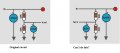
Yes, that was mentioned about the circuit and was the actual reason for asking the question. There was the amp circuit and a separate "power supply" circuit fragment, presumably to make the schematic clearer by not having too many lines crossing. A parallel circuit that went "9 volt in" to "power cap" to "voltage divider" to "LM386 pin 6". In light of the note to place the cap as close to the chip as possible, I was wondering if I could switch the cap and voltage divider so the cap was closer. See pic..

I used the clipper portion of the circuit in my original question because they suggested trying different diodes to get different clipping. I was thinking of having switchable diodes and was wondering if the diode switch could use 1 connections back into the circuit or whether I would need 2 connections (separate connection for each diode of the pair).

Power.jpg
 

cmartinez

Joined Jan 17, 2007
8,760
Yes, that was mentioned about the circuit and was the actual reason for asking the question. There was the amp circuit and a separate "power supply" circuit fragment, presumably to make the schematic clearer by not having too many lines crossing. A parallel circuit that went "9 volt in" to "power cap" to "voltage divider" to "LM386 pin 6". In light of the note to place the cap as close to the chip as possible, I was wondering if I could switch the cap and voltage divider so the cap was closer. See pic..

I used the clipper portion of the circuit in my original question because they suggested trying different diodes to get different clipping. I was thinking of having switchable diodes and was wondering if the diode switch could use 1 connections back into the circuit or whether I would need 2 connections (separate connection for each diode of the pair).

View attachment 114611
Yes you can do that. You just have to think about circuits as a collection of components connected to nodes. If the nodes match, it doesn't matter where you place the components, generally speaking. Component placement only becomes important in more advanced circuits, like analog to digital converters, or high frequency and radio applications, as Wbahn has already explained
 

WBahn

Joined Mar 31, 2012
32,823
Yes, that was mentioned about the circuit and was the actual reason for asking the question. There was the amp circuit and a separate "power supply" circuit fragment, presumably to make the schematic clearer by not having too many lines crossing. A parallel circuit that went "9 volt in" to "power cap" to "voltage divider" to "LM386 pin 6". In light of the note to place the cap as close to the chip as possible, I was wondering if I could switch the cap and voltage divider so the cap was closer. See pic..

I used the clipper portion of the circuit in my original question because they suggested trying different diodes to get different clipping. I was thinking of having switchable diodes and was wondering if the diode switch could use 1 connections back into the circuit or whether I would need 2 connections (separate connection for each diode of the pair).

View attachment 114611
Schematically there is no difference -- the issue comes in the physical layout of the circuit, which schematics generally don't make much effort in reflecting. The schematic is more of a logical/conceptual view of the circuit and not a physical one. Having said that, good schematics make the effort to convey the necessary information about the sensitive portions of the circuit, but this is usually done via notations on the schematic and not the schematic diagram itself (unless accompanied by a note). It is not uncommon to see all of the bypass capacitors located at one corner of the schematic (or even on a separate page) even though it is important that they physically be placed as close as possible to the components they are bypassing.
 
Top