Parallel Diode in RC charging circuit

Thread Starter

chandimajaya85

Joined Sep 27, 2023
41
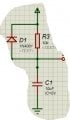
Screenshot 2025-10-03 213343.jpg What is the purpose of the diode on this circuit.Since this RCcircuit,it would slowly charge it up to the potential. so , what is the purpose of the diode.after charge does it discharge from the capacitor through the 5V?
 

WBahn

Joined Mar 31, 2012
32,703
It's hard to tell since you don't show the rest of the circuit. The usual purpose of a diode like that is to clamp that node from going above the supply voltage by more than a diode drop. This is commonly seen in circuits that are AC coupled in order to produce edges.
 

AnalogKid

Joined Aug 1, 2013
12,043
The post #1 circuit assumes that when the 5 v power rail is off, it sits at near 0 V with an impedance to GND that is less than infinity. Without knowing everything else powered by this 5 V rail, it is impossible to say how long it will take to "reset" C1 to a state of near-zero charge. Without D1, the shortest time to reset C1 is set by R3, but again this assumes a 5 V rail off-state resistance to GND of something much less than 10 K. Also, what constitutes a reset capacitor depends on what the R-C circuit is doing. To discharge a capacitor to 5% of its fully charged voltage takes three time constants without D1; in this case, 30 ms. With D1 in place, this reset time can be reduced by over 90%. That might not matter in this case, but if you are running a 15-minute R-C timer, you might not want to wait 45 minutes for the cap to discharge far enough not to affect the next timing cycle.

ak
 

Thread Starter

chandimajaya85

Joined Sep 27, 2023
41
The post #1 circuit assumes that when the 5 v power rail is off, it sits at near 0 V with an impedance to GND that is less than infinity. Without knowing everything else powered by this 5 V rail, it is impossible to say how long it will take to "reset" C1 to a state of near-zero charge. Without D1, the shortest time to reset C1 is set by R3, but again this assumes a 5 V rail off-state resistance to GND of something much less than 10 K. Also, what constitutes a reset capacitor depends on what the R-C circuit is doing. To discharge a capacitor to 5% of its fully charged voltage takes three time constants without D1; in this case, 30 ms. With D1 in place, this reset time can be reduced by over 90%. That might not matter in this case, but if you are running a 15-minute R-C timer, you might not want to wait 45 minutes for the cap to discharge far enough not to affect the next timing cycle.

ak
Thank you for the reply. So you are saying when the 5V rail is off state. Capacitor discharge through the diode quicker. But shortest path is through GND to discharge.
 

WBahn

Joined Mar 31, 2012
32,703
Thank you for the reply. So you are saying when the 5V rail is off state. Capacitor discharge through the diode quicker. But shortest path is through GND to discharge.
If the 5 V supply shorts it's output when off (which some do and some don't), then the discharge path would be through the diode (with it's ~0.7 V voltage drop) and then through the low-impedance shorted output of the supply, and finally back to the other side of the diode.

It would help if you could provide some more detail about this circuit and under what conditions you are expecting this capacitor to be charged and discharged.
 

JohnSan

Joined Sep 15, 2018
121
It's typically used on an reset pin circuit for an IC.

When power is turned on, the reset pin is 'held low' for a time whilst the circuits inside the IC can set to their start condition.
When the reset pin voltage gradually rises passed a threshold point, it releases the IC to do whatever it is intended for.

When the power is switched off, the diode acts to discharge the C into the supply circuit so it discharges as quickly as the supply goes down..
If the power is re-applied shortly after switching off, it will reliably work as a reset again, rather than having to wait a while for it to discharge before switching the power back on.
 

DickCappels

Joined Aug 21, 2008
10,661
Notice that the diode is only forward biased when the anode is above ground. When the power source to the circuit is switched on (capacitor is not charged significantly) begins charging toward the power supply voltage. Later, when power to the circuit is removed, the input voltage will drop and the diode will allow the capacitor to discharge to ground, thus allowing the reset circuit to be rearmed soon after power is switched off, while saving the input ESD protection diode connected to the capacitor from handling the peak discharge current that otherwise damage the input ring furnished with the windows reset signal (such as the power-on reset circuit of an I C such as a microcontroller.
 

WBahn

Joined Mar 31, 2012
32,703
Notice that the diode is only forward biased when the anode is above ground. When the power source to the circuit is switched on (capacitor is not charged significantly) begins charging toward the power supply voltage. Later, when power to the circuit is removed, the input voltage will drop and the diode will allow the capacitor to discharge to ground, thus allowing the reset circuit to be rearmed soon after power is switched off, while saving the input ESD protection diode connected to the capacitor from handling the peak discharge current that otherwise damage the input ring furnished with the windows reset signal (such as the power-on reset circuit of an I C such as a microcontroller.
For the very incomplete circuit fragment shown by the TS, we don't know if this is the case or not. If this circuit is battery powered, then power is likely removed by simply open-circuiting the supply, which results in no path to the ground node for the capacitor to discharge through.
 

MisterBill2

Joined Jan 23, 2018
27,164
The post #1 circuit assumes that when the 5 v power rail is off, it sits at near 0 V with an impedance to GND that is less than infinity. Without knowing everything else powered by this 5 V rail, it is impossible to say how long it will take to "reset" C1 to a state of near-zero charge. Without D1, the shortest time to reset C1 is set by R3, but again this assumes a 5 V rail off-state resistance to GND of something much less than 10 K. Also, what constitutes a reset capacitor depends on what the R-C circuit is doing. To discharge a capacitor to 5% of its fully charged voltage takes three time constants without D1; in this case, 30 ms. With D1 in place, this reset time can be reduced by over 90%. That might not matter in this case, but if you are running a 15-minute R-C timer, you might not want to wait 45 minutes for the cap to discharge far enough not to affect the next timing cycle.

ak
The circuit in post #1 does not even hint ar a 5 volt power rail. So that is totally a guess, UNLESS you have more information.
Presently it gives me the impression that others are aware of the rest of the circuit, but that is withheld from others, such as my self. Are we being "trolled"??? Or has the TS not realized that many of us are not aware of the circuit under discussion.
 

WBahn

Joined Mar 31, 2012
32,703
The circuit in post #1 does not even hint ar a 5 volt power rail. So that is totally a guess, UNLESS you have more information.
Presently it gives me the impression that others are aware of the rest of the circuit, but that is withheld from others, such as my self. Are we being "trolled"??? Or has the TS not realized that many of us are not aware of the circuit under discussion.
It says, " after charge does it discharge from the capacitor through the 5V? " which is a pretty strong hint that the global signal at the cathode of the diode is a 5 V power supply. But we have no idea what kind of supply it is or how it behaves when it is turned off, or even if the TS is talking about it discharging after the 5 V is turned off as opposed to thinking that it somehow discharges through the 5 V supply while it is still at 5 V (we've certainly seen far stranger misconceptions).
 

MisterBill2

Joined Jan 23, 2018
27,164
I avoid making evaluations based on guesses and assumptions, unless I qualify them as such. and based on what is described as missing in post #15, thatis indeed quite a bit.
 
Top