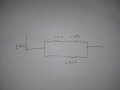
What is the order of operation when calculating the total number of resistance in a circuit? Do you start with calculating parallel resistors first or series?
The combinations involve operations (multiplication and addition) that are both commutative and associative, so I would say that except for mistakes in arithmetic, which we all learned in the 4th grade, the order of operations should not matter. We also know that we can transform impedance into admittance and do the problem that way. This again suggests that the order of operations is not important.
What is the order of operation when calculating the total number of resistance in a circuit? Do you start with calculating parallel resistors first or series?
If you have two resistors in series, then you can combine them into a single equivalent whenever you want.
If you have two resistors in parallel, then you can combine them into a single equivalent whenever you want.
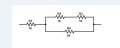
But if you are talking about circuits that are series-parallel combinations, such as
Then you don't have a choice. In this circuit there aren't any resistors that are in series, but there are two pairs of resistors that are in parallel. After you reduce both of them to their single-resistor equivalents, you now have two resistors in series, which you can combine. You could easily construct a similar circuit in which you have sets of series resistors in which the sets are in parallel.
Then you don't have a choice. In this circuit there aren't any resistors that are in series, but there are two pairs of resistors that are in parallel. After you reduce both of them to their single-resistor equivalents, you now have two resistors in series, which you can combine. You could easily construct a similar circuit in which you have sets of series resistors in which the sets are in parallel.
Since your calculations are for two different circuits, I’d expect that you would get two different circuits.
Why did you add the 1K resistor to the 2k resistor in your second calculation? In fact, it’s in series with the 2k resistor and the two 1k resistors. Or... (what?)
Since your calculations are for two different circuits, I’d expect that you would get two different circuits.
Why did you add the 1K resistor to the 2k resistor in your second calculation? In fact, it’s in series with the 2k resistor and the two 1k resistors. Or... (what?)
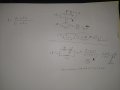
I didn't add the 2k to the 1k in my second I added .66 to the 1k then added the remaining 1k to = 2.66
My calculations are for the exact same circuit, just two different ways of solving it. There is obviously an order of operation which is what I'm trying to figure out.
Guess what, you have just committed a faux pas.
You are here on a public educational forum and you verbally abuse the very people who are genuinely here to guide you.
What do you expect to be the consequences of your action?
Guess what, you have just committed a faux pas.
You are here on a public educational forum and you verbally abuse the very people who are genuinely here to guide you.
What do you expect to be the consequences of your action?
I expect you to be kicked off my thread for being a smart ass who wants to play 20 questions when I'm trying to figure this out. You don't determine what I consider help or not, take a hike.
I expect you to be kicked off my thread for being a smart ass who wants to play 20 questions when I'm trying to figure this out. You don't determine what I consider help or not, take a hike.

 Facebook
 Google
 GitHub
 Linkedin