Operating 120 VDC solenoid from higher voltages

Thread Starter

Blue_Electronx

Joined Jun 10, 2019
112
I have a 120VDC solenoid that I want to use in 480VAC application, i.e., rectified ~680VDC. The signal to activate the solenoid will be given by a micro. The solenoid won't be continuously activated, it needs just a pulse of about 25 ms. The resistance of the coil measured with a meter is 290 ohms. Is there a way, maybe using a MOSFET, to operate the coil at this higher voltage? Maybe the mosfet with the help of some resistor reduces the voltage stress on the coil?
 

Thread Starter

Blue_Electronx

Joined Jun 10, 2019
112
No just use a single diode, but as you can't change the circuit, forget it...
To give a little bit of more insight, the full wave rectifier is for a SMPS, which then generates 12V for the control and micro. As the input voltage max is 480V three phase, and my solenoid is 120VDC, I'm looking for a way to actuate the solenoid from a GPIO port.
 

Dodgydave

Joined Jun 22, 2012
11,395
So if you went across a phase and Neutral you would get 270VAC, rectified to DC with a full wave bridge would approx 268 V.

You can use a relay to switch the Solenoid on!
 

crutschow

Joined Mar 14, 2008
38,536
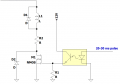
You mean something like this? See attachment.
After looking at the resistor power dissipation (≈500W when on) the resistor size could be very large, depending upon the duty cycle.
That could be reduced, if the solenoid can be momentarily overdriven.
How often will the solenoid be energized?
 

Thread Starter

Blue_Electronx

Joined Jun 10, 2019
112
After looking at the resistor power dissipation (≈500W when on) the resistor size could be very large, depending upon the duty cycle.
That could be reduced, if the solenoid can be momentarily overdriven.
How often will the solenoid be energized?
The solenoid can be momentarily overdriven. This is for a protection relay where you give a brief pulse to the solenoid until the energy is removed. Ideally I want to control the on-time with the micro so I don't necessarily have to remove the power supply to avoid damaging the coil.
 

Thread Starter

Blue_Electronx

Joined Jun 10, 2019
112
You didn't answer my question about how often the solenoid is energized.
How long between "on-times"?
There's no an exact response to that question since the solenoid will be energized only when there's a fault sensed by another circuit. So the process is: The micro senses a fault, trips the solenoid, and stops the current flow through it. So I'm not gonna turn the solenoid again if there's no a fault. I have to make sure the FET turns off quick enough to avoid damage to the solenoid.
 

crutschow

Joined Mar 14, 2008
38,536
There's no an exact response to that question
I don't need an exact value, just the minimum expected time between consecutive operations of the solenoid.

But after further looking at possible circuits, it will still require quite high power resistors, even with a low duty-cycle, so you may have to consider adding a transformer to drop the AC voltage down to about 90V to generate a rectified 120Vdc.
 
Last edited:

MisterBill2

Joined Jan 23, 2018
27,615
My experience has been that the performance of a solenoid designed for DC will not be satisfactory on AC, rectified or not. With a resistance of 290 ohms and 120 volts DC the intended current is about 0.4 amps, and so you need a resistor to drop 360 volts at 0.4 amps. Then, to make the solenoid not buzz horribly you need two diodes back-to-back with the solenoid connected across one of them, The diode across the coil allows current to keep flowing when the supply diode cuts off. I used that trick first a very long time ago. But the diodes need to be rated well over the line voltage and at twice the load current, at least. AND you need a series fuse just in case.
 

kaindub

Joined Oct 28, 2019
179
No one has asked the obvious question
Is the coil 120Vdc OR is it that the contacts are only rated for 120VDC
120VDC for a coil is very unusual.
 
Top