World's Largest Operating Steam Engine

Thread Starter

wayneh

Joined Sep 9, 2010
18,104

WBahn

Joined Mar 31, 2012
32,823
Any trainspotters here?

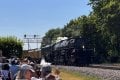
Big Boy 4014 passed nearby yesterday, on its way cross country. Made as 1 of 25 in 1941 and the only one still operating. Designed to burn coal but transitioned to No. 5 oil. Big, to haul loads up out of Salt Lake City on the trip from Utah to Wyoming.
View attachment 367976

https://www.up.com/about-us/history/steam/schedule

https://www.up.com/about-us/history/steam/big-boy-4014
When Union Pacific was restoring 4014, they maintained a blog of their progress and one of the readers asked how they could make donations to the effort. The response was, (as best I can remember), "Union Pacific is a Fortune 500 company. I think we can handle it."

When they moved the Big Boy in Denver from the old Forney museum to the new one, we went up and watched. What was most impressive was the little tug they used to pull it. I asked one the operators how it managed to get enough traction to pull something that massive and he showed how it actually used the weight of the Big Boy itself to put enough of a load on the drive wheels to get the needed traction.

But whether or not it is the largest operating steam engine depends on one's definition of "steam engine". It's certainly the largest operating locomotive steam engine. But there is an operating stationary steam engine at the Kempton Steam Museum that dwarfs it: The Sir William Prescott Engine.

Kempton - triple expansion engine - Kempton Park Steam Engines - Wikipedia

It's difficult to really compare them, though, because they operate in entirely different regimes. The Big Boy was designed as a prime mover and produces about 7000 hp, while the Prescott was designed to move massive amounts of water and runs very slowly, so only producing about 1000 hp. But while the Big Boy has higher starting torque of around 380k lb-ft, that drops quickly as speed increases. The Prescott engine maintains over 200k lb-ft of torque at full operating speed. In comparison, the torque produced by a modern diesel-electric locomotive is on the order of 20k lb-ft and somewhere around 4000 hp.

The engines on the Titanic, which were comparable in size to the Prescott and were also triple-expansion, each produced about 15,000 hp, reflecting the fact that they were designed as prime movers and not slow pumpers.

Another interesting tidbit: A modern top-fuel dragster produces up to around 12,000 hp. But not for very long!
 

SamR

Joined Mar 19, 2019
5,487
Ahhh Steam! My paternal grandfather was the "Master Mechanic" Steam Engineer in charge of the maintenance shop of the Georgia Coastal & Piedmont Railroad here in Belleville Georgia. Later after the RR went bankrupt in the 20s he had his own shop and traveled doing steam work as a licensed steam engineer. My father graduated from the Merchant Marine Academy as a Marine Engineer and worked the boilers and propulsion plants on Liberty Ships during WWII. After the war he got his Mechanical Engineering degree from Georgia Tech and worked as a young engineer on the SS United States steam turbine propulsion (at flank speed, initial designs estimated 266,800 shp) which even today still holds the Blue Riband for crossing the Atlantic in the shortest time. One of the Distributed Control Systems that I designed and built was for the Boiler House and attached Power Plant producing 900PSI steam, cogenerating 3.5MW of electricity, and supplying 600/250/125PSI steam for plant operations. There were actually a couple of piston driven steam powered pumps still in service when they shut the plant down. There are also a couple of young Scottish Steam Engineers in the family from the early 1800s who emigrated to the US and built a foundry and brick works in Savannah to build steam plants and mills throughout the area and also owned many steam powered sawmills down here on the coast of Georgia. I have some various old steam power books going back to the late 1700s that I've kept from the families. The Golden Age of steam is almost gone along with all the steam boilers everywhere providing the steam heat for the radiators that used to be just about everywhere. The 4014 like the SS United States was the pinnacle of steam power that will never be seen again. At least they saved and revived the 4014 while the SS United States is scheduled to be scuttled this year to the bottom near Destin FL to become an artificial reef...
 
Last edited:

SamR

Joined Mar 19, 2019
5,487
Is the 4014 still being accompanied by another active steam and diesel-electric locomotives in the train? The 4014s problem is water supply. It has a tender with quite a bit of fuel oil and water capacity but all the old water stations along the tracks to support steam power are long gone. I can't remember what the tender's capacity is but if I remember correctly, it was only a few hours' worth so only maybe a couple hundred miles or so depending on load. I had an uncle who used to say that back in the day as a kid in NE Alabama they were so poor that they would wait beside the tracks and throw rocks at the locomotives so the firemen would throw coal back at them. The 4014 burned so much coal it had to be auger fed as it was too much for a fireman stoking with a shovel to keep up with. I believe it also had a pulverizer and blower to feed it into the fire box as blown dust.
 
Last edited:

WBahn

Joined Mar 31, 2012
32,823
Is the 4014 still being accompanied by another active steam and diesel-electric locomotives in the train? The 4014s problem is water supply. It has a tender with quite a bit of fuel oil and water capacity but all the old water stations along the tracks to support steam power are long gone. I can't remember what the tender's capacity is but if I remember correctly, it was only a few hours' worth so only maybe a couple hundred miles or so depending on load. I had an uncle who used to say that back in the day as a kid in NE Alabama they were so poor that they would wait beside the tracks and throw rocks at the locomotives so the firemen would throw coal back at them. The 4014 burned so much coal it had to be auger fed as it was too much for a fireman stoking with a shovel to keep up with. I believe it also had a pulverizer and blower to feed it into the fire box as blown dust.
In that video you can see the 4015, a diesel-electric, in the train. Since the 4014 doesn't haul heavy freight any more, my guess is that her fuel and water supply last a lot longer under her current usage.
 
Top