Opamp won't trigger/oscillate

Thread Starter

StrongPenguin

Joined Jun 9, 2018
307
I'm playing around with opamps at the moment, trying to improve my knowledge on these mystical creatures. So far I've had some success, but when it comes to making them oscillate in some way, they just won't.

I don't have -12V (or minus any volt) on my power supply, I just hook them up to 12V or 5V and 0V. Could this be an issue?

I've also tried with 4 different type of caps, but none seem to do the trick.

What am I doing wrong?
 

Attachments

Ylli

Joined Nov 13, 2015
1,092
I don't have -12V (or minus any volt) on my power supply, I just hook them up to 12V or 5V and 0V. Could this be an issue?
Yes.
You really should use a minus supply. Otherwise, you will need to use an op-amp that is spec'd for rail to rail input. Something like a 741 will not work as shown.
 

AlbertHall

Joined Jun 4, 2014
12,625
That circuit does need the negative voltage to work.
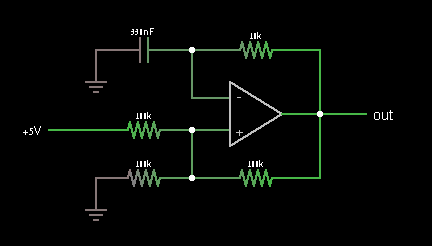
You should try this arrangement which mimics a split supply with a potential divider.
 

Thread Starter

StrongPenguin

Joined Jun 9, 2018
307
@crutschow Forgot to mention it's a 741 opamp, so it is supplied through pin 7.

@Ylli Ok, very good to know. This is why things aren't working. I'm just using a bench PSU, which I know has -12 V, but I ditched that (didn't think I'd need it) Gonna see if it can fish it out.

@AlbertHall That looks interesting, but difficult to see the resistor values. Just curious, how do I calculate the gain of that circuit? Is it G = 1 + (R1/R2) - given R1 and R2 are the voltage dividers for the non-inverting input.

@danadak Like I mentioned, a 741.
 

Ylli

Joined Nov 13, 2015
1,092
AH is using 10K on the feedback to the (-) input, and the other resistors are shown as 100K. Without working it out, I don't know if this will give you 1KHz or not.

'Gain' in this application is not really applicable. The op amp is being used as a comparator and functionally has near infinite gain.
 

Thread Starter

StrongPenguin

Joined Jun 9, 2018
307
Ok, I will try that. The cap is 33nF, right? Should I steer away from electrolyte caps for these opamp experiments?

And also, I don't think I quite understand how these circuits oscillate. I know it has to do something with the opamp being a comparator, which then charges the cap. But I don't see why it discharges again.
 

Ylli

Joined Nov 13, 2015
1,092
Let's assume the capacitor starts out fully discharged. The op-amp inverting input will be low and the non-inverting input will have a voltage on it based on the op-amp output voltage (and any extra from a 'centering' resistor). Since the + input is higher than the - input, the output of the op-amp will be near as high as it can go. That will charge the capacitor through the top R. When the voltage on the cap exceeds the voltage on the + input, the output of the op-amp will drop to the lowest it can go. Now the cap discharges through the top R until the cap voltage drops below the voltage on the + input. And the cycle repeats.

Does that help at all or have I confused you further?
 

Thread Starter

StrongPenguin

Joined Jun 9, 2018
307
I've been playing around with the circuit @AlbertHall suggested. I would like to see a 50% duty cycle, but it seems like no matter what I do, It's around 33% on, and 70% off. I've tried caps from 10nF (smallest I got) to 2,2uF. Pretty much same result, only frequency changes a lot. I've also toyed with all of the resistor values, same result.

Next question is, how do I bring it down to 0V when off, and instead of ~1V? I just see it's not on the 0 grid if I center the scope, not quite sure how much each square is, though 2,5V per square would add up..

IIRC a 555 timer hits 0V on it's off time.

Please excuse my poor terminology.
 

Zeeus

Joined Apr 17, 2019
616
Let's assume the capacitor starts out fully discharged. The op-amp inverting input will be low and the non-inverting input will have a voltage on it based on the op-amp output voltage (and any extra from a 'centering' resistor). Since the + input is higher than the - input, the output of the op-amp will be near as high as it can go. That will charge the capacitor through the top R. When the voltage on the cap exceeds the voltage on the + input, the output of the op-amp will drop to the lowest it can go. Now the cap discharges through the top R until the cap voltage drops below the voltage on the + input. And the cycle repeats.

Does that help at all or have I confused you further?
Haven't read 'anything' on op amp (this coming week) but just going through the thread..Please how does the cap discharge? Through top R and bottom 2 or from top R then discharge current goes into Vout?

Thanks and also, can NTE937 replace lf411?
 

Audioguru

Joined Dec 20, 2007
11,248
Does NTE make ICs? I think they buy normal ICs and put their own numbers on them then sell them at double the cost without detailed datasheets.

In addition to the lousy old 741 opamp, the LM358 dual and LM324 quad opamps have poor performance.
 

Ylli

Joined Nov 13, 2015
1,092
.Please how does the cap discharge? Through top R and bottom 2 or from top R then discharge current goes into Vout
When the capacitor is charged, the op-amp (-) input will be higher than the (+) input and the output of the op-amp will go low. The capacitor will discharge though the 'top' resistor into the op-amp output.
 
Top