Test of OpAmp

Status
Not open for further replies.

Thread Starter

royaaron

Joined Feb 19, 2024
110
Is there a way of testing an OpAmp electrically?

If a device I build isn't working the problem would likely lie in my design or my components. Now I can test resistors and even the viability of capacitors, but not my LF353P.
Years ago i could go into a TV repair joint and stick a tube in the tester and it'd tell me if it was good or not.
What can I do now to rule out a design flaw when all along it's a component?
 

crutschow

Joined Mar 14, 2008
38,513
Yes, of course you can test an op amp, but it requires a test fixture to apply power and test signals to the device.
If you just want to verify that it's alive, the fixture can be fairly simple, consisting of a socket for the amp amp, and a pot to apply an adjustable DC test signal.
 

WBahn

Joined Mar 31, 2012
32,852
Is there a way of testing an OpAmp electrically?

If a device I build isn't working the problem would likely lie in my design or my components. Now I can test resistors and even the viability of capacitors, but not my LF353P.
Years ago i could go into a TV repair joint and stick a tube in the tester and it'd tell me if it was good or not.
What can I do now to rule out a design flaw when all along it's a component?
First and foremost, ensure that your design covers the basics, such as adequate bypassing for all ICs. Then make sure that your design is satisfying the recommended specifications for the opamp, such as supply rails and common-mode input voltage range. We see all the time where someone is using an opamp that is meant to have bipolar supplies and the run it single-supply, which in and of itself is not wrong. But then their input signals are too close to one of the rails (almost always the bottom one) violating the opamp specs and they can't understand why it doesn't work. Or they run it in such a way that the output would need to be outside the device's output voltage range and wonder the same thing. Also make sure that you aren't asking too much of it. For instance, is it capable of supplying the output current you need, or producing voltage changes as fast as you need, or operating with signals in the frequency range you are interested in?

Then make sure that your implementation truly does match your design. Part of this is making sure that your assumed pinout for the part actually matches the data sheet pinout for THAT part (including prefix and suffix) in THAT package.

If all of that seems good, try a different opamp (i.e., another LF353P) and see if the behavior changes. If not, then it's most likely your design. Of course, depending on where you got them, there is the possibility that none of your parts are legitimate parts. Sadly, counterfeit components are everywhere and if you buy from AliExpress or eBay or Amazon, you might easily have fallen victim. Buyer beware. If you got your parts from a reputable source, such as DigiKey or Mouser or any of a number of others, this is pretty unlikely (but not entirely impossible).

If you want to test whether a particular opamp is function, you can set up an extremely simple functional test by implementing a simple inverting amplifier with a modest gain of, say, ten and then using a potentiometer for both the input signal and the reference signal at the non-inverting input. Then choose a load resistor that is approaching the point of pulling the max rated output current when the opamp is at one of the rails. Then simply test a few signals at various settings of the potentiometers. If they are all reasonably close to the expected values, the opamp is functioning properly, at least at DC, and is almost certainly good.

If you provide a schematic of your design, tell use what you expect it to do, and also what it is actually doing, you may well find that someone can immediately point out if you are overlooking something, either obvious or subtle, that might save you hours (days? weeks?) of stumbling around to locate.
 

MisterBill2

Joined Jan 23, 2018
27,530
Adding to post #3, checking voltages on an opaMP can reveal a whole lot. Powered up and connected asa unity gain buffer will reveal if it functions, is noisy, or has leakage causing offset voltages.
 

Thread Starter

royaaron

Joined Feb 19, 2024
110
Thank you to all who have replied.

I think I posted a bit early as it's not as if I've yet experienced a failure; I just wanted to get ahead of things.

Last year - yeah, I’ve been on hiatus - one of the top guys on Audiokarma (Mooly) was very patient and very helpful.
He reviewed the schematic and concluded that I hadn't broken any rules and that it appeared as though it would work as expected.
Of course, he could not give any guarantees.

I do understand that if I believe that one (of the three amps) is at fault I would replace it unless it was hot, suggesting that the circuit was causing it to fry.
I also understand that both aspects of the device are to be considered before questioning the quality of the amp: design and implementation.
But from there I think it's reasonable to assume that with a reasonable design (a) I've got a shot, and (b) if I am meticulous and "wire" it per the schematic I, again, have a shot.

Apropos my remark about the tube tester I had just wondered if there was an OpAmp tester. And, admittedly, I posted without bothering to simple google it.

So thank you again to all -- if I run into trouble I'll pursue the avenues you've all suggested.

-Roy
 

MrChips

Joined Oct 2, 2009
34,817
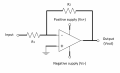
This is the first test of an op amp in the inverting configuration.

Apply positive and negative supply voltages, for example, +9 V and -9 V. Do not exceed the maximum supply voltages as stated in the device datasheet.

Input is a sinewave signal, for example, 100 mV @ 1 kHz.

The gain of the amplifier is -R2/R1.
For example, R1 = 1kΩ, R2 = 2kΩ, gives a gain of -2.
The negative sign indicates that it is an inverting amplifier.

This is not an exhaustive test and you would need a signal generator and an oscilloscope to perform this test. There are other test that cover other aspects of the op amp.
It would at least indicate a working inverting amplifier.

1780692009247.png
 

SamR

Joined Mar 19, 2019
5,491
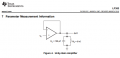
I've had problems with batches of op amps I've purchased from AliX and had to test each batch on receipt using the circuit from the PDF shown above. You can do it as a simple go/nogo or put as fine a point on it as you wish. Choose you resistor values based on your test parameters put it on a breadboard. Easy Peasy... Your key is the PDF! You can vary the voltage, frequency, waveform, etc. and measure the results on your scope compared to the values from the PDF.
NOTE: I only use chinese op amps for messing around and NEVER for actual repairs or final builds. I've had several lots of 10 that were BAD hence test all on receipt before storage!
 

WBahn

Joined Mar 31, 2012
32,852
NOTE: I only use chinese op amps for messing around and NEVER for actual repairs or final builds. I've had several lots of 10 that were BAD hence test all on receipt before storage!
I refuse to buy them. Partly it's because I don't want to deal with the frustration and the waste of my time and effort represented by having to test every component I buy because I know that there's a good chance I'm being ripped off. My time still has value to me, albeit not as much as when I was working and had plenty of disposable income to be more than willing to pay DigiKey's prices in order to get something that I knew was good and was almost certainly in stock. But mostly it's because I don't want to contribute to the problem buy doing business with outfits that I know are probably trying to rip me off -- these outfits sell the fake crap because people buy it, so I'm not going to reward them by buying it. If no one bought it, they would stop selling it and start promoting Chair Tai Chi or some other nonsense. Totally unrealistic pipe dream, to be sure, but I can still elect not to participate in the madness.
 
I refuse to buy them. Partly it's because I don't want to deal with the frustration and the waste of my time and effort represented by having to test every component I buy because I know that there's a good chance I'm being ripped off. My time still has value to me, albeit not as much as when I was working and had plenty of disposable income to be more than willing to pay DigiKey's prices in order to get something that I knew was good and was almost certainly in stock. But mostly it's because I don't want to contribute to the problem buy doing business with outfits that I know are probably trying to rip me off -- these outfits sell the fake crap because people buy it, so I'm not going to reward them by buying it. If no one bought it, they would stop selling it and start promoting Chair Tai Chi or some other nonsense. Totally unrealistic pipe dream, to be sure, but I can still elect not to participate in the madness.
I buy the majority of my components from Amazon since i get free delivery and can get orders in some cases the day after ordering as opposed to digikeys extortionate shipping costs and sometimes up to two weeks delivery times, although i expect amazons components are of chinese origin, that being said, i have had very little trouble with faulty parts.
 
Status
Not open for further replies.
Top