opamp osciltions cause problem

LowQCab

Joined Nov 6, 2012
5,101
You have stated that your YIG Electromagnet operates at a "Center-Frequency" of 9.5Ghz,
and has a "Frequency-Range" that may vary by roughly 2.2Mhz from the Center-Frequency.

The following 5 questions are simply 5 different ways to define a single concept ...........

( how "fast" must the "Center-Frequency" change ) ?,

( at what maximum-Input-Frequency must the Center-Frequency change
from 9.5Ghz, plus or minus 2.2Mhz ) ?,

( how much "Time" is allowed for the Output-Frequency to
sweep-through it's full-Frequency-Range ) ?

( is this Project an FM-Modulated-Transmitter ?, if so,
what is the maximum Frequency that it will be Modulated at ?,
what is the maximum level of Signal-Distortion that is acceptable ) ?

( how much "Over-Shoot", or "Ringing", is permissible in
the Change of Output-Frequency, relative to, the change in Input-Frequency ) ?


This is "THE QUESTION" that must be accurately answered in order to provide a workable solution.
.
.
.
 

MisterBill2

Joined Jan 23, 2018
27,519
If I replace the inductor with a resistor than there may be no problem. And if we use a series RESISTOR to providecurrent feedback then there would probably not be a problem.
BUT, for starters, is that feedback input even a current input?? NO!!! it is a voltage input, and with that coil resistance specified as 2 ohms, what we have is close to 100% feedback with a bit of phase shift.

Note that I did not ask for any other information except for the coil resistance and inductance. The rest is interesting but not needed for the analysis.
One more thing is that if the frequency response of the feedback loop is greater than the frequency of the modulation signal, the loop will tend to cancel the modulation signal.
 
Last edited:

MrAl

Joined Jun 17, 2014
13,704
If I replace the inductor with a resistor than there may be no problem. And if we use a series RESISTOR to providecurrent feedback then there would probably not be a problem.
BUT, for starters, is that feedback input even a current input?? NO!!! it is a voltage input, and with that coil resistance specified as 2 ohms, what we have is close to 100% feedback with a bit of phase shift.

Note that I did not ask for any other information except for the coil resistance and inductance. The rest is interesting but not needed for the analysis.
One more thing is that if the frequency response of the feedback loop is greater than the frequency of the modulation signal, the loop will tend to cancel the modulation signal.
Hello again MisterBill,

"If I replace the inductor with a resistor than there may be no problem. And if we use a series RESISTOR to provide current feedback then there would probably not be a problem."
There isn't really a 'problem' this kind of circuit is not that new really, with one exception. I think it's better to drive the op amp from the inverting input rather than the non inverting input. Driving from the inverting input gets rid of that pesky impulse term that shows up in the response, which I think causes problems.
If you look at the two circuits I posted previously, they both use the inverting input as the drive input, and have appropriate other components.
Another interesting difference is the current sense resistor R4 looks to be too large. Right now it is 100 Ohms, and that is probably an attempt to get a higher feedback voltage at low cost. However, it should probably be more like 10 Ohms using a low input offset op amp.

So the bottom line is that the technique is not new it may be he just has the wrong value for the components right now, but I think an improvement would be to go to the inverting amplifier type design which eliminates the pesky output term in the response.

Another factoid is that a sense resistor is very often used for current feedback. It measures the current and converts that into a voltage which then can be compared with another voltage, which allows easy adjustment. It does not really matter if it is a coil or resistor it is still going to provide a measure of the current because that is what has to be controlled. Also, the current is very low according to his notes so far, on the order of 20ma or lower. It is very possible though that a special current sense resistor be used which is made just for sensing current, and that might be a four terminal device not just two. Another possibility is that a dedicated IC chip to measure current might be a good idea.

I can't stress enough though that the design is not faulty just because there is an inductor there. We would often use a resistor to sense current for any load no matter what kind it was. If there comes the need for compensation, then we provide that compensation network also. I can't say all this though without recommending the inverting amplifier design vs the non inverting design as it is so far.

I'll post the two circuits again so you can take a look.
 

Attachments

Thread Starter

yef smith

Joined Aug 2, 2020
1,459
Hello , I want to change the YIG center frequency with 1msec responce time.
BW spec from the article its 4MHz so i need at least 1MHz BW
another spec is the responce time:
So Suppose my YIG is at 9800MHz I want the main carrier to go 9801Mhz after 1msec (when i update the FM coil current.
Thanks.


1.Could you please reccomend me a suitable configuration to do a current driving my YIG so i will be stable and not oscilate?
2.Do you think AD8033 is more suitable for my task then LT1028?
Thanks.


https://www.analog.com/media/en/technical-documentation/data-sheets/AD8033_8034.pdf
https://www.analog.com/media/en/technical-documentation/data-sheets/1028fd.pdf
 
Last edited:

LowQCab

Joined Nov 6, 2012
5,101
Now that the bare minimum of Specifications have been revealed,
a Circuit that can be Simulated can be designed.

The Input-Frequency has been stated as a minimum of ~1ms settling time.

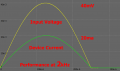
The following Circuit was simulated at 2kHz, which is one half of the required response-time.
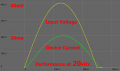
It was also simulated at 20kHz.
Graphs are below.

Testing was not done on a perfect Square-Wave, which would have shown the lag in response.
Oh well, maybe later if that's an important thing to know.

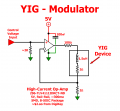
This Circuit uses only 1 active device, a 5-Volt, Rail-to-Rail, High-Current (~300ma), Op-Amp.
DigiKey p/n 296-TLV4111IDRCT-ND , ~$2.oo each
.
.
.
YIG Modulator .png.
Performance @ 2kHz .png.
Performance @ 20kHz .png
.
 

Attachments

Last edited:

LowQCab

Joined Nov 6, 2012
5,101
There are hundreds of different Op-Amp designs for a multitude of reasons.
It would be interesting to know why You chose the LT1028,
( please don't say that it was chosen because You have ~20 of them in your Junk-Drawer,
Op-Amps should be chosen to suit the particular requirements of a project ).


The vast majority of Op-Amps can not handle extremely low Output-Impedances,
such as the ~2-Ohm DC-Resistance of your YIG-Device.

The Op-Amp specified in my Schematic is rated for up to ~300ma of Output-Current,
and therefore will not have any problems with driving a nominal ~100-Ohm Load,
and will have plenty of "over-head" capacity for accurately controlling the ~20ma Current in your device.

This results in a very simple Circuit, with fewer problems to overcome,
that far exceeds your presently stated performance requirements.

My provided Circuit does have a minor amount of "Phase-Shift",
but this should not be a problem with your application,
( I'm only guessing with the minimal amount of information that You have provided ),
( we still don't know what your project will be used to accomplish ).

To completely remove the minor Phase-Shift is almost impossible,
and reducing it further would require substantially more Circuit complexity.
.
.
.
 

MrAl

Joined Jun 17, 2014
13,704
There are hundreds of different Op-Amp designs for a multitude of reasons.
It would be interesting to know why You chose the LT1028,
( please don't say that it was chosen because You have ~20 of them in your Junk-Drawer,
Op-Amps should be chosen to suit the particular requirements of a project ).


The vast majority of Op-Amps can not handle extremely low Output-Impedances,
such as the ~2-Ohm DC-Resistance of your YIG-Device.

The Op-Amp specified in my Schematic is rated for up to ~300ma of Output-Current,
and therefore will not have any problems with driving a nominal ~100-Ohm Load,
and will have plenty of "over-head" capacity for accurately controlling the ~20ma Current in your device.

This results in a very simple Circuit, with fewer problems to overcome,
that far exceeds your presently stated performance requirements.

My provided Circuit does have a minor amount of "Phase-Shift",
but this should not be a problem with your application,
( I'm only guessing with the minimal amount of information that You have provided ),
( we still don't know what your project will be used to accomplish ).

To completely remove the minor Phase-Shift is almost impossible,
and reducing it further would require substantially more Circuit complexity.
.
.
.
Hello,

Did you try the inverting amplifier version?
The two versions have different impulse parts.
In the non inverting case the impulse adds to the output, in the inverting case the impulse subtracts from the output.
With a changing input this may make a difference.
 

LowQCab

Joined Nov 6, 2012
5,101
Edit,
sorry, I thought I was talking to the TS MrAl.

There is no difference in the performance of the Circuit when the
Input to the Op-Amp is used in an Inverting-Configuration.

Is a ~40mV Input, for a 20mA Output, not adaptable to your needs ?

What "problem" or "performance-specification" do You think
would be "solved" or "improved" by using an Inverting-Configuration ?
There are none that I am aware of.

Maybe someone else can join in and explain further, what difference there might be .........

The response of the Circuit is already reasonably close to perfect as shown by
the supplied Simulation-Graphs,
and far exceeds your stated requirements by at least ~100%.

You can just Invert the Polarity of the Input-Signal if You think that would make a difference,
but it will not make a measurable difference that I know of,
other than simply inverting the Output-Polarity.
.
.
.
 
Last edited:

LvW

Joined Jun 13, 2013
2,027
Hello,

Did you try the inverting amplifier version?
The two versions have different impulse parts.
In the non inverting case the impulse adds to the output, in the inverting case the impulse subtracts from the output.
With a changing input this may make a difference.
Please, can you further explain these sentences?
(What are "different impulse parts"?)
 

MrAl

Joined Jun 17, 2014
13,704
Edit,
sorry, I thought I was talking to the TS MrAl.

There is no difference in the performance of the Circuit when the
Input to the Op-Amp is used in an Inverting-Configuration.

Is a ~40mV Input, for a 20mA Output, not adaptable to your needs ?

What "problem" or "performance-specification" do You think
would be "solved" or "improved" by using an Inverting-Configuration ?
There are none that I am aware of.

Maybe someone else can join in and explain further, what difference there might be .........

The response of the Circuit is already reasonably close to perfect as shown by
the supplied Simulation-Graphs,
and far exceeds your stated requirements by at least ~100%.

You can just Invert the Polarity of the Input-Signal if You think that would make a difference,
but it will not make a measurable difference that I know of,
other than simply inverting the Output-Polarity.
.
.
.

Hi,

Theoretically there is an output as expected from the op amp. That would be the signal that drives the coil. But there is also an output impulse part that occurs when the input changes (during adjustment). You probably don't think about this because we hardly ever see this mentioned.
Now when we use a non-inverting configuration, the impulse part is positive, meaning it adds to the output, which causes a higher than normal output usually just for a short time. When we use an inverting configuration, the impulse part is also positive but the normal input signal has to be negative to get a positive output. That means that the impulse part subtracts from the normal output, which keeps the higher-than-normal output lower.
This could be significant, or it could be insignificant, due to the op amp internal response. Thus, it would have to be tried, and if the current sense resistor value is changed that changes the impulse so it would have to be checked with the desired current sense resistor.

There is a chance that this makes a big difference, small difference, or no difference at all. If it makes a big difference then obviously what will happen is the output will jump up faster than it is supposed to and drive the coil to a higher current than required for a short time. It also makes a difference how much the input changes. If the input changes slowly, the output impulse will be smaller and maybe not a problem.

I don't think it is very hard to check this using a simulation. It's just a matter of adding a resistor and swapping inputs. On the breadboard not that hard to do either really, especially if you know ahead of time that you will be doing a swap.
 

MrAl

Joined Jun 17, 2014
13,704
Please, can you further explain these sentences?
(What are "different impulse parts"?)
Hi,

Yes. I am sure you know what an impulse is. It's a signal jump up or down for a short period of time.
Theoretically the output of the op amp will produce an impulse in addition to the normal signal we expect out of the op amp which is a fairly quick ramp.
This is a little difficult to analyze but not impossible, but not hard to imagine looking at the circuit as it is.
If we look at the circuit and imagine a step change on one of the input terminals (simplest scenario), we can see that a significant change on the input would be seen as a change on the output as well because there is a short delay in the feedback signal due to the inductor. That is, the inductor will take time to pass current and thus the sense resistor voltage will not rise immediately, but rather take time to ramp up.

The question arises does this affect the stability or not.
Since this impulse part will be lower for the inverting configuration than for the non-inverting configuration, it may help to use the inverting configuration rather than the non-inverting configuration. That's because the impulse polarities are different for the two configurations, one being subtractive and the other being additive.
Note that there is a chance that it will not be that much different, but I think it's worth a quick test at least in simulation.

Also note that this comes from a purely theoretical analysis and therefore does not include parasitics, and the impulse is seen as a voltage at the output of the op amp, not the current through the coil. Since the impulse is short, it may not even reach the output, thus the suggestion of the test.
 

MrAl

Joined Jun 17, 2014
13,704
I think I have a vague idea of what you're referring to,
I'll look into it.
.
.
.
Hi,

Oh great, and it's not hard to test.

Keep in mind that if the effect is small, it may be hard to see without a careful test, and may not make much difference.
Hopefully it does not make much difference as I prefer a non-inverting configuration if they end up being almost the same.
 

MisterBill2

Joined Jan 23, 2018
27,519
OK, I believe it is the time between the op-amp input voltage affecting the output voltage, and the correction by means of the feedback into the inverting output. This is caused by the amplifier response delay. And it will be at it's worst for an amplifier with instant response. This is always considered in the design of physical servo systems where the response is never instant. It should be possible to compensate for this by restricting the input change "slew rate" to less that the amplifier's output slew rate. That solution may, or not, be possible.
Clearly, if the feedback were taken as voltage feedback, the correction could occur before the inductor current had time to change.
 

LowQCab

Joined Nov 6, 2012
5,101
( Not simulated yet )
Here's where I see the problem ..........

In order to "instantaneously" alter the Current in an Inductor,
requires "Infinite" Voltage.

Per the TS's specification of 1ms of settling-time, ( or 1kHz ),
my Circuit is already very close to perfection in meeting this spec..

So it would appear that any reduction of response-time would just be "over-kill".

Additional Gain, with the additional required Feedback,
to increase the response-speed,
would ultimately be limited by the maximum Power-Supply-Voltage.
.
.
.
 

LvW

Joined Jun 13, 2013
2,027
Yes. I am sure you know what an impulse is. It's a signal jump up or down for a short period of time.
Yes - I have heard of this
[/QUOTE]
Theoretically the output of the op amp will produce an impulse in addition to the normal signal we expect out of the op amp which is a fairly quick ramp.
I don`t think that this effect can be describe as an "impuls" - In system theory an "impuls" has another definition.

If we look at the circuit and imagine a step change on one of the input terminals (simplest scenario), we can see that a significant change on the input would be seen as a change on the output as well because there is a short delay in the feedback signal due to the inductor. That is, the inductor will take time to pass current and thus the sense resistor voltage will not rise immediately, but rather take time to ramp up.
Yes - I know what you mean: Delayed feedback action. (cause of slew rate)

The question arises does this affect the stability or not.
Since this impulse part will be lower for the inverting configuration than for the non-inverting configuration, it may help to use the inverting configuration rather than the non-inverting configuration. That's because the impulse polarities are different for the two configurations, one being subtractive and the other being additive.
No - I don`t think that this effect will have any influence on stability. It is something like "overshoot".

But my main concern is your claim (without evidence) that "the impulse polarities are different for the two configurations".
Why do you think that there is a difference in polarity?
For the non-inverting configuration the amplifiers response will be positive ("impulse" and "normal" signal) - and for the inverting configuration both "parts of the response" will go in the other direction.
Why do you expect a "subtractive" effect?
 
Last edited:

MisterBill2

Joined Jan 23, 2018
27,519
In at least one class an impulse was described as having "zero width". How accurate that was is not clear to me now, I suggest that a simple check would be to look at the signal with a scope having an adequate response time. feeding it a square wave similar to what would be present in the proposed application.
The impulse issue sounds a bit like the "Transient Intermodulation Distortion" issue that was presented in some stereo amplifier advertising quite a few years ago. I don't recall how those presenting the issue claimed to have solved the problem that nobody else had noticed.
Do others even recall that topic??
 

MrAl

Joined Jun 17, 2014
13,704
OK, I believe it is the time between the op-amp input voltage affecting the output voltage, and the correction by means of the feedback into the inverting output. This is caused by the amplifier response delay. And it will be at it's worst for an amplifier with instant response. This is always considered in the design of physical servo systems where the response is never instant. It should be possible to compensate for this by restricting the input change "slew rate" to less that the amplifier's output slew rate. That solution may, or not, be possible.
Clearly, if the feedback were taken as voltage feedback, the correction could occur before the inductor current had time to change.
Yes, and because of the high gain of the op amp that is why we see a (theoretical) impulse on the output. Hopefully this does not matter.
 

MrAl

Joined Jun 17, 2014
13,704
In at least one class an impulse was described as having "zero width". How accurate that was is not clear to me now, I suggest that a simple check would be to look at the signal with a scope having an adequate response time. feeding it a square wave similar to what would be present in the proposed application.
The impulse issue sounds a bit like the "Transient Intermodulation Distortion" issue that was presented in some stereo amplifier advertising quite a few years ago. I don't recall how those presenting the issue claimed to have solved the problem that nobody else had noticed.
Do others even recall that topic??
Hi,

An impulse is a fast rise and fall pulse that goes as high as is dictated by the circuit, but the theoretical idea is that it causes an instant change in something like a capacitor or inductor. For example, if a capacitor sitting at 0v was hit with a 5v (theoretically perfect) impulse, the voltage across the cap would instantly increase to the full 5 volts without any delay. We could say that it was at 5v at time t=0+ which is an instant (zero time) after t=0.
In real life of course this isn't going to happen, so we often get by without any worry. In this circuit, if the impulse actually did reach the output, it would be clamped to one of the power rails.
 
Top