Op-amp Design Simulation - KiCAD8 Simulation

Irving

Joined Jan 30, 2016
5,138
Thank you for your reply.
I was thinking of using SAFT LS 14250 primary Li-SOCL2 cells. Is this battery reliable you think? are there better choices?
Sorry, but those are terrible batteries for this application. Assuming your 30mA is continuous, and not pulsed, a quick look at the datasheet shows that their internal resistance is huge. At 8.5mA they are only giving 3.5v, at 85mA it's down to 3.1v! Extrapolating, at 30mA, your starting voltage won't be 3.6v but more like 3.35v, too low even for an LDO. Those cells are intended for pulsed operation, eg 0.1second on/2min off cycle. Is the 1/2AA form factor critical?
 
I am in a bit of a weird position here.

The common emitter PNP output transistor approach should greatly improve the overall dropout voltage (Vsupply-Vout). Putting any transistor gain inside the feedback loop will affect the feedback loop stability, but this common emitter PNP will have a much greater impact. Instability/oscillation is a very likely 1720734701487.pngresult unless you add loop compensation.

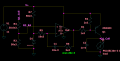
In the image I am attaching, R5, R6, and C1 are all added for the purpose of loop compensation. I am 98% confident in this "architecture". But the values shown for those are only an educated guess. That is because I cannot seem to get a working model of LM324 in LTSpice. The schematic design might work OK as shown but at least the compensation values are not optimized.

So I am also attaching a zip of my LTSpice simulation in case someone can fix my LM324 model for LTSpice? I am using Version 24.0.12.

I think I have provided the solution in terms of basic design of the regulator for lower dropout and higher output current, but I need help with the LTSpice model for the LM324. Can anyone help by fixing my model for LM324 in LTSpice?
 

Attachments

Last edited:

Bordodynov

Joined May 20, 2015
3,431
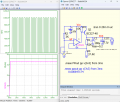
My scheme is sustainable. This is achieved by a sufficient value of the capacitor at the output of the stabilizer. No additional correction is needed. And the larger the value of the capacitor, the better.stabLM324_.png
 
Thank you.

I was thinking to ask you for clarification about not needing one of the resistors around the transistor. The base-emitter resistor is needed to bypass any positive leakage current flowing into the op amp output. And the op amp to base resistor is needed for my feedback loop compensation to work. It also provides some current limiting to avoid excessive base current into the transistor. (I think this is a good idea although it may not be absolutely necessary) So you have eliminated the second of these resistors and instead (I think) introduced a dominant pole in the feedback loop by adding a much larger value output capacitor.
 

Bordodynov

Joined May 20, 2015
3,431
I drew the circuit at once, and knowing the stability problems when using a common emitter circuit, I put a capacitor with a capacitance of 100 µF.
 
Top