Op Amp Bode Plot 3db Point

Audioguru again

Joined Oct 21, 2019
6,826
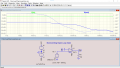
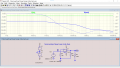
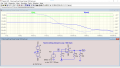
Your last two "closed loop" simulations have no negative feedback then they are open loop instead.
With an open loop gain of almost 1 million times then with the 0.5V peak input the output is clipping like crazy causing the curves to be wrong.

Even if the opamp had a gain of 101 times then with the 0.5V peak input, the output will still be clipping like crazy trying to produce 0.5V x 101=50.5V peak output and its output curve will be wrong..
 

Attachments

Thread Starter

SamR

Joined Mar 19, 2019
5,488
Let's look at this...
at TA = 25°C, VS = 40 V ( ±20 V), RLOAD = 10 kΩ connected to VS / 2

1642475017748.png
And my corrected unity gain...
1642477998900.png
The Vout should be ((R1+R2)R1/)Vin = 2V = A
1642478095881.png
That's it for tonight, too tired to do any more now.
 

Attachments

Last edited:

Audioguru again

Joined Oct 21, 2019
6,826
My previous schematic had an error (the opamp output was shorted to ground) that I fixed.

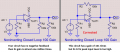
Your new opamp still has no negative feedback so it is open loop with a voltage gain of nearly one million times.
Negative feedback has a resistor or a wire from the output to the inverting input that is missing in your circuit. Maybe with a resistor from the inverting input to ground forming a voltage divider that sets the amount of voltage gain.

Maybe your simulation shows an attenuation instead of a gain because its output is clipping like crazy.
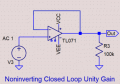
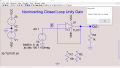
Here is the correct non-inverting closed loop unity gain opamp;
 

Attachments

Papabravo

Joined Feb 24, 2006
22,082
In post #103, a non-inverting configuration, you have positioned the resistors for a gain of 2
The gain of 2, using 20 Log (2) results in 6 dB in the passband
 

eetech00

Joined Jun 8, 2013
4,705
Let's look at this...
at TA = 25°C, VS = 40 V ( ±20 V), RLOAD = 10 kΩ connected to VS / 2

View attachment 258018
And my corrected unity gain...

The Vout should be ((R1+R2)R1/)Vin = 2V = A

That's it for tonight, too tired to do any more now.
Your circuit still is not correct.
AGA has given you the correct circuit in post #104.
PB has point out in post #105 that your circuit in #103 has a gain of 2.
I have already given you a unity gain example in the zip file.

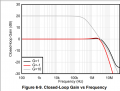
Look carefully at graph figure 6-9.
G=1 (black trace) is the unity gain measurement.
Unity gain is a gain of 1 and is 0db on the graph.

The example in the zip file is posted again below. I've circled the Unity Gain circuit.

1642483093051.png
 

Thread Starter

SamR

Joined Mar 19, 2019
5,488
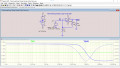
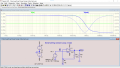
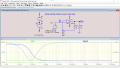
Ok, the title is wrong. It is in fact 2 gain. When I did a true unity feedback...
1642494624388.png
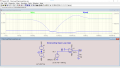
Which is odd because yours obviously worked. When I looked at the output plots in Volts, I see that the dB conversion is correct. Here is what I have now and in Volts it looks good.
2 gain
1642495219746.png
15 gain
1642495852461.png
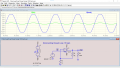
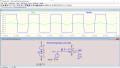
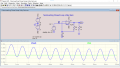
Yes, it is clipping...
1642496497944.png
Open loop
1642496828407.png
And yes, it is slamming the rails. So the models are working even though the plots in dB looked odd to me because I'm not used to working in dB.
1642497136543.png
 

crutschow

Joined Mar 14, 2008
38,504
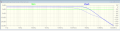
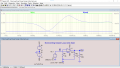
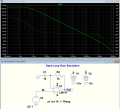
Here's a simple op amp open-loop AC gain simulation to give the Bode plot:
The resistor provides DC feedback so the op amp DC output equals the DC input (in this case 0V), while the 1kF capacitor shunts the AC signal feedback to ground so the AC gain is below the open-loop to a very low frequency.

1642519253177.png
 
Last edited:

Thread Starter

SamR

Joined Mar 19, 2019
5,488
Thanks Carl! I think that was the last piece of the puzzle that I needed. Now to do some breadboarding and looking at it on the scope with the sweep mode of my sig gen.
1642520379011.png
1642520507052.png
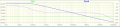
Rolls off pretty quick @ max gain. And for giggles 0.001V@1kHz input.
1642521123153.png
 
Last edited:

Thread Starter

SamR

Joined Mar 19, 2019
5,488
Good article. Not quite as simple as I thought it would be. I'll read it in more detail later instead of just scanning it. Also, for the sweep I'll need to figure out how to look at it on my DSO. Kinda new area for me to explore as almost all has been in real time so far. Thx Carl!
 

Thread Starter

SamR

Joined Mar 19, 2019
5,488
1642525744420.png
Hadn't considered this although I've heard it from AG many times concerning breadboards. Anyway what I am really looking at now is the effect of peripheral components on gain so I'll have to play within the limits of my sandbox. I shall see...
 

crutschow

Joined Mar 14, 2008
38,504
Also, for the sweep I'll need to figure out how to look at it on my DSO
You would synchronize the DSO sweep to the sweep speed of the generator.
But to see the open-loop plot similar to the simulation, you would need a log amp and precision rectifier for the output to convert the AC output to a log DC value.
They log amp can be built using diodes, or use an IC log amp such as Analog Devices builds.

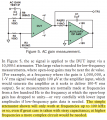
Regarding the caveat about frequencies above 100kHz for the Analog Devices test circuit , I would think reducing the values of R1, R2, R3, and R9 each by a factor of 10 or 100, would increase the upper frequency limit.
 

ericgibbs

Joined Jan 29, 2010
21,440
Why do you simulate the frequency response of an open-loop opamp when its graph is shown on its datasheet??
hi agu,
It's a simple way of cross-checking your own simulations, whilst learning LTspice.:cool:
E
 
Top