I do not buy cheap no-name-brand Ch***** junk.
The Simulator also does not believe the datasheet, showing no problems when the opamp max allowed supply voltage is exceeded.
Because I learn by doing and not simply taking things at face value by simply calculating. Did you not have any labs in school? And I am using TI parts from a reputable source. To Quote President Reagan "Trust but verify".
As to the R9 999KΩ resistor... I know it is supposed to attenuate but the sig gen is capable of mV inputs. Not sure why it's 999kΩ instead of simply 1MΩ but I assume the designers had a reason for that odd value and a few others like the 5uF cap that does not exist and even paralleling a 2.2uF and a 3.3uF won't fit the spec so I settled on a 4.7uF... I guess I could parallel 5 1uFs... Can I not lower the input attenuating resistor value? Also, I have decided to hard wire this due to breadboard noise issues so I should be working on that today.
As to the R9 999KΩ resistor... I know it is supposed to attenuate but the sig gen is capable of mV inputs. Not sure why it's 999kΩ instead of simply 1MΩ
I think they wanted an exact attenuation of 1/10,000, but for that, R1 would need to be 999.9k.
For an open-loop gain of 100dB (100,000) you need µVolts of input, not mV, to avoid output saturation.
As I previously noted, yes you can reduce the values while maintaining their ratio (such as 99.99kΩ and 10Ω), which should increase the frequency response.
You can achieve the 99.99k value by putting some 1% resistors in series/parallel (for example 97.6k in series with 2.32k gives 99.92k, which is close enough for government work ).
"Finished" it and first thing I noticed is I left off the female socket for the power supply ground. Added on and plugged it in and something pulling the power supply voltage down. I had already checked the sockets for shorts and continuity on power and grounding so time to do a bit more inspection.
Good call, it's dead on +/-15. I'll test the ICs. Yup, one bad. And I didn't ground the +input on U2 or connect the 99.9k to U2s pin 6 output.
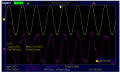
Very noisy and I haven't even begun to ramp up the freq. Actually the signal gets better as I up the freq but @ 100kHz it is already attenuated.
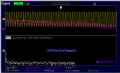
Ooops, had the FFT on the wrong channel, that was input noise! Here is the output @80kHz.
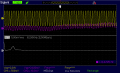
Scope is showing wrong output freq and not picking up the input freq at all. From this it looks like my noise gremlins are still at it. I can try and do it in the Faraday box I have.
EDIT: Nope, designed it for breadboards and all the connecting pins inside are male as are the board inputs...
The TL071 opamp is made for audio and has a slew rate that cuts levels of frequencies from 100kHz to 400kHz depending on the output level.
Then why are you feeding it radio frequencies?
Is the cable between the signal generator and opamp board a shielded audio cable with the shield at the circuit's 0V?
Yes, it is coax with minigrabbers to connect with. Not very well grounded since the sig gen is supplied by a wall wart and the case is all plastic. The idea here was to replicate the PDF waveform for open loop gain. It seems to start attenuating almost immediately instead of flat until close to 1MHz as the PDF curve shows. I can sweep with the sig gen but, so far, have not found a way to display the sweep on a single screen.
Yes, it is coax with minigrabbers to connect with. Not very well grounded since the sig gen is supplied by a wall wart and the case is all plastic. The idea here was to replicate the PDF waveform for open loop gain. It seems to start attenuating almost immediately instead of flat until close to 1MHz as the PDF curve shows. I can sweep with the sig gen but, so far, have not found a way to display the sweep on a single screen.
A signal ground at your signal, generator, opamp circuit and oscilloscope are usually not earthed.
The DUT opamp in post #114 has a gain of almost 1 million times and its datasheet shows its gain is flat up to only 10Hz because it has no AC negative feedback. Its negative feedback is DC only due to the large value of the capacitor on the 2nd opamp.
It has a flat output to 1MHz when its gain is only 1 because then it has LOTS of AC negative feedback.
The DUT opamp in post #114 has a gain of almost 1 million times and its datasheet shows its gain is flat up to only 10Hz because it has no AC negative feedback. Its negative feedback is DC only due to the large value of the capacitor on the 2nd opamp.
After due consideration I realized that I left something out of the circuit. I need to add a pin to connect a probe to the attenuated input of the opamp. I need to compare the attenuated opamp input to the output.
The attenuated input to the opamp is at an extremely low level that is maybe only 12 micro volts peak if you want to measure open loop gain at 10Hz or less.
You do not need to measure the output level of the attenuator since the input of the amplifier is at such a high impedance that it does not load down the attenuator and the resistor values of the attenuator determine the amount of attenuation (100 ohms/(1M + 100)= one ten thousandth). Your 'scope or multimeter cannot measure signals as low as 12 micro volts.

 Facebook
 Google
 GitHub
 Linkedin





![IMG_0937[1].JPG](https://forum.allaboutcircuits.com/data/attachments/245/245890-ed08fc96dcdb54f60601d319c56671b2.jpg "IMG_0937[1].JPG")