Old Foggie seeks guidance on current MPU's, Programming software...

dendad

Joined Feb 20, 2016
4,641
For a start, I too would vote for the Arduino.
Google "ASK manual" and you can download a slightly out of date pdf and it will tell you how to get going. It has a lot of basic electronic info and explains the IDE and programming language too. Worth a read to help you make up your mind.
I use ebay Arduino Unos in my electronics course, and the version has male and female connectors. Very handy.
http://www.ebay.com.au/itm/NEW-UNO-...epid=0&hash=item46546f3c02:g:coMAAOSw8oFXz6U9
They are available cheaper than this link, but is was the first I found.
They also have some other connectors duplicated in usable groups, like I2C, serial and 3.3V power.
It is almost a religious thing, what processor to use, and I use top end PICs in my business, but for a start to learning, you cannot beat the Arduino ecosystem. It puzzles me why there are so many that are dead against Arduinos. Still, each has an opinion I s'pose.
 

be80be

Joined Jul 5, 2008
2,395
Here my arduino I'm not all for Pic said that too. I just no there cheaper I play with both and I no you can get cheap ones from china.
done that too.
 

TQFP44

Joined Sep 3, 2016
51
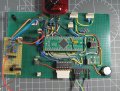
Hi Scott.. I came to mcu some years ago , when I retired in 1999 ,( Service techie ) so I had lots of time to learn and create mcu stuff, and move on from 74 TTL / CMOS logic played with in the 80's , with hours of fun along the way , I found buying pre-assembled bits it was good for a quick result but you don't find out about the guts of the beast. like I2C and PWM driving LCD etc etc. so I started building my own dev boards.(PIC) . learning C followed on after years of assembler, while shoving 8,16 and a little 32 bit devices on strip board ... but I seem to have settled on PIC24 . your post suggest a hardware knowledge , investing in test equipment, the software development can be copied and pasted from many sources. Have fun....

My PIC24FV32KA304 dev machine .... I2C , RTC, EEprom , Port expander, serial...

PIC24FVdev.jpg
 

Thread Starter

ScoJamBre

Joined Aug 28, 2017
6
You've all been wonderful in your replies! Some have give me remembrances of things that I hadn't thought about in my delving back into this. I.E. boot loaders, etc.. I'm thinking i'll start out easy (probably the Arduino line) and take things from there. I used to lurk on this site way back when, and look forward to gaining all I can from it, and all the infinite knowledge that I can gleam from it from here on.! I look forward to discussing and developing my skills with all of you!
Take care,
Scott
 

dendad

Joined Feb 20, 2016
4,641
Searching for "Arduino MEGA328P", best I can see on Ebay was $7.65AU
http://www.ebay.com.au/itm/Newly-UN...931227?hash=item237ed7dc5b:g:gRQAAOSwOgdYs5R4

And on Aliexpress, $5.72AU.
https://www.aliexpress.com/item/Sma...lgo_pvid=f27b25e4-1d16-4a12-b784-46c895fb6136

The DIP boards are more than the SMT ones.

I use these sort of boards in one of my products as it has the processor, crystal and regulator at a price I can't beat making my own..
http://www.ebay.com.au/itm/1X-NEW-P...335372?hash=item361d82a5cc:g:WM0AAOSw6B5ZdtQd
 

dendad

Joined Feb 20, 2016
4,641
DIP parts have the advantage that you can program them in the Arduino board then take them out and plug them into your application board.
I don't know if that is the reason for going with DIP but it is a good one. Also the DIP parts can go into breadboards. Home made PCBs will be easier too.
 

shteii01

Joined Feb 19, 2010
4,644
DIP parts have the advantage that you can program them in the Arduino board then take them out and plug them into your application board.
Today. Waste of effort.

I am looking at my Chinese copy of Uno, how small it is (TQFP ic or whatever it is called package). If I needed something smaller, there is Nano. No way am I building a board and moving chips around.
 

philba

Joined Aug 17, 2017
959
DIP parts have the advantage that you can program them in the Arduino board then take them out and plug them into your application board.
I don't know if that is the reason for going with DIP but it is a good one. Also the DIP parts can go into breadboards. Home made PCBs will be easier too.
But, you can turn your arduino into a programmer so you get a 328P dip part and keep your arduino functioning. And turn the 328P into another arduino.

Also, for breadboard use, there are quite a few arduino versions that can be directly used in a breadboad. The Nano is perfect for this. super low cost and basically an Uno with pin headers. Cheap on ebay. Frankly, I dislike the Uno/Shield form factor.

 
Top