Odd supply for an op amp?

Thread Starter

Homebrew1964

Joined Nov 22, 2024
238
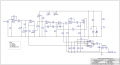
I just built this circuit that has a CA3080 op amp at the output, i understand this device isn't a regular op amp but i always thought chips needed a positive and a 0V or negative on the other supply pin, i havn't measured whats on pin 4 in this circuit but clearly it doesn't go to 0V or negative, the data sheet states a 0V supply.

Just curious since the circuit is working fine.
 

Attachments

dl324

Joined Mar 30, 2015
18,362
i havn't measured whats on pin 4 in this circuit but clearly it doesn't go to 0V or negative, the data sheet states a 0V supply.
There's nothing that says the positive and negative supplies for an opamp need to be the highest and lowest voltages in the circuit.

There's a voltage divider on the V- pin. It's at 1.62V.
 

WBahn

Joined Mar 31, 2012
32,925
There's nothing that says the positive and negative supplies for an opamp need to be the highest and lowest voltages in the circuit.

There's a voltage divider on the V- pin. It's at 1.62V.
But the two questions that come to my mind are:

What is the purpose of having the negative supply elevated?

What is the purpose of powering the opamp with a supply having well over 1 kΩ of resistance?

Assuming it's not a mistake, I have to assume that it's some kludged-up distortion effect.
 

dl324

Joined Mar 30, 2015
18,362
Assuming it's not a mistake, I have to assume that it's some kludged-up distortion effect.
There's so much wrong with that schematic (for instance, using a box instead of an opamp symbol for the CA3080), that I'm not inclined to try to analyze it.

There's a weak virtual ground formed by R14 and R15, so the V- voltage would allow the output to just about get down to the virtual ground voltage.
 

WBahn

Joined Mar 31, 2012
32,925
There's so much wrong with that schematic (for instance, using a box instead of an opamp symbol for the CA3080), that I'm not inclined to try to analyze it.
I'm not going to get bent over someone using the symbol that the simulator provides instead of taking the time to make their own, which likely involves learning how to create symbols and tie them to the device model.
 

Thread Starter

Homebrew1964

Joined Nov 22, 2024
238
There's so much wrong with that schematic (for instance, using a box instead of an opamp symbol for the CA3080), that I'm not inclined to try to analyze it.

There's a weak virtual ground formed by R14 and R15, so the V- voltage would allow the output to just about get down to the virtual ground voltage.
All i can tell you is that despite any wrongs in the schematic, the circuit works very well and does exactly what i wanted

thanks for the replies everyone.
 

WBahn

Joined Mar 31, 2012
32,925
All i can tell you is that despite any wrongs in the schematic, the circuit works very well and does exactly what i wanted

thanks for the replies everyone.
Try connecting the negative supply of the opamp to the negative power supply rail and see if it actually makes a significant difference.
 

Thread Starter

Homebrew1964

Joined Nov 22, 2024
238
Try connecting the negative supply of the opamp to the negative power supply rail and see if it actually makes a significant difference.
My circuit isn't on breadboard, it's laid out on veroboard and since it's working well i'm not going to mess with it... time to fit it in a box me thinks :)
 

dl324

Joined Mar 30, 2015
18,362
All i can tell you is that despite any wrongs in the schematic, the circuit works very well and does exactly what i wanted
The problem is that uA741 and CA3080 don't have much headroom when operating from 9V (4.5V/-4.5V). They're only guaranteed to get within 3V of the supplies. MC3403 isn't much better. It can go to the negative supply, but only within 2V from the positive rail. Maybe the intent is to have distortion.

The schematic would be a bit cleaner if some/all of the IC2 opamps were flipped WRT the X-axis.
 

Thread Starter

Homebrew1964

Joined Nov 22, 2024
238
The problem is that uA741 and CA3080 don't have much headroom when operating from 9V (4.5V/-4.5V). They're only guaranteed to get within 3V of the supplies. MC3403 isn't much better. It can go to the negative supply, but only within 2V from the positive rail. Maybe the intent is to have distortion.
There is absolutely no distortion, the output is a triangle wave. It sounds great
 
Last edited:
The CA3080 is a transconductance opamp, which was widely, and I mean widely used on analog synthesizers, until it was discontinued over 20 years ago.
Synth fans still cry its demise.
 

AnalogKid

Joined Aug 1, 2013
12,158
The schematic would be a bit cleaner if some/all of the IC2 opamps were flipped WRT the X-axis.
Disagree. Raised differently. Flip IC1.

Also, IC2.3 and 2.4 are non-inverting, so flipping them increases crossovers.

I don't have a hard-and-fast rule. The intent of the decal is to convey the signal flow with the fewest distractions, so I have no problem with both orientations in the same schematic if that serves the story being told. But my default position is plus-up / minus-down; positive above negative.

ak
 
The intent of the decal is to convey the signal flow with the fewest distractions
Absolutely! Some people here are rather pedantic about schematics.... about things which seem more like personal preferences.

I have only few hard and fast rules:

● ground symbols ALWAYS point down.

● positive voltage connections ALWAYS point up; negative voltage connections ALWAYS point down.

● lines DO NOT cross symbol packages.

● in general signal flow is top left to bottom right, but may be otherwise for clarity.
 

WBahn

Joined Mar 31, 2012
32,925
Absolutely! Some people here are rather pedantic about schematics.... about things which seem more like personal preferences.

I have only few hard and fast rules:

● ground symbols ALWAYS point down.

● positive voltage connections ALWAYS point up; negative voltage connections ALWAYS point down.

● lines DO NOT cross symbol packages.

● in general signal flow is top left to bottom right, but may be otherwise for clarity.
Those are good general rules, but I always leave the door open for exceptions by (almost) never saying things like never or always (notice how I even left the door open there).

In addition to the above, I don't connect signals by label unless the signal is truly global, or close to it. Power supplies, widely used clock signals, references, and bias voltages are the usual candidates. Almost never do I connect information signals via label.

My "rules" always have the caveat of "without a damn good reason". It acknowledges that damn good reasons can and do exist, but requires that it be given careful thought and shouldn't be done unless a good defense for it can be articulated.
 
Top