NTC Selection Criteria for 'Temperature range: -5°C until +35°C Accuracy: ± 1%'

Thread Starter

mishra87

Joined Jan 17, 2016
1,063
No calculation.
The resistor values vs. temperature are from the thermistor data sheet.
Depends upon what output voltage range you want for that temperature change, and which thermistor you select.
Thanks for support and guidance !!!

I have chosen 103AT for my application. Below is the datasheet
https://www.mouser.in/datasheet/2/362/semitec_atthermistor-1202913.pdf

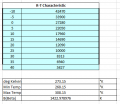
Below is RT characteristic
Temp Resistance
-10 42470
-5 33900
0 27280
5 22050
10 17960
15 14690
20 12090
25 10000
30 8313
35 6940
40 5827

Could you suggest how do I set Opamp output voltage for negative temperature in your schematic.

Thanks !!!
 

Thread Starter

mishra87

Joined Jan 17, 2016
1,063
I have dome some preliminary calculation for 103AT.
Still I have confusion to read negative temperature using Opamp circuit posted by Mr. crutschow.
May be he can guide more on the same.

upload_2019-7-28_13-4-48.png
upload_2019-7-28_13-5-35.png
 

Thread Starter

mishra87

Joined Jan 17, 2016
1,063
q
hi,
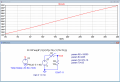
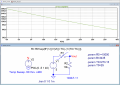
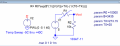
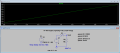
This is what LTS shows for your 104AT , with 5Vdc supply and a 10k series resistor.
E

Added NTC resistance plot.
hi,

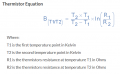
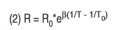
I think you are talking about below equation.
upload_2019-7-28_15-45-0.png
I
but in simulation file you mentioned

V=?
vt =?

Could you guide me about LT spice setting you used in simulation.
How did you plot this equation in LT spice

Regards,
 

Thread Starter

mishra87

Joined Jan 17, 2016
1,063
hi,
Look Equ(2) of this PDF
E

Added a 2nd PDF that may be helpful. [linearise data]

Ref your questions.


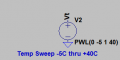
V(vt) is the temperature sweep as marked on the plot.

How can the Vout ever be negative with a single +5V supply.????
Hi,

I do not find any voltage vs resistance plot.
could you help me LT spice setting to achieve results.

1. How to do below setting.
upload_2019-7-28_16-18-56.png

2. How to write equation in LT spice
upload_2019-7-28_16-19-46.png

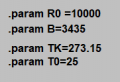
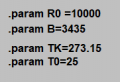
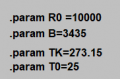
3. parameter setting : ??

upload_2019-7-28_16-22-9.png

4. what is setting for KHz vs Vout


Regards,
 

Attachments

Last edited:

ericgibbs

Joined Jan 29, 2010
21,477
hi,
Why don't you just run the asc file I posted.
Your Thermistor Thread is turning into a LTSpice tutorial.:)

Ref the V(Vt), you will see in the Equ(2) that it gives the Thermistor temperature as 'T'.

But we want see what happens over a range of temperatures, so V(Vt) replaces 'T' in the equation, it's only an algebraic expression.
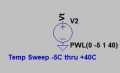
So as we vary V(Vt) from -5v thru +40V, its the same as the temperature 'T' varying from -5C thru +40C, so we can view the resistance etc ....

OK.?
E
 

Thread Starter

mishra87

Joined Jan 17, 2016
1,063
hi,
Why don't you just run the asc file I posted.
Your Thermistor Thread is turning into a LTSpice tutorial.:)

Ref the V(Vt), you will see in the Equ(2) that it gives the Thermistor temperature as 'T'.

But we want see what happens over a range of temperatures, so V(Vt) replaces 'T' in the equation, it's only an algebraic expression.
So as we vary V(Vt) from -5v thru +40V, its the same as the temperature 'T' varying from -5C thru +40C, so we can view the resistance etc ....

OK.?
E
Hi,

I run your simulation file I do not find results as per your attachment.
It would be my pleasure if answer my query posted in post #49


Regards,
 

Attachments

ericgibbs

Joined Jan 29, 2010
21,477
hi m87,
You should study tutorials for LTSpice, the questions you are asking are very basic in the use of LTS, the answers will take sometime to type up and they will only lead to more questions.

Sorry if I sound a little blunt in my reply.:)

I thought in your Thread, the problem was to find a suitable NTC component for the project, you have chosen the 103AT, which looks OK.
Your next step should be how you can adapt the crutschow circuit to enable you to use that thermistor.

You are getting distracted by trying to learn LTS.

Eric
 

Alec_t

Joined Sep 17, 2013
15,130
What is achievable accuracy in your opinion.
That depends on the environment and the volume of water involved.
If you have a large volume then its temperature will not change very quickly with environment temperature change, but there will be temperature gradients within the volume (warmer at the top than lower down) so a measurement at a single location may not be representative of the whole volume.
Conversely, if the volume of water is small then its temperature will change more quickly with the environment change, but temperature gradients within the volume may be less significant.
If the purpose of measuring the temperature is simply to decide whether or not to switch on a heating or cooling device, then in my opinion a measurement tolerance of 2 or 3 degrees would be adequate.
 

Thread Starter

mishra87

Joined Jan 17, 2016
1,063
hi m87,
You should study tutorials for LTSpice, the questions you are asking are very basic in the use of LTS, the answers will take sometime to type up and they will only lead to more questions.

Sorry if I sound a little blunt in my reply.:)

I thought in your Thread, the problem was to find a suitable NTC component for the project, you have chosen the 103AT, which looks OK.
Your next step should be how you can adapt the crutschow circuit to enable you to use that thermistor.

You are getting distracted by trying to learn LTS.

Eric
Thanks for your reply.

You are quite correct. Thread opened for NTC selection but it is distracting towards LT spice .
But I have finalize components so my next step is to do the simulation.

I have basic idea about LT spice simulation and I use to do simulation.

A small your help will make me to understand to I will be able to do by my own.

Regards
 

Thread Starter

mishra87

Joined Jan 17, 2016
1,063
That depends on the environment and the volume of water involved.
If you have a large volume then its temperature will not change very quickly with environment temperature change, but there will be temperature gradients within the volume (warmer at the top than lower down) so a measurement at a single location may not be representative of the whole volume.
Conversely, if the volume of water is small then its temperature will change more quickly with the environment change, but temperature gradients within the volume may be less significant.
If the purpose of measuring the temperature is simply to decide whether or not to switch on a heating or cooling device, then in my opinion a measurement tolerance of 2 or 3 degrees would be adequate.
Thanks for your inputs.

Regards,
 

Thread Starter

mishra87

Joined Jan 17, 2016
1,063
hi,
OK.
Prepare your best LTS asc file and we will be pleased to help you through it, to get the project working.
E
Hello,

I wanted to understand you schematic.

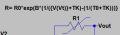
1. This you have drawn from PWL(piece wise linear) source that I got it.
upload_2019-7-28_18-28-5.png
2. You assign some for R1 from 'Text" if I am correct
upload_2019-7-28_18-31-25.png
3. you assign value for formula using 'Spice Directive'
upload_2019-7-28_18-33-55.png
4. Now still not clear how to get KHz vs Vout graph .

Pl help me, probably I am closer to simulation.

Regards,
 

ericgibbs

Joined Jan 29, 2010
21,477
hi,
Run the sim.
Place the cursor on the X axis lettering, the cursor should change to a Rule image, Right click and an Entry box will pop up, replace 'time' with V(Vt) [ Vt is in degree C]

Ref your Q2; yes,. the formula is the value for the resistor [NTC]

E
 

Thread Starter

mishra87

Joined Jan 17, 2016
1,063
Thank you so much for your support.

I was able to simulate your circuit.
I told you that give me some hint I will do it.


now I will try to simulate opmap circuit.

Regards,
 

Attachments

crutschow

Joined Mar 14, 2008
38,572
Could you suggest how do I set Opamp output voltage for negative temperature in your schematic.
You set the value of the U2 pot plus R3 equal to the thermistor resistance at the minimum temperature of -5°C (for simulation purposes you can eliminate U2 and just use R3).
That will give 0V out @ -5 degrees.
Then you select a bridge voltage, Vb, to give the maximum output voltage you want at the +35°C resistance (formula given in post #31).
 
Top