NTC Selection Criteria for 'Temperature range: -5°C until +35°C Accuracy: ± 1%'

Thread Starter

mishra87

Joined Jan 17, 2016
1,063
Hi Guys,

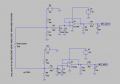
I tried to simulate below circuit to nullify the variation of internal ADC reference i.e. 2% of internal reference of STM32F405.
My Idea was measuring the differential voltage using two microcontroller adc channel will meet the objective.
But when i ran the simulation i found the same voltage appear across the at NTC_ADC1 and NTC_ADC2.
My perception was wrong.
Could anybody check and correct me ?
1582725497910.png
1582725908344.png
 

Attachments

OBW0549

Joined Mar 2, 2015
3,565
I tried to simulate below circuit to nullify the variation of internal ADC reference i.e. 2% of internal reference of STM32F405.
This circuit will not accomplish that.

My Idea was measuring the differential voltage using two microcontroller adc channel will meet the objective.
If there were any differential voltage (see below), the measurement accuracy of that voltage would still be subject to the same error caused by the ADC's reference voltage uncertainty.

But when i ran the simulation i found the same voltage appear across the at NTC_ADC1 and NTC_ADC2.
Good grief! LOOK at your circuit: both ends of the thermistor are at the same voltage, as set by voltage dividers R2-R3 and R7-R8. There is no voltage across the thermistor, and both outputs, at NTC_ADC1 and NTC_ADC2, are the same and are constant over temperature. With this circuit, how in the world could you expect otherwise???

The ADCs in microcontrollers operate ratiometrically; that is, they measure the ratio of an unknown input voltage to the ADC's reference voltage. To deal with reference voltage inaccuracy, you must make the measurement ratiometric by doing one or the other of the following:

a) If the STM32 allows external access to its internal voltage reference on some I/O pin, use an op amp to buffer that voltage and use the op amp output as the voltage supply to a standard thermistor circuit-- i.e., a thermistor and a reference resistor connected as a voltage divider between the reference voltage and ground, with the junction going to your ADC input.

b) Use an external voltage reference to supply the thermistor-resistor divider described in a) above, and use that same voltage as the STM32's ADC reference input.

But as for the circuit you've presented, it is useless.

The bottom line, for both approaches, is to make the thermistor drive voltage and the ADC reference voltage vary together (if they vary at all) in the same ratio, preserving ADC accuracy.
 

Thread Starter

mishra87

Joined Jan 17, 2016
1,063
This circuit will not accomplish that.

If there were any differential voltage (see below), the measurement accuracy of that voltage would still be subject to the same error caused by the ADC's reference voltage uncertainty.


Good grief! LOOK at your circuit: both ends of the thermistor are at the same voltage, as set by voltage dividers R2-R3 and R7-R8. There is no voltage across the thermistor, and both outputs, at NTC_ADC1 and NTC_ADC2, are the same and are constant over temperature. With this circuit, how in the world could you expect otherwise???

The ADCs in microcontrollers operate ratiometrically; that is, they measure the ratio of an unknown input voltage to the ADC's reference voltage. To deal with reference voltage inaccuracy, you must make the measurement ratiometric by doing one or the other of the following:

a) If the STM32 allows external access to its internal voltage reference on some I/O pin, use an op amp to buffer that voltage and use the op amp output as the voltage supply to a standard thermistor circuit-- i.e., a thermistor and a reference resistor connected as a voltage divider between the reference voltage and ground, with the junction going to your ADC input.

b) Use an external voltage reference to supply the thermistor-resistor divider described in a) above, and use that same voltage as the STM32's ADC reference input.

But as for the circuit you've presented, it is useless.

The bottom line, for both approaches, is to make the thermistor drive voltage and the ADC reference voltage vary together (if they vary at all) in the same ratio, preserving ADC accuracy.
Thanks for your time

a) If the STM32 allows external access to its internal voltage reference on some I/O pin, use an op amp to buffer that voltage and use the op amp output as the voltage supply to a standard thermistor circuit-- i.e., a thermistor and a reference resistor connected as a voltage divider between the reference voltage and ground, with the junction going to your ADC input.
1582731074775.png
Currently i am using this circuit for temperature measurement.
Supply at R38 is the same dc rail connected to micro-controller.

Now as per your suggestion, I should internal ADC reference signal which is 1.18V-1.24V for STM32F405 and buffer it then connect it to R38 and then do the measurement as per above circuit.

I did not still understand that how will you get 1.21V of ADC internal reference voltage using uC GPIO ?
Could you brief about more because this concept is new to me.


b) Use an external voltage reference to supply the thermistor-resistor divider described in a) above, and use that same voltage as the STM32's ADC reference input.
This option is not worth full as we do not external reference in 64Pin ADC

thanks again.
 

OBW0549

Joined Mar 2, 2015
3,565
I did not still understand that how will you get 1.21V of ADC internal reference voltage using uC GPIO ? Could you brief about more because this concept is new to me.
Surely there must be some configuration option for the STM32 that allows the internal reference to be made available on an I/O pin? Without that, and without being able to use an external reference, the ADC would be almost useless.

There has to be some way to do one or the other; read the data sheet.

And with that, I'm done with this thread; I've already indicated above what you need to do.
 
Top