Generally you want a thermistor that has about 1kΩ to 10kΩ resistance at the center of your temperature range.
Pick one that is rated for 1% accuracy of value over the range.
If you connect the thermistor in the feedback circuit of an op amp in a quasi-bridge connection, then the output is a linear function of the thermistor resistance.
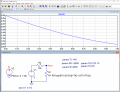
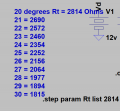
The LTspice of such a circuit is shown below for a typical thermistor:
The values shown give an output of zero volts at 20°C.
For your circuit you would likely want zero output at -5°C.
The gain is a function of the bridge reference voltage, Vb, which should be a stable voltage from a reference circuit, such as a TL431.
If you need more gain to match the micros input scale, than add a non-inverting op amp with gain at the bridge output.
Generally you want a thermistor that has about 1kΩ to 10kΩ resistance at the center of your temperature range.
Pick one that is rated for 1% accuracy of value over the range.
If you connect the thermistor in the feedback circuit of an op amp in a quasi-bridge connection which maintains a constant current through the thermistor, then the output voltage is a linear function of the thermistor resistance.
The LTspice of such a circuit is shown below for a typical thermistor:
The values shown give an output of zero volts at 20°C.
For your circuit you would likely want zero output at -5°C.
The gain is a function of the bridge reference voltage, Vb, which should be a stable voltage from a reference circuit, such as a TL431.
If you need more gain to match the micros input scale, than add a non-inverting op amp with gain at the bridge output.
Generally you want a thermistor that has about 1kΩ to 10kΩ resistance at the center of your temperature range.
Pick one that is rated for 1% accuracy of value over the range.
If you connect the thermistor in the feedback circuit of an op amp in a quasi-bridge connection which maintains a constant current through the thermistor, then the output voltage is a linear function of the thermistor resistance.
The LTspice of such a circuit is shown below for a typical thermistor:
The values shown give an output of zero volts at 20°C.
For your circuit you would likely want zero output at -5°C.
The gain is a function of the bridge reference voltage, Vb, which should be a stable voltage from a reference circuit, such as a TL431.
If you need more gain to match the micros input scale, than add a non-inverting op amp with gain at the bridge output.
Could you send me simulation file of LT spice for temperature range -5degC to 35degC.
Pl explain how did you plot this graph in LT spice and How do you calculate temperature.
This is what he keeps repeating. If the actual temperature is 1°, then his circuit must return something in the range of 0.99° to 1.01°!
Which is ridiculous... Most components won’t be able to support that accuracy. Add the resistor accuracy to the supply accuracy to the op amp accuracy, and he’ll require component ratings which don’t exist.
You aren't listening and still don't get it.
1% of what?
If the temperature is zero, then based upon your definition, the accuracy would also be zero, which is nonsensical.
So how about 1% of the range (40°C) which would be 0.4°C?
The output is determined by the gain of the circuit.
The bridge is biased at 1/2 the bridge voltage by R1 and R2.
The output is then (Vb/2)/(R3+Ru2) * Rt.
Calculating Rt from the output voltage by plugging into that equation, you can then determine the temperature that caused that value of Rt.
If you are going to immerse it in the water, then you need one that's waterproof.
It's not as linear as the one I posted.
You aren't listening and still don't get it.
1% of what?
If the temperature is zero, then based upon your definition, the accuracy would also be zero, which is nonsensical.
So how about 1% of the range (40°C) which would be 0.4°C?
Where/what is this water whose temperature you want to measure? If it's turbulent or subject to rapid temperature fluctuations then an accuracy of even ±0.5° may not be achievable.
See attached.
I plotted it as shown.
What do you not understand about that.
The output is determined by the gain of the circuit.
The bridge is biased at 1/2 the bridge voltage by R1 and R2.
The output is then (Vb/2)/(R3+Ru2) * Rt.
Calculating Rt from the output voltage by plugging into that equation, you can then determine the temperature that caused that value of Rt.
Where/what is this water whose temperature you want to measure? If it's turbulent or subject to rapid temperature fluctuations then an accuracy of even 1% of the temperature range (0.4°) may not be achievable.
The output voltage is a linear function of resistance if the thermistor has a constant current through it.
The bridge circuit does that, since the current through the pot and R3 does not vary (there is a constant voltage across them), and the thermistor current has to equal that current to keep the bridge circuit balanced, so thus the output is a linear function of resistance.
Remember that, with negative feedback, an op amp will do whatever it can to keep the voltage across its two inputs very close to zero volts.
Where/what is this water whose temperature you want to measure? If it's turbulent or subject to rapid temperature fluctuations then an accuracy of even ±0.5° may not be achievable.
The output voltage is a linear function of resistance if the thermistor has a constant current through it.
The bridge circuit does that, since the current through the pot and R3 does not vary (there is a constant voltage across them), and the thermistor current has to equal that current to keep the bridge circuit balanced, so thus the output is a linear function of resistance.
Remember that, with negative feedback, an op amp will do whatever it can to keep the voltage across its two inputs very close to zero volts.

 Facebook
 Google
 GitHub
 Linkedin