Thanks
Yeah I was think around the 100-200V mark, and that always seems to go hand in hand with the current rating I'm after which is nice and convenient.
I do have to say though all the FETs I've looked at have ratings for say 150V and 80A and 600W power dissipation but they are the TO-247 package and have itty bitty legs (1mm). Are these ok with these currents with a heatsink and big tracks?
80A and 600W power dissipation but they are the TO-247 package and have itty bitty legs (1mm). Are these ok with these currents with a heatsink and big tracks?
What you have done here is, you named the difficult part of designing with those transistors. You want to throw 80 amps through 1 mm? You better know how to do it!
I can easily imagine a solder joint that cracked because of heat cycling, developing half an ohm, and bursting into flame when an 80 amp pulse hits it.
The last time I checked, no transistor would do more than 75 amps continuous without the internal bonding wires melting. I come from a time when a TO-3 package was good for 4 amps. No way I'm going to tell a TO-220 to handle 50 or 60 amps. You're going to have to wait for somebody younger than I to tell you what the real limits are.
What you have done here is, you named the difficult part of designing with those transistors. You want to throw 80 amps through 1 mm? You better know how to do it!
I can easily imagine a solder joint that cracked because of heat cycling, developing half an ohm, and bursting into flame when an 80 amp pulse hits it.
Lol this is exactly it I just can't get my head round that. 80Amps through that small a cross sectional area, its crazy! Gonna have to research how to mount these, might be some reference somewhere I hope.
I'm not sure what your goals are and I just hate to rain on a parade - but I will.
The type of heater you have chosen is tricky to get running right and the results can make smoke.
So give this a read before you go to far. http://www.richieburnett.co.uk/indheat.html
If you don't have the equipment I have seen people get this type to work pretty good. It automatically oscillates at the right frequency. https://markobakula.files.wordpress.com/2012/10/royer_ih.png
The difficulties always seen to stem from finding inductors that will take the current and the size of the power supply.
Mostly depends on how big of a piece you need to heat.
As far as the heat goes you can calculate it from the data sheet.
Using your IRFB4710 as an example:
It's on resistance is .014 ohms and at 40 amps is about 22 watts in the FET.
So if you go to the thermal characteristics it will show that from the junction to case is .74 C per watt and case to heat sink is .5 C per watt.
So if you had a perfect heat sink that kept the temperature at 25 C the junction would be about 52C.
If you have a good sized heat sink it might rise 2C per watt, so another 44C - for about 97 C.
The absolute maximum is 150C, so it's pushing it, but it will work there. The heat sink will be hot enough to hurt.
Most of the bond wires will do 60 amps - more for a short time. They are amazing little guys.
Have #12 check me out. He's the thermal guy.
haha it's ok I'll check those out thanks, "noobheater" lol I love it. I'm constructing my own inductor for the purpose of heating shallow materials and possibly particulates and only for very short times so hopefully I'll be able to make nicely tuned parallel LC circuit.
I'm not sure what your goals are and I just hate to rain on a parade - but I will.
As far as the heat goes you can calculate it from the data sheet.
Using your IRFB4710 as an example:
It's on resistance is .014 ohms and at 40 amps is about 22 watts in the FET.
So if you go to the thermal characteristics it will show that from the junction to case is .74 C per watt and case to heat sink is .5 C per watt.
So if you had a perfect heat sink that kept the temperature at 25 C the junction would be about 52C.
If you have a good sized heat sink it might rise 2C per watt, so another 44C - for about 97 C.
The absolute maximum is 150C, so it's pushing it, but it will work there. The heat sink will be hot enough to hurt.
Most of the bond wires will do 60 amps - more for a short time. They are amazing little guys.
Have #12 check me out. He's the thermal guy.
Good to hear the current should be ok with high gauge attached to it I'm not sure on heatsinks though. Have you got any suggestions for heatsinks for the TO-247 packages? I can find the little ones for them but are there anything a little bigger or are they made for multiple FETs?
EDIT this post really helped me with the thermal understanding, thanks
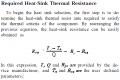
I am working out the required maximum thermal resistance of the heatsink, for Q in the below equation do I take the full maximum PD value (e.g. 200w for the IRFB4710) for Q? Because if I do that I end up with a maximum thermal resistance for the heat sink being -0.54C/W. Surely this can't be right can it? have I got the wrong value somewhere?
The alleged power rating of a transistor has never worked for me. As far as I can tell, it's a fantasy number based on perfect conditions and designs that will barely survive the warranty period.
You want heatsinks? Try thermalloy.com or Wakefield
A lot of vendors sell heatsinks according to C/W specifications. If they don't, don't buy a specless product.
Ronv put you on the right track. It's all about the watts that the transistor suffers times the thermal resistance to the outside world. If you get a negative number, you broke a rule.
22Watts causing a 75 degree C rise in temperature is 75C/22W and that is 3.4 C/w as the maximum sum of all thermal resistances. Theta JC is .74 and the greased interface to the heatsink is 0.5 so you have 2.17 C/W leftover for the heatsink. Everybody with good sense would buy a better heatsink than that because we don't want our transistors able to boil water.
See? We're looking at, "You can't get there from here." and we're only trying to use half the amps the transistor is rated for! It is always a search to get the right heatsink. How do you feel about using a fan?
The alleged power rating of a transistor has never worked for me. As far as I can tell, it's a fantasy number based on perfect conditions and designs that will barely survive the warranty period.
You want heatsinks? Try thermalloy.com or Wakefield
A lot of vendors sell heatsinks according to C/W specifications. If they don't, don't buy a specless product.
Ronv put you on the right track. It's all about the watts that the transistor suffers times the thermal resistance to the outside world. If you get a negative number, you broke a rule.
22Watts causing a 75 degree C rise in temperature is 75C/22W and that is 3.4 C/w as the maximum sum of all thermal resistances. Theta JC is .74 and the greased interface to the heatsink is 0.5 so you have 2.17 C/W leftover for the heatsink. Everybody with good sense would buy a better heatsink than that because we don't want our transistors able to boil water.
Ahhhhh thank you, I see now More than happy to use a fan I had planned to use an intake and exhaust fan (or just 2 exhausts) of 40 or 80mm blowing/pulling air directly over the heatsinks. If I had that setup would one of these be ok? I was think this one but I suppose I'd have to check the airflow would be in the 300LFM range first.
I read that as 400 FPM needed. The numbers on the right aren't aligned properly.
Besides, it's a waste of time to specify parts for one transistor when you have to cool 4 of them.
Besides, the amps you are using is only part of the story. The time it takes for the mosfet to turn on and turn off is a major contributor. It is only good that you got some practice in on this example.
I'd be swarming on the math, but how many amps and how fast and what is the duty cycle and how good are the gate drivers, and the integral of rise time and current flow and so forth aren't clear to me. Bottom line is, you do the heatsink last.
I read that as 400 FPM needed. The numbers on the right aren't aligned properly.
Besides, it's a waste of time to specify parts for one transistor when you have to cool 4 of them.
Besides, the amps you are using is only part of the story. The time it takes for the mosfet to turn on and turn off is a major contributor. It is only good that you got some practice in on this example.
I'd be swarming on the math, but how many amps and how fast and what is the duty cycle and how good are the gate drivers, and the integral of rise time and current flow and so forth aren't clear to me. Bottom line is, you do the heatsink last.
Yeah I have been trying to make sure all my components will have the minimum cut-off frequencies for my application. I'm gonna do some selection then and the draw up a comparison table for my components specifications, just to try and spot any inconsistencies and to determine a maximum attainable output frequency.
#12 and ronv thank you so much for your help with these questions, this thread has somewhat gone off course so thanks for sticking with me.
Gonna get all this compiled and I'll be back to get final critique on the circuit if that's ok. Prob best if I start a new thread for that I 'm guessing

 Facebook
 Google
 GitHub
 Linkedin