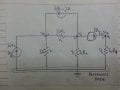
nodal analysis. what are the equations of the node a, b and c

having trouble with the signs in the equation and how to find the equation of node c?

  • direction of the currents toward nodes

    Votes: 0 0.0%
  • signs used

    Votes: 0 0.0%

  • Total voters
    0

MrAl

Joined Jun 17, 2014
13,805
Hi,

You could start by assigning currents in each small loop section, or you could just use nodal analysis. Which have you used in the past?
 

WBahn

Joined Mar 31, 2012
33,218
In Nodal Analysis, the equation for each node is written in terms of the currents leaving the node and expressed in terms of the node voltages. These are then summed up and set equal to zero.

For instance, for Node A the current flowing OUT of the node through R2 is (Va - Vb)/R2. When you get to Node B, the current flowing OUT of the node through R2 is (Vb - Va)/R2.

Similarly, the current flowing OUT of Node A through the 2 A source is -2 A while the current flowing OUT of Node B through that same source is +2 A.

With practice, you will be able to write down the node equations directly as linear polynomials in the unknown node voltages on the left with the terms due to independent sources on the right, but for now put everything on the left and rearrange later.

Note that the I1R1 (and similar) terms in your diagram aren't very useful because there is no polarity associated with them. They are meaningless unless you indicate which direction those currents are flowing. You can flip a coin for each one, if you want, but that information has to be specified. But this is really neither here nor there since these currents are not used in Nodal Analysis.
 

Thread Starter

natalie rose

Joined Oct 22, 2016
3
Hey!
i am not sure that at node b the direction for the R3 resistor will be entering or leaving and i am not able to finde the node c equation and i used nodal analysis to do it.
 

WBahn

Joined Mar 31, 2012
33,218
You need to show your best attempt to work the problem. That let's us see what you are doing right and what you are doing wrong and help you make the necessary corrections.

It's important to see that you don't need to concern yourself with what direction the current is actually flowing in a particular resistor when you are setting up the equations. You write the equations for each node from the perspective that all of the current is leaving that node when you write that node's equation. We KNOW that this is not possible, which means that some of those currents will actually be flowing the other way. That's fine. That will make itself apparent once we have solved for the node voltages because if Node A turns out to have a higher voltage than Node B, then the current through any resistor connected between Node A and Node B will have current flowing from Node A to Node B through that resistor.

Again, we can't help too much unless and until you post YOUR best attempt (doesn't have to be complete or correct) to solve (or at least set up) the problem.
 

MrAl

Joined Jun 17, 2014
13,805
Hey!
i am not sure that at node b the direction for the R3 resistor will be entering or leaving and i am not able to finde the node c equation and i used nodal analysis to do it.
Hi again,

Oh ok so i guess you dont mind using Nodal then. If you show at least a little of your work so far we can see what went wrong. That's better than just handing you the answer which wont help you when you get to the next circuit in your studies.
 

MrAl

Joined Jun 17, 2014
13,805
Hi again,

Oh BTW, since your resistor at node 'c' is R4 and it is in series with a current source of 5 amps, then you immediately know the voltage across it using Ohm's Law because E=I*R. The current can not be anything other than 5 amps.
Try that for node 'c'.
 

anhnha

Joined Apr 19, 2012
904
So does that mean you're not going to post what you got and how you did it?

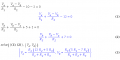
In that case I'll show this extract from a Maple worksheet showing the two node equations for Va & Vb. Vc does not need a node equation since the voltage at Node C is a constant.

View attachment 114280
I think it would be more exact if we say that the main reason for Vc not needed to be a node equation because it is not a principle node - a node where three or more wires meet.
 

RBR1317

Joined Nov 13, 2010
715
True. But if you recognize that the voltage at node C is a constant, then a node equation for Vc is not necessary to solve for Va & Vb. Can't say that I ever learned the terminology for a "principle node" however it seems obvious enough.
 
Top