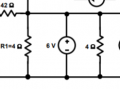
How to determine the power in resistors R1 and R2 in this complex circuit?

Thread Starter

Gr10

Joined Feb 10, 2025
15
0
I'm trying to solve the circuit shown in the attached image, where I need to determine the power of resistors R1 (4 Ω) and R2 (6 Ω).
I’ve attempted to use mesh analysis, but the results don’t match, and I’m unsure if I’m setting up the equations correctly. This circuit includes multiple current and voltage sources, as well as several resistors in series and parallel.
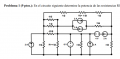
  1. What is the correct approach to analyze this circuit and find the currents needed to calculate the powers?
  2. Would it be better to use the nodal analysis method instead of mesh analysis in this case?
  3. How do I properly handle the dependent sources when setting up the equations?
I would greatly appreciate any guidance or detailed steps to approach this problem, especially using a systematic method like mesh or nodal analysis.

Screenshot_20250208-182035.png
 

WBahn

Joined Mar 31, 2012
32,703
It should be 6 volts in R1? The problem is I see a current source in R1.
What current source in R1?

R1 is a resistor. Nothing more, nothing less.

If you know the voltage across a resistor, what is the power dissipation in that resistor?

As for R2, simply the circuit based on your knowledge of how things behave when connected in certain ways.

Consider the following questions:

If a voltage source and a current source are in series, what is it equivalent to?

If a voltage source and a current source are in parallel, what is it equivalent to?

If you can determine that a resistor has no current through it, what can it be replaced by?

If resistors are in parallel, how can they be replaced with a single resistor?

If resistors are in series, how can they be replaced with a single resistor?

If two voltage sources are in series, how can they be replaced with a single source?

If two current sources are in parallel, how can they be replaced with a single source?

What impact does a resistor in parallel with a voltage source have on the rest of the circuit?

What impact does a resistor in series with a current source have on the rest of the circuit?
 

ronsimpson

Joined Oct 7, 2019
4,646
A 6V source will make 6V no matter what is off the picture. It does not matter if current is flowing (into or out of) the wires that go off the page. 6V will be across both of the 4 ohm resistors. Changing the right resistor for 2 or 10 ohms has no effect n R1.
1739220303855.png
 

WBahn

Joined Mar 31, 2012
32,703
To get the current in R2, the circuit can be simplified all the way down to a single series circuit. Most of it can be done by inspection.
 

linhvn

Joined Nov 6, 2024
297
0
I'm trying to solve the circuit shown in the attached image, where I need to determine the power of resistors R1 (4 Ω) and R2 (6 Ω).
I’ve attempted to use mesh analysis, but the results don’t match, and I’m unsure if I’m setting up the equations correctly. This circuit includes multiple current and voltage sources, as well as several resistors in series and parallel.
  1. What is the correct approach to analyze this circuit and find the currents needed to calculate the powers?
  2. Would it be better to use the nodal analysis method instead of mesh analysis in this case?
  3. How do I properly handle the dependent sources when setting up the equations?
I would greatly appreciate any guidance or detailed steps to approach this problem, especially using a systematic method like mesh or nodal analysis.

View attachment 342326
I am a student like you, from what I know, you should reduce your circuit to a simpler circuit, like parallel resistors make 1 resistor, or voltage source in series with a current source mean current in that branch equal to that current source, and so on....
 
Top