Nodal Analysis Explanation

Status
Not open for further replies.

Thread Starter

Ankit Bali

Joined May 6, 2017
7
Hi guys,

I am just working on some problems for Nodal Analysis and am having issues understanding the concept fully. I understand the fact that each node is treated independently however in the problems below, I am having issues with Node 3 in problem 1 and Node 3 & 4 in problem 2. Trying to calculate the values is confusing me. I was wondering if someone can help me out and possibly explain where I am going wrong.

Thanks
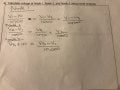
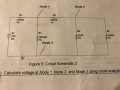
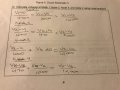
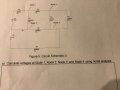
Problem 1 Attempt.jpgProblem 1.JPGProblem 2 Attempt.jpgProblem 2.JPG
 

Jony130

Joined Feb 17, 2009
5,597
As we can see in the circuit diagram the node 3 is used as a reference node (ground), hence node 3 voltage is 0V( All other voltages in the circuit are measured with respect to node 3).

As for node 4 what about R7 current?
Nodal analysis is based on Kirchhoff's current law, so first, try to write a KCL for node 4.
 

Thread Starter

Ankit Bali

Joined May 6, 2017
7
Oh that makes sense now. So basically i can say that node 3 in Problem 1 is ground hence the voltage at node 3 will be 0v.

In problem 2, i should use r7 and apply KCL. I will try that and get back to you guys.

In the meantime if someone could write out the simultaneous equations that i should expect to get, i would really appreciate it. If you can't I will post back later with my attempt.
 

Jony130

Joined Feb 17, 2009
5,597
And a hint:
To simplified a bit always try to assume that all the currents are living the given node.
Therefore for Problem 1 we have:
Node 1
V1/R3 + (V1 - 10V)/R1 + (V1 - V2)/R2 = 0 (all currents leaving the node1 )
Node2
(V2 - V1)/R2 + V2/R4 + V2/R5 = 0 (all currents leaving the node2 )
 

Thread Starter

Ankit Bali

Joined May 6, 2017
7
Hi thanks for your help Jony. I believe i have sorted out problem 1 now.

For problem 2 i so far have:
Node 1
(V1-10V)/R1+(V1-V3)/R3+(V1-V2)/R2=0
Node 2
(V2-V1)/R2+V2/R4+V2/R5=0
Node 3
(V3-V1)/R3+V3/R6+(V3+5)/R7=0

Does that seem right? I don't understand how i can bring node 4 into the equations.
 

Thread Starter

Ankit Bali

Joined May 6, 2017
7
Oh i see what you mean, your saying node 3 is grounded in this problem as well and i should apply my laws to node 4 and so thus my equations will become:
Node 1
(V1-10V)/R1+V1/R3+(V1-V2)/R2=0
Node 2
(V2-V1)/R2+(V2-V4)/R4+(V2-V4)/R5=0
Node 4
(V4-V2)/R4+(V4-V2)/R5+V4/R6+(V4-5)/R7=0
 

Thread Starter

Ankit Bali

Joined May 6, 2017
7
Sorry i completely forgot about it and hence ignored the grounding. For some reason i have it in my head if the ground is not directly underneath the node then its not grounded but its a misconception.

And really, even the ones for node 4? Those are the ones i am concerned about.
 

Thread Starter

Ankit Bali

Joined May 6, 2017
7
I can see and understand the currents flowing in and out of nodes 1 and 2 and they are easy to see but with node 4 it just feels like theres so much more happening, that its relying on everything else thats all.
 

Jony130

Joined Feb 17, 2009
5,597
Ok, I see. But if you will stick with the assumption that current at given node flows out of the node ( away from the node ) you will be safe almost always.
But kept in mind that if you make assumptions about current directions then you are also making assumptions about the relative potentials of the nodes. Which node voltage is at higher potential. Because the current flow from the higher potential to the lower one.
 

WBahn

Joined Mar 31, 2012
32,805
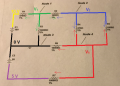
Doing some quick annotations on your drawing can make it a lot easier to see what to do.

Edit_2017-05-06_1.png

There are six nodes. The voltages on three of them are known. For the remaining three, just apply KCL on the currents leaving the node (the currents that are the same color as the node). Each current is merely an application of Ohm's Law in which the current is the voltage at the tail of the arrow (the node voltage in question) minus the node voltage at the head with this different then divided by the resistance between them.
 

RBR1317

Joined Nov 13, 2010
715
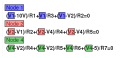
...and i should apply my laws to node 4 and so thus my equations will become:
Node-Voltage-Eqn.png
This is what I focus on when writing a node equation: Each term in the node equation begins with the voltage of that node. Never need to address current direction, except when a current source is connected to the node - then current leaving the node is positive, entering is negative.
 

Thread Starter

Ankit Bali

Joined May 6, 2017
7
Hi guys thanks a lot for your help!! I really appreciate it, I have a much better understanding now of what I am attempting. My nodal analysis understanding was a bit limited but now I understand and how to apply it much clearer.

Thanks once again and this thread can be closed if thats how its done.
 
Status
Not open for further replies.
Top