[Newbie]: I have some difficulties constructing this breadboard power module.

dl324

Joined Mar 30, 2015
18,337
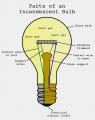
Can someone tell me if these are incandescent bulbs?
Need a higher resolution image and something to show scale.
I tried to plug them directly to the 5 volts without a resistor and I tried polarizing them in both ways and they work no matter what.
That's a good way to destroy things. Always limit current when working with something unknown.
 

Thread Starter

babaliaris

Joined Nov 19, 2019
208
By the way, I just found a really cool video that explains what I needed to know. The reason was that I did not know what a rectifier is.


dendad

Joined Feb 20, 2016
4,639
The only places that are connected together are those at the same potential. Pin 2 is isolated from pin 4 via the diode bridge. They are not the same thing. You may be getting confused by the "ground" term in use. Often on circuits, it is just a lazy way of not drawing all the lines. A ground symbol is used to indicate the common connections. In the same way, a + in a circle, labled, for instance, "5V", is used to indicate all the points connected to the +5V supply, saving lines all over the circuit diagram.
And, for this and many power supplies, the 0V, or the -ve terminal of the power supply output is regarded as the reference point that all the voltages are to be measured from. This is by convention, but there is nothing to stop you from designating any other point in the circuit as the reference point for measurements. But is you do, you will just get more confused with funny readings. And then you would have to specify to others where your measuring reference point is. Best stick to convention.

And, yes, those are incandescent lamps.
 

dl324

Joined Mar 30, 2015
18,337
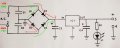
This is the problem. I'm trying to figure out what is the difference between pin2 and ground. If the ground is not the wire that returns back to the ac source, then where does it end up to? Where does the current go?
If you supplied the circuit with DC, Pin 2 or Pin 1 could be "ground" relative to the DC adapter.

One use of a bridge rectifier with DC input is to prevent polarity reversal from causing a problem. With a bridge rectifier on the input, the input can be DC of either polarity or AC.

When the input is DC, you lose 2 diode drops in the bridge rectifier. If you label the DC input +VDC and -VDC circuit ground will be 0.7V above -VDC. You could also call -VDC ground, but this ground is different than circuit ground.
 

DickCappels

Joined Aug 21, 2008
10,661
Can't tell for sure whether they are incandescent lamps or not. Your electrical test seems to indicate that they are. Can you see a filament between the two electrodes coming from the base of the lamp?
1574233092844.png
 

dl324

Joined Mar 30, 2015
18,337
This is the problem. I'm trying to figure out what is the difference between pin2 and ground. If the ground is not the wire that returns back to the ac source, then where does it end up to? Where does the current go?
Maybe it would be clearer if you labeled the GND node on the bridge rectifier as it was in the original schematic.

Here's the circuit being supplied with both polarities of DC:
bridgeDC.jpg
If you follow the green arrows (GND to pin 1) or red arrows (GND to pin 2), you'll see that circuit ground is a diode drop above ground for the DC adapter.
 
Top