Need help with design of windshield wiper control circuit

Thread Starter

davidy

Joined Dec 20, 2017
7
Disclaimer - I know NOTHING about electronics. I do know positive and negative, on and off, voltages, etc, but how it all comes together to actually make something happen is a mystery to me.

What I would like to build is a work box circuit that will do the following:
A 0-12 VDC input that will result in a 12 VDC pulsed output where the pulse is one second long and the duration between pulses is dependent on the actual voltage input with a 12V input having 1 second between pulses and a 2V input having 7-8 seconds between pulses.​

Specifics are:
An antique automobile has an electric windshield wiper that runs continuously on 12VDC. When switched on the wipers work at one speed until switched off, I want to use a rheostat to control the input voltage (not to the wiper itself) so that the wipers can be turned on with a one second pulse. After one sweep they return to park position until they receive another pulse. Varying the voltage, resulting in pulses of varying intervals will result in either continuous operation or delayed operation.​

I have no interest in marketing this; I only want it to work for me. Can anyone help?
 

MrChips

Joined Oct 2, 2009
34,630
What you request is known as an intermittent windshield wiper control circuit.
This is actually done commercially using an integrated circuit called a 555-timer circuit. The output of the 555-timer drives a power transistor that then fires the windshield wiper start solenoid. The wiper motor stops automatically when it reaches the end of the cycle.
 

eetech00

Joined Jun 8, 2013
4,704
Hi

I think your looking for a voltage to frequency conversion circuit. The voltage level at the input changes the frequency of the output pulses. The output pulses could drive a mosfet that, in turn, drives a relay connected to the wiper motor power switch circuit. Maybe use LM331 chip.

eT
 
Last edited:
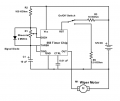
I am not sure if this is the complete solution, but this circuit should satisfy most of your requirements:
- The wiper motor is controlled by a 555 Timer Chip. The Reset (RST) pin is kept either at high (positive) voltage or at low (negative) voltage, by the switch. When the RST pin is low, the chip does nothing, and the motor is off. When the RST pin is high, the chip pulses.
- In the ON mode, the wiper motor is activated in 1 second pulses (1.1 seconds, technically). This is specified by the 10uF capacitor and the
100 KOhm R2 resistor through which it charges (the rheostat is bypassed through the diode).
The capacitor discharges through the rheostat, which controls the time the chip is inactive between pulses. By my calculations, setting the rheostat to 1.196 MOhm will give you 8 seconds inactivity between pulses, and setting it to 0.19 MOhm will give you 1 second between pulses. For every 188 KOhm additional resistance on the rheostat you gain 1 second of delay.
The only thing I am not sure about is whether 1.1 seconds is enough for the wipers to do one sweep and return to park position or how to prevent them from doing a partial second sweep if 1.1 seconds is long enough to allow it.
Wiper-Pulses.png
 

Thread Starter

davidy

Joined Dec 20, 2017
7
Thanks for the responses. Now, since as I said, I'm a complete dolt as far as electronics goes, I can, however, follow a diagram and, even with my limited abilities I might even be able to put this together. I do have several questions about the provided diagram.
1. Which position of the on-off switch is off?
2. It looks like no matter which position the switch is in, there's still power going through the circuit. What is this power doing?
3. I assume the output from the OUT terminal on the 555 goes directly to the motor without connecting to the wire it crosses.
4. Which end of R1 is 0 Ohm and which end is 2 MOhm?
5. What type of capacitors are C1 and (the unmarked) C2?
 
Judging by what MrChips said, I reinvented the wheel with this circuit, or rather I reinvented the "intermittent windshield wiper control".
Because the centerpiece of this circuit is the 555 timer chip, which is an integrated circuit, to really understand what's going on, it might behoove you to do a bit of reading on how such a chip works. I am attaching a PDF file with the specification sheet from Texas Instruments for your reference. I am also attaching a manual for a series of 2 Megaohm rheostat models so you can get a sense of how that piece fits into the circuit.

Now, to answer your questions:

1. Which position of the on-off switch is off? The position that connects the Reset (RST) pin through R5 to the negative terminal of the power supply. As long as the RST pin is connected to negative voltage, the timer chip is forced into a quiescent state (i.e. the OUT pin sends no signal). This leads to your question 2:
2. It looks like no matter which position the switch is in, there's still power going through the circuit. What is this power doing? No matter which position the switch is in, power is supplied to the timer chip. But the chip does nothing with that power unless certain conditions are met (that's what the capacitor and the resistors are for). When the chip goes active, the OUT pin becomes a source of positive voltage, and that is the only source of positive voltage to the motor - the motor, unlike the chip, is not connected to the + side of the power supply. So, if the chip is not active, there is no complete circuit for the motor.
3. I assume the output from the OUT terminal on the 555 goes directly to the motor without connecting to the wire it crosses. You are right.
4. Which end of R1 is 0 Ohm and which end is 2 MOhm? R1 is a variable resistor (i.e. a rheostat, or potentiometer). If you look at the PDF file I attached, you'll see that a potentiometer of this kind has 3 pins. The center pin (usually designated pin #2) is the reference connection, represented by the arrow on R1 in the schematic. The resistance between this center pin and either one of the side pins is changed by turning the knob of the potentiometer clockwise or counterclockwise.
In my schematic, lets say that the top end of R1 is pin 1 on the actual potentiometer, the arrow is pin 2, and the bottom is pin 3. You'll notice that pin 1 and pin 2 are actually connected to each other with a wire, so there is no resistance between them. What we can change is the resistance between pin 2 and pin 3. Conventional current goes from the + plate of C1, onto pin 3 of the rheostat and then through the resistance of the rheostat onto pin 2 (the arrow), and from there onto the DSCH pin of the 555 timer, and from there (through the internal circuitry of the chip) to the negative side of the power supply. So, to change the resistance of the rheostat between 0 and 2 MOhm, you will have to turn a knob either clockwise or counterclockwise. Which direction (CW or CCW) increases the resistance depends on which way you connect the rheostat into your circuit.


5. What type of capacitors are C1 and (the unmarked) C2? As drawn on the schematic, C1 is an aluminum electrolytic capacitor and C2 is a non-polarized ceramic capacitor. But there is no special reason C1 has to be an electrolytic capacitor - a ceramic capacitor would be fine there too. What matters is the capacitance value of C1 (10 microfarads) - if you change that, or the resistance values of R1 or R2, the active/inactive time durations of the timer chip will change.
 

Attachments

Lyonspride

Joined Jan 6, 2014
137
To be perfectly honest, just buy a commercially available 555 timer module/circuit (very cheap), replace the trimmer pot with a nice chunky potentiometer (of the same value), buy a commercially available relay module/circuit (again very cheap), connect the 555 output to it's input and then wire the relay in series with the existing wiper switch.

The problem with doing full DIY on this is you'll spend a lot of time and money trying to build something that already exists and unless you intend to do more electronics, you'll end up with spare parts you'll never use.

I would not try to re-invent the wheel for something like this.
 

Thread Starter

davidy

Joined Dec 20, 2017
7
My thanks to everyone who chimed in on this. It looks like there are no commercially available units which match my vision and the suggestions for building one probably don't meet my needs either.

My setup is this - a single rotary mechanical "switch" on the dashboard which is connected to the wiper motor through a flexible cable. Turning the knob moves the cable connection on the wiper motor and activates an internal switch in the motor, starting the wiper action. There is a single +12VDC wire connected to the motor, which is grounded through the motor's mounting. Thus, turning the dash knob connects power to the single speed motor and turning the knob back cuts the power and switches the motor off.

My vision was to replace the mechanical dash knob with a rotary switch which, through circuitry would energize and provide timed pulses to the existing single power line to the motor, thereby turning it on at variable times determined by the amount of rotation of the dash switch.

With the provided help and commercially available units I don't see how this will be possible.
 

eetech00

Joined Jun 8, 2013
4,704
My thanks to everyone who chimed in on this. It looks like there are no commercially available units which match my vision and the suggestions for building one probably don't meet my needs either.

My setup is this - a single rotary mechanical "switch" on the dashboard which is connected to the wiper motor through a flexible cable. Turning the knob moves the cable connection on the wiper motor and activates an internal switch in the motor, starting the wiper action. There is a single +12VDC wire connected to the motor, which is grounded through the motor's mounting. Thus, turning the dash knob connects power to the single speed motor and turning the knob back cuts the power and switches the motor off.

My vision was to replace the mechanical dash knob with a rotary switch which, through circuitry would energize and provide timed pulses to the existing single power line to the motor, thereby turning it on at variable times determined by the amount of rotation of the dash switch.

With the provided help and commercially available units I don't see how this will be possible.
Hi

The circuit shown by "Loki" in post #4 should fit your requirements.

eT
 

ArakelTheDragon

Joined Nov 18, 2016
1,366
First you should give us the type and serial number of the motor that controls the wiper or perhaps if possible you should use a new one that we know how to control! Its hard to guess what that motor is, especially if its antique and how its controlled.

We can easily make you a circuit for controlling a motor and stopping it immediately with ms delay. Meaning when you stop the motor the wiper stops on its current position.
 

GopherT

Joined Nov 23, 2012
8,009
I am not sure if this is the complete solution, but this circuit should satisfy most of your requirements:
- The wiper motor is controlled by a 555 Timer Chip. The Reset (RST) pin is kept either at high (positive) voltage or at low (negative) voltage, by the switch. When the RST pin is low, the chip does nothing, and the motor is off. When the RST pin is high, the chip pulses.
- In the ON mode, the wiper motor is activated in 1 second pulses (1.1 seconds, technically). This is specified by the 10uF capacitor and the
100 KOhm R2 resistor through which it charges (the rheostat is bypassed through the diode).
The capacitor discharges through the rheostat, which controls the time the chip is inactive between pulses. By my calculations, setting the rheostat to 1.196 MOhm will give you 8 seconds inactivity between pulses, and setting it to 0.19 MOhm will give you 1 second between pulses. For every 188 KOhm additional resistance on the rheostat you gain 1 second of delay.
The only thing I am not sure about is whether 1.1 seconds is enough for the wipers to do one sweep and return to park position or how to prevent them from doing a partial second sweep if 1.1 seconds is long enough to allow it.
View attachment 142140
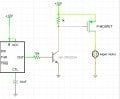
A wiper motor is usually protected by a 20A to 30A fuse so I am guessing they will draw more than the 200 mA that a 555 timer can output. Add a 2N2222A with emitter connected to ground and a heavy duty MOSFET as a high-side switch.

A770EDEA-2504-49BD-A59D-04B1DA42607C.jpeg
 

Thread Starter

davidy

Joined Dec 20, 2017
7
This is getting complicateder and more complicateder! How about using the 555 output to trigger a simple 12VDC relay to pass the current? I still haven't found a 2K Ohm rheostat with a SPDT switch separate from the resistance part. Any suggestions there? Oh, and there is no external fuse to the motor; it has an internal circuit breaker.
 

GopherT

Joined Nov 23, 2012
8,009
This is getting complicateder and more complicateder! How about using the 555 output to trigger a simple 12VDC relay to pass the current? I still haven't found a 2K Ohm rheostat with a SPDT switch separate from the resistance part. Any suggestions there? Oh, and there is no external fuse to the motor; it has an internal circuit breaker.
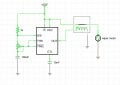
Yup, a 12V relay would be much easier.

5231FB46-1B47-454E-AA29-C8A8F9B9A4BD.jpeg

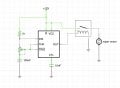
And off...

9C4D6CED-34F4-43AC-AAC7-8848874F7A51.jpeg
 
Last edited:

Alec_t

Joined Sep 17, 2013
15,105
Do the wipers have a self-park facility, i.e. do they return to the park position even if they are switched off mid-wipe?
 

eetech00

Joined Jun 8, 2013
4,704
hi

Also...It seems like using a rheostat to adjust the wiper delay would be a little cumbersome to use.
For example, there are certain settings you might like. How will you know at what position the setting is?
You could guess...but not as easy as remembering "oh its 3 clicks". Maybe a 10 position rotary switch
would be better to adjust the delay where fully turned to the left would be the "off" position.

eT
 

GopherT

Joined Nov 23, 2012
8,009
hi

Also...It seems like using a rheostat to adjust the wiper delay would be a little cumbersome to use.
For example, there are certain settings you might like. How will you know at what position the setting is?
You could guess...but not as easy as remembering "oh its 3 clicks". Maybe a 10 position rotary switch
would be better to adjust the delay where fully turned to the left would be the "off" position.

eT
I like the rheostat on my Honda. I would only need a favorite wiper position if it always rains at one of my favorite rates.
 
Top