Need clarity on TI's LM555 datasheet Usage of words on Trigger & Threshold

Thread Starter

kaviyarasu34

Joined Oct 16, 2024
6
Good day . i am able to understand 555 . However . while reading datasheet of lm555. they gave pin description of Trigger & Threshold like this,
Trigger- Responsible for ! transition of the flip-flop from set to reset !. The output of the timer depends I on the amplitude of the external trigger pulse applied to this pin.Threshold-Compares the voltage applied to the terminal with a reference voltage of 2/3 Vcc. The I amplitude of voltage applied to this terminal is ! responsible for the set state of the flip-flop! .
In what aspect they are mentioning "Responsible for transition of the flip-flop from set to reset" for trigger & " responsible for the set state of the flip-flop " for threshold. Need some clarity on these words.
 

crutschow

Joined Mar 14, 2008
38,316
Yes, that wording is rather confusing.
Perhaps this will help:
  • It is a level-triggered latch (flip-flop) with an added DIScharge output to reset the timing capacitor.
  • When the TRIG voltage goes below 1/3 Vcc, the latch is set (OUT high and DIS open).
  • If the TRIG voltage is back above 1/3 Vcc, then when the THRS voltage goes above 2/3 Vcc, the latch is reset (OUT low, and DIS connected to ground to discharge the timing capacitor).
  • It stays low until a low on the TRIG input again sets the latch (if the THRS voltage is below 2/3 Vcc).
 
Last edited:

AnalogKid

Joined Aug 1, 2013
12,043
I don't know which datasheet version you have, so please post a link to it.

I went to the TI website for the latest datasheet. WOW, what a mess! It's not until paragraph 7.4 that the errors stop. Coincidentally, this is where it starts copying the National Semiconductor datasheet.

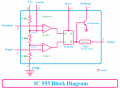
The block diagram on page 8 is missing a critical connection. Also, without polarity indicators on the comparators and Set and Reset labels on the flipflop it is just about useless.

And, the text you quoted is incorrect. The Trigger input Sets the flipflop, and the Threshold input Resets it.

Here is a decent 555 block diagram. The heart of a 555 is a Set-Reset flipflop and two comparators, one for each input. The flipflop Set comparator is driven by the Trigger input, and the Reset comparator is driven by the threshold input.

Standard astable operation, Trigger and Threshold inputs connected together: When the Trigger input goes below 1/3Vcc, the comparator output goes high, which Sets the flipflop, which drives the Q- signal low. The output stage is inverting, do the device output goes high. When the Threshold input goes above 2/3Vcc, its comparator's output goes high and resets the flipflop. This drives the Q- signal high, which drives the device output low. The Q- signal also turns on the discharge transistor, which starts to discharge the timing capacitor.

From the point of view of the pins, not internal structures, the 555 is a Set-Reset flipflop with an inverted Set input. Pulling Trigger low drives the output high, and pulling Threshold high drives the output low. Note that the Reset input is shown as a direct connection to the flipflop innards, bypassing and overriding the Trigger and Threshold inputs. This is incorrect. The Reset input goes into the output driver circuit, overriding the signal from the flipflop and forcing the output to a low state.

ak


1729131465543.png
 
Last edited:

MrAl

Joined Jun 17, 2014
13,667
Good day . i am able to understand 555 . However . while reading datasheet of lm555. they gave pin description of Trigger & Threshold like this,

In what aspect they are mentioning "Responsible for transition of the flip-flop from set to reset" for trigger & " responsible for the set state of the flip-flop " for threshold. Need some clarity on these words.
As you can now see, the internal diagram makes a complete analysis possible. If you would like to see an analysis, show the connections you would like to use and we can do a quick analysis. That will tell you exactly how it will work. If you don't have the connections but know what mode you want to use the 555 in, you can mention that and we could proceed with the analysis.
It's not that hard to do it is just about charging and discharging a capacitor usually between two voltage levels. For example, in the multivibrator mode it charges from Vcc/3 to 2*Vcc/3 volts, so if powered from 6vdc the cap would charge from 2 volts to 4 volts and discharge from 4 volts to 2 volts, then repeat that entire charge/discharge cycle. If powered from 12vdc the cap would charge and discharge between 4 volts and 8 volts.

There are some unwritten notes though too. Some 555's have a maximum capacitor value but I do not think that is written down anywhere. If you use a large cap value and it does not work, you can try a smaller value just to test for this. In that case if you want to use the large value cap then you can place a resistor in series with the discharge pin and try that. The resistor might be 10 to 100 Ohms, and it will change the timing somewhat.
 
Top