Yes, I already ordered the 74HC14 from Mouser. Let's see if that makes a difference. Thanks.Using a 74HC14 instead of an '04 would be a good start - the circuit specifies a schmitt trigger device for a good reason.
I'm using a 0.1uF cap close to Vcc as recommended by the inverter datasheet.What type of bypass capacitors are you using for each chip (as close as possible to each chips VCC and GND pins) on that plug-in breadboard?
Good video. Thanks for sharing.Solderless spring contact boards are one thing, but there are MANY other ways to prototype circuits that perform as well as a PCB.
the Schmitt (although the 74HC14 has a narrow hysterresis of 0.4V if i remember right) is good if the X-tal is already "Energized" . . . while - if you consider not overdriving your X-tal the the single-gate CMOS inverter or some dedicated comparator may perform better for startupYes, I already ordered the 74HC14 from Mouser. Let's see if that makes a difference. Thanks.
Dead bug and Manhattan architecturePaying for a PCB board that I don't even know if it's going to work is tough. How would you test this circuit without a breadboard?
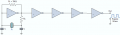
Consider using an unbuffered gate in the oscillator stage. Buffered or Schmitt trigger gates are good for signal conditioning.I've struggling trying to get a 10MHz square wave generator circuit to work. I'm using the circuit below with a 10MHz crystal and the SN74HC04 hex inverter. I'm powering the inverter with 5V.
Improve your probing technique. No way to get 9Vpp from an inverter you are supplying with 5V.The problem I'm having is that I get a sine wave in the output instead of a square wave. I get a sine wave of 10MHz, 9V peak to peak and about 3.2V RMS. What am I doing wrong here?
It looks ugly, but it works.
I'm using 5V. Yes, I have a similar oscillator to the one you posted as a backup option. My oscillator is working.What voltage are you running the IC at ?
These things are not that fast, the output has a long rise / fall time. Im betting you have 9v Vcc,
if so drop that to 5v or even 3v3 might help.
Rule of thumb of oscillators , they dont oscillate, at least yours does,
BTW: You know you can purchase a 10 Mhz oscillator "chip" for a few dollars,
put in 5v, it outputs the square wave
e.g.
https://www.digikey.co.uk/en/products/detail/nextgen-components/RA10M00000L100/14301765
Yes, look at my picture in post #12. I don't know why I'm getting 9V peak to peak. I have to research this.Consider using an unbuffered gate in the oscillator stage. Buffered or Schmitt trigger gates are good for signal conditioning.
74LVC1404 (TI) or 74LVC1GX04 (TI, NXP) have all that in one package.
Improve your probing technique. No way to get 9Vpp from an inverter you are supplying with 5V.
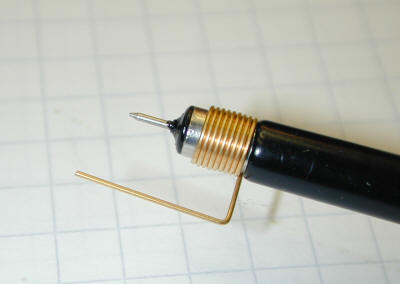
Are you sure the scope probe is on 10x?Yes, look at my picture in post #12. I don't know why I'm getting 9V peak to peak. I have to research this.
I think that the way I'm measuring 10MHz signals with my oscilloscope might be the issue. Just for testing, I put a signal generator with a 1MHz square wave as an input and it looked cleaned in my oscilloscope. When I increased the frequency the square wave started to look more sinusoidal.
http://beckelec.com/john-vig-crystal-tutorial.pdf#page=147... if you consider not overdriving your X-tal ...
The mentioned pic in #12 shows the voltage at the input of the scope and not what the waveform really looks like at the output of the inverter.Yes, look at my picture in post #12. I don't know why I'm getting 9V peak to peak. I have to research this.