Need a 10 MHz Circuit

Thread Starter

PIC-User

Joined Sep 25, 2015
104
I've struggling trying to get a 10MHz square wave generator circuit to work. I'm using the circuit below with a 10MHz crystal and the SN74HC04 hex inverter. I'm powering the inverter with 5V.

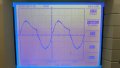
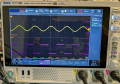
The problem I'm having is that I get a sine wave in the output instead of a square wave. I get a sine wave of 10MHz, 9V peak to peak and about 3.2V RMS. What am I doing wrong here? How do I get the square wave I want? Thanks in advance.
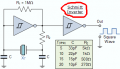
SquareWave.png
 

MrChips

Joined Oct 2, 2009
34,626
What is the make and model of your oscilloscope and its bandwidth?
What type of probe are you using on the oscilloscope?
SN74HC04 is not a Schmitt-Trigger inverter.
 

Thread Starter

PIC-User

Joined Sep 25, 2015
104
What is the make and model of your oscilloscope and its bandwidth?
What type of probe are you using on the oscilloscope?
SN74HC04 is not a Schmitt-Trigger inverter.
I have a EZ oscilloscope that can go up to 150MHz. I'm using the coax connector that came with it. Do you think that using the Schmitt-Trigger inverter makes a difference here?
 

Thread Starter

PIC-User

Joined Sep 25, 2015
104
A coax cable will have way too much capacitance at 10MHz.
You need a 10:1 oscilloscope probe.
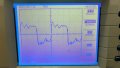
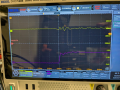
Using the 10:1 probe, the signal looks more square but it has a lot of noise, harmonics. I'm thinking about ordering the Schmitt trigger inverter. What is better for this application, a Schmitt trigger inverter or a LT1719 comparator? I have a module that I'm trying to make it work and it needs a square wave clock input of at least 10MHz.
 

WBahn

Joined Mar 31, 2012
32,702
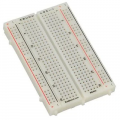
Getting circuits to work at 10 MHz on a solderless breadboard is not at all easy -- it can be done, I know someone that was somewhat notorious for getting a 20 MHz function generator to work on a set of solderless breadboards, but he most definitely knew what he was doing and he went to some rather extreme and ridiculous lengths to get it to work, primarily for the bragging rights of having done it.

A good rule of thumb is to abandon solderless breadboards once you are trying to work with frequencies above 1 MHz, particularly for analog circuits, and expect significant distortion in higher frequency digital signals due to corruption of the harmonics.
 

Thread Starter

PIC-User

Joined Sep 25, 2015
104
Getting circuits to work at 10 MHz on a solderless breadboard is not at all easy -- it can be done, I know someone that was somewhat notorious for getting a 20 MHz function generator to work on a set of solderless breadboards, but he most definitely knew what he was doing and he went to some rather extreme and ridiculous lengths to get it to work, primarily for the bragging rights of having done it.

A good rule of thumb is to abandon solderless breadboards once you are trying to work with frequencies above 1 MHz, particularly for analog circuits, and expect significant distortion in higher frequency digital signals due to corruption of the harmonics.
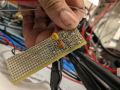
Paying for a PCB board that I don't even know if it's going to work is tough. How would you test this circuit without a breadboard?
 

Sensacell

Joined Jun 19, 2012
3,767
Solderless spring contact boards are one thing, but there are MANY other ways to prototype circuits that perform as well as a PCB.


nsaspook

Joined Aug 27, 2009
16,249
Nice! Thank you for sharing. Do you think the Schmitt trigger inverter will make a difference? Is the LT1719 comparator a better option?
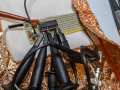
What type of bypass capacitors are you using for each chip (as close as possible to each chips VCC and GND pins) on that plug-in breadboard?
 
Top