Need Help in LC and diode circuit

Thread Starter

Vihaan@123

Joined Oct 7, 2025
223
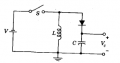
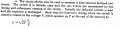
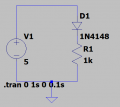
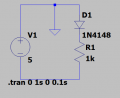
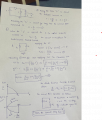
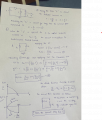
The below is the circuit
1765171111722.png

1765171185352.png
Few questions keep coming up is when i consider ideal diode or when it is not mentioned and if anode and cathode are at the same voltages as in the case above shall i consider it is forward biased or reverse biased?
Is there any step-by-step procedure to analyze any circuit or randomly we have to think?
In the above circuit the Anode is at ground voltage and the cathode also at ground voltage so i assume the diode as reverse biased, is it correct?
In that case one side of the capacitor is open circuited and capacitor voltage shall not increase, or shall i consider very high reverse diode resistance and apply Laplace transform? I am really failing to analyze the above circuit.

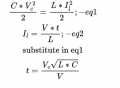
For inductor is
V = L*di/dt -> I = V*t/L -> (1)
 

WBahn

Joined Mar 31, 2012
32,737
You are way overthinking it.

Hint: The key is applying the conservation of energy.

If you are treating the diode as ideal, then how much power does it dissipate?

If none, then were does all of the energy delivered by the voltage source have to end up?
 

Thread Starter

Vihaan@123

Joined Oct 7, 2025
223
1765174079765.png
Yes by applying energy equation i could get the answer, thank you for the hint and guidance.
Few questions are i have to apply the energy equation when the switch is opened or at what instance i can apply the equation?
During the switch closed condition my assumption that the diode is open is it correct and i assume that small current flows to charge the capacitor?
 

WBahn

Joined Mar 31, 2012
32,737
View attachment 360172
Yes by applying energy equation i could get the answer, thank you for the hint and guidance.
Few questions are i have to apply the energy equation when the switch is opened or at what instance i can apply the equation?
During the switch closed condition my assumption that the diode is open is it correct and i assume that small current flows to charge the capacitor?
You should be able to answer these questions for yourself, and it seems like you are heading in the right direction.

At what instant in time do those equations apply? That's when you apply them.

How much current flows through an ideal diode when it is reverse-biased?

Is the diode reverse biased while the switch is closed?
 

Thread Starter

Vihaan@123

Joined Oct 7, 2025
223
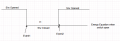
I understood when energy equation to be applied after time t1 and when the switch is opened the energy will be stored in inductor and capacitor.
1765176738179.png

Is the diode reverse biased while the switch is closed?
I think there is some mistake in the circuit diagram in the way it is represented, should the polarity of the power supply be reversed?
1765176989915.png

How much current flows through an ideal diode when it is reverse-biased?
When the diode is reverse biased the current flow will be 0.
 

Thread Starter

Vihaan@123

Joined Oct 7, 2025
223
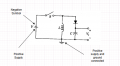
My standard way of representing the circuit is
1765179049461.png
where the negative of power supply always matches with the ground symbol. But i tried representing different way
1765179189263.png

the circuit behaviour that is the current direction is the same. Finally both the circuits are same.
 

WBahn

Joined Mar 31, 2012
32,737
The ground simply merely identifies which node you happen to declare as being at 0 V. It is an arbitrary choice.

But the polarity of the source, with respect to the diode, matters a LOT. It is NOT arbitrary.
 

MrAl

Joined Jun 17, 2014
13,673
You are way overthinking it.

Hint: The key is applying the conservation of energy.

If you are treating the diode as ideal, then how much power does it dissipate?

If none, then were does all of the energy delivered by the voltage source have to end up?
Hi there,

Although that might be true, it completely bypasses the understanding of this circuit.

To understand the circuit, we have to do an actual circuit analysis. That means knowing what is happening as far as current and voltage, and also when the diode turns 'on' if it does turn on, and when it turns 'off' if in fact it does turn off.

If we don't know that, we won't be able to analyze some future circuits where we can't just throw a physical law at it and hope for the best :)

As it stands, he still does not know how the circuit itself actually works. I mention this because it's got a very interesting way to it that we don't usually see in regular diode circuits. The underlying principle of the circuit operation is very interesting, and highlights how some diode circuits work.

I think the idea of knowing the law is good, but we should also go over the circuit operation itself as well. It's not that difficult and it leads to a very fascinating idea that should help with a LOT of future diode circuits. I'll add some notes also.
 

MrAl

Joined Jun 17, 2014
13,673
The below is the circuit
View attachment 360170

View attachment 360171
Few questions keep coming up is when i consider ideal diode or when it is not mentioned and if anode and cathode are at the same voltages as in the case above shall i consider it is forward biased or reverse biased?
Is there any step-by-step procedure to analyze any circuit or randomly we have to think?
In the above circuit the Anode is at ground voltage and the cathode also at ground voltage so i assume the diode as reverse biased, is it correct?
In that case one side of the capacitor is open circuited and capacitor voltage shall not increase, or shall i consider very high reverse diode resistance and apply Laplace transform? I am really failing to analyze the above circuit.

For inductor is
V = L*di/dt -> I = V*t/L -> (1)
Hi,

First, usually we consider an ideal diode to be a short when forward biased and an open circuit when reverse biased. This sometimes leads to your question of what happens when both the anode and the cathode are the same exact voltage with no difference whatsoever.
The answer is if we know the voltage on both the anode and the cathode and the two are exactly the same, then it is either conducting or not conducting, depending on what happens just before that. It could be just starting to conduct or just starting to stop conducting.
In the case of a rising voltage on the anode, it will probably start to conduct at some point, and that is when the anode becomes equal to the cathode voltage. In the case of a falling voltage on the anode, it will probably stop conducting at some point, and that is when the anode becomes equal to the cathode voltage also.
In the case of a current that is known to establish itself in the right direction, the diode conducts. In the case when the current might look reversed, it won't conduct as long as there is something else in the circuit that can pass the current. If there is nothing else to pass the current, then the diode would conduct in reverse, but that's probably not something that we will see. Remember here that we are now talking about a current that is known or believed to have been already established, and that would include an inductor current.

So with a diode you have to sort of weight out the factors that might make it conduct and what might make it not conduct. That usually comes from knowing the voltages or how they change, or the current that is believed to have been already established. We can look at some examples.

As far as analyzing this and other circuits like this, the conservation laws should help you verify your solution, but as far as circuit analysis goes, you still have to analyze it and figure out when the diode conducts if it does, and when it does not conduct if it does not. That way you can come up with a solid circuit analysis which will help a LOT with future diode circuits.

To start, you know already that the current through the inductor builds:
V=L*di/dt

and solving that for di. That's a start, and a hint for this analysis is that this would be considered a step change when the switch is opened, and that is the initial current in the inductor when the switch is first opened.

Now see if you can do the analysis from there. I'm pretty sure you can, but it might be a little tricky trying to figure this out in its entirety because of the diode, and the diode is a very important feature of this circuit. Knowing how that operates is tantamount to understanding these kinds of circuits in the future. You will be surprised, I think.
 

Thread Starter

Vihaan@123

Joined Oct 7, 2025
223
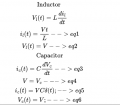
When i analysed during the time when switch is closed, i have the following equations for capacitor and inductor

1765259613584.png
The inductor equations are correct as already confirmed, but are the capacitor equations correct? what i observe is that the voltage is directly applied across the capacitor and hence its voltage shall be V but not instantaneously. There is a spike in the capacitor current when switch is closed. What mistake i am doing writing capacitor equations?
 

WBahn

Joined Mar 31, 2012
32,737
When i analysed during the time when switch is closed, i have the following equations for capacitor and inductor

View attachment 360253
The inductor equations are correct as already confirmed, but are the capacitor equations correct? what i observe is that the voltage is directly applied across the capacitor and hence its voltage shall be V but not instantaneously. There is a spike in the capacitor current when switch is closed. What mistake i am doing writing capacitor equations?
In order for the capacitor voltage to change, current had to flow through it, right?

But how can current flow through it when you've already established that the diode is reverse biased and have asserted that no current flows in an ideal reverse-biased diode.
 

Thread Starter

Vihaan@123

Joined Oct 7, 2025
223
In order for the capacitor voltage to change, current had to flow through it, right?

But how can current flow through it when you've already established that the diode is reverse biased and have asserted that no current flows in an ideal reverse-biased diode.
Yes i am sorry i got confused.
 

Thread Starter

Vihaan@123

Joined Oct 7, 2025
223
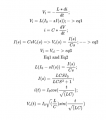
Calculated the inductor current and capacitor voltage
1765269170081.png


I0 assumed as the initial Inductor current when the switch opened, i think I0 depends on how long the switch closed.
 

WBahn

Joined Mar 31, 2012
32,737
Calculated the inductor current and capacitor voltage
View attachment 360274


I0 assumed as the initial Inductor current when the switch opened, i think I0 depends on how long the switch closed.
Ask yourself if these results make sense.

You say that this is the inductor current and capacitor voltage, yet your third equation is for the capacitor current. Since the inductor and capacitor are not in series (all the time), they aren't the same thing.

You are brute forcing the blind application of Laplace transforms to a nonlinear circuit whose topology changes with time, when Laplace transforms, in their general form, are only valid for linear time-invariant systems.

You know that current in an inductor can't change instantly, yet you having it go from zero to Io instantly at t=0.

What is Io, anyway. You never define it. It would need to be identically zero in order to satisfy the conservation of energy continuity requirements for the inductor, but then that would say that the current in the inductor is always zero, which makes no sense, either.

You have the voltage in the capacitor being sinusoidal, which means that current in it is reversing direction periodically. Yet we have established, repeatedly, that the diode will prevent current from flowing in one of those directions.

You need to stop just throwing equations at circuits and hoping that something sticks.

This is effectively four different circuits, depending on if the switch is closed and whether the diode is forward or reverse biased. Each of these four circuits are individually linear, which means that you can apply Laplace transforms to them. But the results only apply as long as that circuit exists. Each time the circuit changes -- when the state of either the switch or the diode changes -- you need to stop. Determine the final conditions just before the change. Then determine the initial conditions just after the change based on continuity constraints. Then continue the analysis in the next segment using the new circuit model.
 

MrAl

Joined Jun 17, 2014
13,673
Calculated the inductor current and capacitor voltage
View attachment 360274


I0 assumed as the initial Inductor current when the switch opened, i think I0 depends on how long the switch closed.

Hello again,

These notes and questions were designed to help you understand this circuit fully so you can go on to do other circuits with ease.

It looks like you are on the right track, but you still need to define I0 in your last expression.
What do you get after you define I0 and replace it in your last expression?

Also, after you do that, you have to figure out how they had arrived at the last expression they gave. This might be a little tricky but not too difficult I don't think.

A couple of equations now because you are just showing expressions without any explanation as to why you are using those expressions.

1. Do you see now when the diode turns on and when it turns off, if it actually does either of those, or can you at least imagine when the diode should turn on or off?
2. Can you see that the topology changes from a one-element storage element L to a system of both L and C?

This is a third question which you might be interested in to simplify the writing of the equations, and don't worry about this one too much just yet:
3. Did you ever hear of an "initial condition generator" used in circuit analysis?
 

MrAl

Joined Jun 17, 2014
13,673
Ask yourself if these results make sense.

You say that this is the inductor current and capacitor voltage, yet your third equation is for the capacitor current. Since the inductor and capacitor are not in series (all the time), they aren't the same thing.

You are brute forcing the blind application of Laplace transforms to a nonlinear circuit whose topology changes with time, when Laplace transforms, in their general form, are only valid for linear time-invariant systems.

You know that current in an inductor can't change instantly, yet you having it go from zero to Io instantly at t=0.

What is Io, anyway. You never define it. It would need to be identically zero in order to satisfy the conservation of energy continuity requirements for the inductor, but then that would say that the current in the inductor is always zero, which makes no sense, either.

You have the voltage in the capacitor being sinusoidal, which means that current in it is reversing direction periodically. Yet we have established, repeatedly, that the diode will prevent current from flowing in one of those directions.

You need to stop just throwing equations at circuits and hoping that something sticks.

This is effectively four different circuits, depending on if the switch is closed and whether the diode is forward or reverse biased. Each of these four circuits are individually linear, which means that you can apply Laplace transforms to them. But the results only apply as long as that circuit exists. Each time the circuit changes -- when the state of either the switch or the diode changes -- you need to stop. Determine the final conditions just before the change. Then determine the initial conditions just after the change based on continuity constraints. Then continue the analysis in the next segment using the new circuit model.
Hi,

I am not sure why you keep stressing the fact that Laplace Transforms are for linear circuits. In many circuits that change topology, the two or more resulting topologies are in fact linear, and so Laplace Transforms lend themselves to that kind of use as well. The entire circuit may be extremely nonlinear, but the individual circuits are still linear.

There are also advanced methods for handling general nonlinear circuits using Laplace Transforms, but I don't find them too useful for what I usually do anyway. These methods would be outlined in books dedicated to the analysis of nonlinear circuits.
 

WBahn

Joined Mar 31, 2012
32,737
I am not sure why you keep stressing the fact that Laplace Transforms are for linear circuits.
Perhaps because people keep blindly applying them to non-linear circuits in ways that are completely invalid????

In many circuits that change topology, the two or more resulting topologies are in fact linear, and so Laplace Transforms lend themselves to that kind of use as well. The entire circuit may be extremely nonlinear, but the individual circuits are still linear.
Gee, that thought never entered my mind as I wrote the last paragraph you quoted.
 

Thread Starter

Vihaan@123

Joined Oct 7, 2025
223
Sorry for the last post which was done in hurry assuming that the circuit is solved, spent time to understand the circuit for the past 2 days, came up with some solution but have few doubts and still not sure if the analysis is complete. Please find attached the work.

1765431793355.png
 

Attachments

WBahn

Joined Mar 31, 2012
32,737
You've started off on the wrong foot right out of the gate.

The problem states that the whole point of the circuit is to determine how long the switch was closed. Yet your starting assumption is that the switch is closed for so long that everything has settled to some steady state, meaning that you can no longer determine anything about when the switch was closed beyond "a really long time ago".

The you say that it has been closed for so long that the current 'saturates' as a value of

I = V/L

You know that this equation is meaningless because the units don't work out.

V has units of volts and L has units of henries, which reduce to ohm-seconds. So if you divide former by the latter you get something with the units of amps/second on the right-hand side, which is not compatible with current.

The first phase of the circuit operation starts when the switch is closed under the given initial conditions of no current in the inductor and no voltage on the capacitor.

What is the relationship between the voltage across an inductor and the current through it?

Given that relationship and the circuit configuration in the first phase of operation, what is the current in the inductor just before the switch is opened at time T?
 
Top