Need 1V for reference

tindel

Joined Sep 16, 2012
939
@BobTPH I actually tried the voltage divider way earlier, and it works. In fact I tried a higher reference also, that works too (only the baseline Vout shifts to a higher voltage, which is not a problem in my application). The max current drawn by the sensor is 100uA. I was just curious that if getting a reference is as easy as a voltage divider, why do things like the ICs mentioned above by other contributors exist? Do they have some added benefit which I don't know? (There's actually a lot I don't know, I'm Jon Snow after all). Should I expect any problems with the voltage divider way or the higher reference way if ambient temperature changes between summers and winters (change of maybe 30 degrees Celsius)? Or some other hidden pitfalls?
View attachment 301462
In general, you want to have a stable reference voltage over time and temperature if you're measuring a wheatstone bridge. A resistor divider will drift a lot with time and temperature.

Things you have to ask yourself when determining your reference voltage.
- What is the reference voltage of my ADC?
- What is half the reference voltage of my ADC?
- How much gain does my Amplifier Circuit need to get the best signal to noise ratio?
- What is the maximum deflection I expect on the bridge.
- Is a gain of 10 in the amplifier adequate?

This assumes that your 'Amplifier Circuit Unit' is a single device and not discrete resistors - because then you'll have the same problem with those resistors. Note also that the values of R1, R2, and R3 will change with temperature too (as will the bridge resistors itself!). Something else you might need to account for as you learn more.

Getting the circuit to 'basically' work is a lot different than getting it working in a safety critical application. A good analog engineer might take a few weeks to design this circuit for safety critical application going over hundreds of spec sheets and optimizing each little neuance of the circuit.

All that to say - what are your specs?

I'm a fan of building things and learning what the specs need to be at a rapid rate too. Just build it and see if works for you. I'm not seeing any obvious design flaws in the circuit.
 

MisterBill2

Joined Jan 23, 2018
27,540
In general, you want to have a stable reference voltage over time and temperature if you're measuring a wheatstone bridge. A resistor divider will drift a lot with time and temperature.

Things you have to ask yourself when determining your reference voltage.
- What is the reference voltage of my ADC?
- What is half the reference voltage of my ADC?
- How much gain does my Amplifier Circuit need to get the best signal to noise ratio?
- What is the maximum deflection I expect on the bridge.
- Is a gain of 10 in the amplifier adequate?

This assumes that your 'Amplifier Circuit Unit' is a single device and not discrete resistors - because then you'll have the same problem with those resistors. Note also that the values of R1, R2, and R3 will change with temperature too (as will the bridge resistors itself!). Something else you might need to account for as you learn more.

Getting the circuit to 'basically' work is a lot different than getting it working in a safety critical application. A good analog engineer might take a few weeks to design this circuit for safety critical application going over hundreds of spec sheets and optimizing each little neuance of the circuit.

All that to say - what are your specs?

I'm a fan of building things and learning what the specs need to be at a rapid rate too. Just build it and see if works for you. I'm not seeing any obvious design flaws in the circuit.
I have done quite a bit of interfacing with strain gage bridge transducers. Making a circuit "work" is not that difficult. and +/- 10% accuracy is not terribly difficult. Getting to +/-3% takes a fair amount of effort if that accracy needs to last a year and within a reasonable temperature range. Holding +/- 1% accuracy over the whole range for a year IS a BIG DEAL achievement that takes a lot more effort and more expensive parts. Not only does the amplifier gain and the offset need to be stable with time and temperature over the whole input range, but also the bridge supply voltage must be stable as well. And avoiding the problems is better than fixing them, usually.
Check out "Instrument Amplifiers" to see how some of the problems are avoided.
 

Thread Starter

JohnSnow16041992

Joined Jun 2, 2023
62
@tindel @MisterBill2 I didn't know resistances can change that much over time and temperature. I use the plain old carbon film resistors for everything, be digital signal projects or analog signal projects. I just checked on the net and they say that the values can drift by as much as 5-15% in just one year. I am just curious, not that any of my projects need it currently (I am not exactly building super computers right now, I think I can do with tolerance of 5-15% for my projects right now), but if the drift was to be kept minimum (for the resistors), what helps? Maybe Potting? Or must one use the super expensive Foil Resistors?
 
Last edited:

Janis59

Joined Aug 21, 2017
1,894
Something like TL431 or ADR510
Note the TLV431 have 1.25 V instead of TL431 having 2.5 V. Its more easy then.

However, the main point is not the 1 V but the demands for precizity. Best "letters" of 431 gives +/- 0.2% and 4 mV per centigrade. Its ultimate important to realize - do this is good or it is not good enough? Because exists also a bunch or more expensive ultra-high accuracy alternatives.
 

MisterBill2

Joined Jan 23, 2018
27,540
There are different resistor technologies that are more stable and some are less stable. Metal film resistors tend to be more stable, and those made to resist absorbing moisture are also more stable, in general.
 

Thread Starter

JohnSnow16041992

Joined Jun 2, 2023
62
So I was checking out few videos on TL431 (TLV431) to understand how to use it (how to wire it etc). Correct me if I got anything wrong. Basically this IC is a regulator which would regulate any reference voltage supplied, but we would still have to supply the reference voltage. Which means this is to be used in addition to the voltage divider way, only the output of the voltage divider has to afterwards go through this IC. But if the output of the voltage divider changes with time (that 5-15 % resistor drift discussion we had above), the output of the TL431 would change also? Only it would be more stable?

And what do we mean by stable, does it mean low fluctuations, low noise?

One more thing, since this can regulate up to 40V, can it be used to regulate 5V power supply at 100mA drawn? Datasheet says its cathode is fit for up to 150mA.
 

Thread Starter

JohnSnow16041992

Joined Jun 2, 2023
62
No. It's internal to the IC. Either 2.5V for the TL431 or 1.25V for the TLV431 (as per post #24).
Ok, so the anode to GND, and basically any voltage connected to Vref Pin of TL431 through any resistor (say 1K) and it would give out 2.5V through its cathode? Is that it?
 

Thread Starter

JohnSnow16041992

Joined Jun 2, 2023
62
Yes. There are some example circuits in the datasheet.
Just to know, what is the role of the 1K resistor? is it a current limiting resistor? Someone said current should not be more than 100mA, so what's the math? If Vref is 12V, how to know resistor value? Also, the datasheet said cathode can handle as much as 150mA, so up to 150mA 2.5V we can even use this IC is a power regulator?
 
Last edited:

Thread Starter

JohnSnow16041992

Joined Jun 2, 2023
62
In which schematic?
Section 9.3 of the datasheet describes the IC's operation.
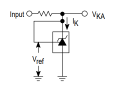
This schematic
1693414357785.png

Its a bloody big datasheet and I am not very skilled at deciphering these texts. This above is supposed to be the circuit for the stable reference voltage. Input can be anywhere between Vref and 33V. Correct me if I am wrong. I am guessing the current drawn [which is not to be exceeded by 150mA (or 100mA by TI datasheet)] is decided at the point Vka by the sensor circuit which is using the reference Voltage Vka? That means if the current drawn is 100mA, and if the resistor shown in the schematic is 1K Ohm, then the voltage drop just after the resistor would be 1000 X 0.1 = 100V? That seems too large. I am not getting this. What is the role of this resistor? How to calculate its value?
 
Last edited:

Veracohr

Joined Jan 3, 2011
783
TL431 is not meant to power anything so I wouldn’t recommend trying to use it to supply 100mA.

First figure out how much current you need to supply. You mentioned 100uA earlier so use that as an example. Then see what the minimum current the TL431 needs (1mA worst case). Then choose some margin over the minimum current, say 0.5mA. So the cathode resistor needs to carry 100uA + 1mA + 0.5mA= 1.6mA minimum to maintain regulation and provide the current necessary for your application.

If your power source is 5V, calculate the maximum resistor value as (5V-1.25V)/1.6mA. You can use a lower resistor value and the TL431 will sink the extra current. But it’s not a good idea to try to run any part near its maximums.
 

MisterBill2

Joined Jan 23, 2018
27,540
So I was checking out few videos on TL431 (TLV431) to understand how to use it (how to wire it etc). Correct me if I got anything wrong. Basically this IC is a regulator which would regulate any reference voltage supplied, but we would still have to supply the reference voltage. Which means this is to be used in addition to the voltage divider way, only the output of the voltage divider has to afterwards go through this IC. But if the output of the voltage divider changes with time (that 5-15 % resistor drift discussion we had above), the output of the TL431 would change also? Only it would be more stable?

And what do we mean by stable, does it mean low fluctuations, low noise?

One more thing, since this can regulate up to 40V, can it be used to regulate 5V power supply at 100mA drawn? Datasheet says its cathode is fit for up to 150mA.
What "stable" means relative to a reference voltage source device is that it does not change, neither drifting nor flickering noise. And no drift means that the 1.5 volts will not vary over time or temperature, as described in the data sheet, which contains a lot of useful information.
 

crutschow

Joined Mar 14, 2008
38,516
What is the role of this resistor? How to calculate its value?
Typically you want the current through the reference to be just a little above the minimum required for regulation to minimize power (1mA below for the TL431), so design for about 2mA minimum current through the TL431 for margin.

So the resistor needs to supply that 2mA plus any load current (call the sum Itotal = 2mA + Iload).
Since the nominal regulated voltage for the TL431 is 2.5V, the resistor value is then selected to provide that total current or R = (Vinput-2.5V) / Itotal.

Make sense?

1693416112016.png
 
Top