Need 1V for reference

DickCappels

Joined Aug 21, 2008
10,661
Something like @Alec_t suggested. If you need high precision or extremely low drift that can be arranged but it would be a little more trouble.

Let us know what you need in more detail.
 

DickCappels

Joined Aug 21, 2008
10,661
It depends upon your application,but the temperature coefficient might be important. A few years back I used a TL431 but after the air conditioner came on and the voltage drifted off scale, I figured 50 pp/°C was pretty loose.
 

xox

Joined Sep 8, 2017
936
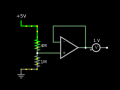
What about a simple voltage follower?

vref.png

Just an op-amp in the single-supply configuration and a few of resistors. I can't imagine it would be much sensitive to temperature changes either, and practically zero current draw.
 

AnalogKid

Joined Aug 1, 2013
12,049
An opamp's input offset voltage error usually has a temperature component, which might be a problem. And with such large resistor values, input bias current comes into play. That can be partially fixed with a resistor in the voltage follower feedback loop.

Of course, it would help if we had any kind of useful information from the TS.

ak
 

BobTPH

Joined Jun 5, 2013
11,465
Unless the reference draws significant current, there is no need to buffer it. How much current is required for the reference input?
 
Last edited:

Pyrex

Joined Feb 16, 2022
501
It depends upon your application,but the temperature coefficient might be important. A few years back I used a TL431 but after the air conditioner came on and the voltage drifted off scale, I figured 50 pp/°C was pretty loose.
Not good.
Can you recommend other type , not very expensive
 

DickCappels

Joined Aug 21, 2008
10,661
You need to determine the tolerance and temperature coefficient necessary for your application. I just wanted to consistently hit 10.000 volts ±500 uV using the LM4140. See attachment. The TL431 is a very "ok" reference for many things.
 

Attachments

MisterBill2

Joined Jan 23, 2018
27,187
Post #15 asks half of the needed information. The accuracy required and also how much current is required That is in addition to the stability and temperature effect voltage change.
Also, what external voltages are available, if any?
Two forward biased schottky diodes should come close, but I can't immediately predict the stability with temperature change.
 

xox

Joined Sep 8, 2017
936
An opamp's input offset voltage error usually has a temperature component, which might be a problem. And with such large resistor values, input bias current comes into play. That can be partially fixed with a resistor in the voltage follower feedback loop.
The cumulative error of the circuit posted would likely be significantly less than a millivolt. I've used similar for applications which have required exposure to some pretty extreme weather conditions without any issues to speak of.
 

AnalogKid

Joined Aug 1, 2013
12,049
+/-1% tolerance resistors would yield an error band of -15.9 mV to +16.1 mV. This is independent of the offset and bias errors.

ak
 

Thread Starter

JohnSnow16041992

Joined Jun 2, 2023
62
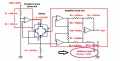
@BobTPH I actually tried the voltage divider way earlier, and it works. In fact I tried a higher reference also, that works too (only the baseline Vout shifts to a higher voltage, which is not a problem in my application). The max current drawn by the sensor is 100uA. I was just curious that if getting a reference is as easy as a voltage divider, why do things like the ICs mentioned above by other contributors exist? Do they have some added benefit which I don't know? (There's actually a lot I don't know, I'm Jon Snow after all). Should I expect any problems with the voltage divider way or the higher reference way if ambient temperature changes between summers and winters (change of maybe 30 degrees Celsius)? Or some other hidden pitfalls?
1693200653892.png
 
Last edited:

MisterBill2

Joined Jan 23, 2018
27,187
There are two primary reasons for seeking a stable reference source, which are accuracy and stability of whatever is using that reference. For the circuit shown in post #19, the reference voltage as a large effect on the output voltage, and thus the indicated value of whatever the strain gage sensor is monitoring.
In very loose (low accuracy) systems the limits on drift and error are +/- 3%, while tighter tolerance applications limit the allowable error to 1% off actual value.
The reference voltage is one of the easier potential sources of error to control, and so there is great motivation to have the reference voltage be "totally stable", or at least as stable and accurate as is economicaly possible.
The value of a voltage divider output depends on both the input voltage and the external load current, so the stability and accuracy is no better than those variables. THAT is why the much more complex reference voltage sources are used.
 
Top