NE555 SMPS, Will this work?

Thread Starter

Gilbert Velez 1

Joined Feb 9, 2017
18
I'm currently learning EE and I've been experimenting with low voltage DC-DC converters. Now I want to build an offline DC-DC converter that plugs directly into the AC mains.

I've gone as far as designing the circuit for PFC and small flyback to power the primary for a half bridge topology. The schematic works very well in simulation, but being this converter draws its power directly from AC mains, I'd like some input from experienced users before I build this thing and test it in a real world scenario.

Will this work?
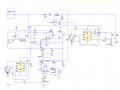
NE555_PFC.fw.png
 

Kermit2

Joined Feb 5, 2010
4,162
Put a fuse in the output line of your power supply while testing.

Replace with higher rated fuses after initial low power testing.

Use slow blo fuses to allow for startup inrush currents.

And always insist on "transformer isolation from mains voltage" for everything you say and do here.
 

ian field

Joined Oct 27, 2012
6,536
Why would anyone want to make a smpsu with a 555, when there are several dedicated chips for this purpose?!!!
There are dozens of proper job chips - the one I encountered more than all the others put together is the UC384x family.

There's a vast resource of example circuits in various schematics and service manual archives.

The one I'd avoid like the plague is the TDA460x family.
 

Thread Starter

Gilbert Velez 1

Joined Feb 9, 2017
18
Perhaps for the experience it would generate.
You've hit the nail on the head!

When I wanted to learn nodeJs, I wrote a full featured MVC framework with no external packages. Now that I want to learn EE, I've decided to take on an equally complex task using as few ICs("APIs") as possible. I come from a time when everything wasn't plug n' play (MS-DOS 3.11 days) so I like finding my own way to do things.

I started this project with a BJT Astable (lol) that operated directly from rectified mains using a resistive voltage divider to keep the voltage down. The oscillator worked, but it would have been very difficult to implement PFC in such a configuration so I chose to go the NE555 route.

BTW, the design above gets ridiculous current peaks so I've made revisions where PSU starts to boost stage gradually. Though figuring out how to control the PWM of the NE555 using that inverted 100Hz pulse was a lot of fun.
 

ian field

Joined Oct 27, 2012
6,536
I have KA3525As, FAN4800s, some newer resonant controllers from fairchild, a few from TI, ST and a bunch more I can't remember off the top of my head, Hi/Low side drivers, etc., and I could always follow instructions in datasheets to put them together and make em work to spec, but how much fun would that be?

Making something do what it's meant to do is easy. Bill Gates wrote an OS for a CPU designed to operate microwave ovens (8086), now we have microsoft and the device, and infrastructure that I'm using to reply to your post.
There's plenty to be learned from using those chips for their intended purpose - the text book method of 555 PWM is one as a monostable and one as variable frequency, as you increase the frequency; the fixed monostable pulse fills more of the total cycle time.
 

Thread Starter

Gilbert Velez 1

Joined Feb 9, 2017
18
IDK why everyone keeps slamming the NE555 for this application. No it's not the best chip to use in 2017, that's obvious. However it's a good general purpose oscillator with voltage controlled PWM along with RC timing control if you use a pot and a couple of 1N4148s with a pot, and with a little auxiliary circuitry, at least in simulation it seems to serve the purpose just fine.
 

Dodgydave

Joined Jun 22, 2012
11,395
I'm not knocking it for it's use as a led flasher, or buzzer, or egg timer, dc motor speed control, but it's not designed for high speed switching like in smpsu design.

Crack open any Smpsu, phone charger, Atx, TV, Dvd etc,,

Guess what NO 555 in sight!!

If you want simplicity and reliability you use use a deadicated chip....

Here is the simplest one Tny267/80 chip set..


https://www.google.co.uk/url?sa=t&s...ggtMAY&usg=AFQjCNHw1ktYamOZOgjOAQuTJP0KZt8JEw
 

Thread Starter

Gilbert Velez 1

Joined Feb 9, 2017
18
There's plenty to be learned from using those chips for their intended purpose - the text book method of 555 PWM is one as a monostable and one as variable frequency, as you increase the frequency; the fixed monostable pulse fills more of the total cycle time.
I totally agree,
As an Astable I believe they can oscillate at about 1MHz. I've used them extensively for low voltage applications, but I'm just using it as an astable to switch a couple of flyback topologies one offline and the other non-isolated for PFC and I'm probably going to add a tertiary NE555 and comparator for a buck module to regulate the output maintaining a constant 15V output.

This is just an experiment where I'm designing a stable, voltage mode, offline SMPS (The larger transformer and half bridge control circuitry is not included in the above schematics LTSpice has a fit) using BJTs, MOSFETs, OP-AMPs and NE555s. which should be totally possible. Then I'll build a textbook supply with the control chips I have and compare results,
 

Papabravo

Joined Feb 24, 2006
22,082
High speed Oscillation the NE555 does quite well. Stable up to about +/-1MHz (Most SMPS controllers top out at 630KHz I think), most of the designs I've seen operate at 100-250KHz and I have FAN4800 (CM6800) PFC/PWM and SG3525 (which has programmable soft start) controllers that are pretty much plug n play (done that already). I noticed that most PWM controllers aren't much different from the 555, it even has a shutdown pin (RESET). Add a comparator, current sense circuit and ideally a soft start you've got an SMPS controller.

Dude, I like making things do what they're not supposed to do. It's all about building on my problem solving abilities. Let's say I wanted to program an MCU (not an arduino) to control some power circuitry in some cool funky way that interacts with an app that I write. I'd have to do loads of funky cool programming and circuit design to get it to do what I want, right? How could I do that without learning how to do something as simple as making a voltage mode SMPS from a simple oscillator IC and a bunch of discreets?
The word that comes to mind is hubris. Just because a thing can be done does not necessarily mean that doing it is a good idea. If you want to do it then do it, and stop wasting our time trying to make everything look like a nail because the only tool you have is a hammer.
 

DickCappels

Joined Aug 21, 2008
10,661
Gilbert Valez1 is doing this to learn. He will have a much more insightful experience rolling his own with an NE555 than the would by just hooking a few passive components to a pre-packaged solution. With the experience gained he will be able to more expertly apply pre-rolled power supply solutions.

The power supply is not the objective, learning is.
 

Thread Starter

Gilbert Velez 1

Joined Feb 9, 2017
18
Gilbert Valez1 is doing this to learn. He will have a much more insightful experience rolling his own with an NE555 than the would by just hooking a few passive components to a pre-packaged solution. With the experience gained he will be able to more expertly apply pre-rolled power supply solutions.

The power supply is not the objective, learning is.
THIS GUY GETS ME!
Thank you very much.
 

ian field

Joined Oct 27, 2012
6,536
IDK why everyone keeps slamming the NE555 for this application. No it's not the best chip to use in 2017, that's obvious. However it's a good general purpose oscillator with voltage controlled PWM along with RC timing control if you use a pot and a couple of 1N4148s with a pot, and with a little auxiliary circuitry, at least in simulation it seems to serve the purpose just fine.
The method with steering diodes is difficult to design for anything other than an adjustment pot - most people use 2x 555 (or a 556) with a monostable driven by a VF oscillator.
 

Papabravo

Joined Feb 24, 2006
22,082
"Dude, I like making things do what they're not supposed to do."

That's all fine, but it is hard see the value in doing this for learning or any other purpose. Learn what you need to, but skip the self aggrandizement.
 

Thread Starter

Gilbert Velez 1

Joined Feb 9, 2017
18
The method with steering diodes is difficult to design for anything other than an adjustment pot - most people use 2x 555 (or a 556) with a monostable driven by a VF oscillator.
I Didn't know that. Thanks for that piece of information, I'll research play with that configuration.

In my application I just use the steering diodes to keep the duty cycle from being pushed beyond 75% by the control voltage in the boost circuit and at >50% on time in the flyback transformer.
 
Top