N-Fet driven using TTL

Thread Starter

cmartinez

Joined Jan 17, 2007
8,760
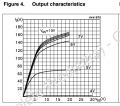
Can the STW75NF30 n-fet be safely driven with a 5V signal at its gate? Assuming it's on the low-side of the load, of course. Attached is its datasheet.

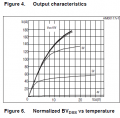
My guess is that it can, considering the following graph.
upload_2017-3-22_9-59-39.png

Specifically, my doubt is if it can safely handle a 20A load using just 5V to trigger it.
 

Attachments

crutschow

Joined Mar 14, 2008
38,503
You cannot use typical characteristics to guarantee a design will work.
You need to look at the Vgs used to specify the Rds(on) value.
 

dl324

Joined Mar 30, 2015
18,326
I say it can handle it. On resistance would be lower if you drove the gate harder but, with proper heat sinking, the device can handle 320W.

upload_2017-3-22_9-24-26.png

5V is the best case when driving from TTL.
 

Papabravo

Joined Feb 24, 2006
22,082
The real problem with plain TTL (74xx) is that an output is a very good current sink, but a really lousy current source. When you ask a TTL gate to source current, the maximum voltage at a given current may be as low as 2.0Volts. That is why TTL thresholds are set the way they are:
  1. A LOW is anything less than 0.8V
  2. A HIGH is anything greater than 2.0V
As always consult the individual datasheets for precise details. You would be much better off using a device from the HCT family. Those devices have TTL input thresholds and CMOS output characteristics. In particular they will source as much current as they can sink.
 
Last edited:

Jony130

Joined Feb 17, 2009
5,598
Vgs(th) - "gate threshold". This is the gate-source voltage where the MOSFET just starts to conduct (Id=250μA).
And as you can see the Vgs(th) spread is from 2V-->4V (at 250μA) this is why it is risky to use this MOSFET and driven it from TTL (Voh_min = 3.6V) and high load current.

But if you are gonna to build one or two prototype boards, then you can select the MOSFET with the lowest Vgs(th) on your benchtop. Or even checking Vds(on) at given load current.
 

dl324

Joined Mar 30, 2015
18,326
One way to get 5V on the gate of the MOSFET put a resistor between 5V and the gate and use the TTL gate to turn the MOSFET off.
 

Papabravo

Joined Feb 24, 2006
22,082
One way to get 5V on the gate of the MOSFET put a resistor between the drain and gate to 5V and use the TTL gate to turn the MOSFET off.
If you're going to do that, you can use an open collector device characterized for higher voltage operation.
 

ronv

Joined Nov 12, 2008
3,770
Can the STW75NF30 n-fet be safely driven with a 5V signal at its gate? Assuming it's on the low-side of the load, of course. Attached is its datasheet.

My guess is that it can, considering the following graph.


Specifically, my doubt is if it can safely handle a 20A load using just 5V to trigger it.
A definite maybe.:D
The thing on your side is that the gate threshold goes down with temperature.
Another thing to worry about is that TTL highs aren't really 5 volts. You could add a pull up I suppose.
I think I would look for a logic level FET.:(
 

Thread Starter

cmartinez

Joined Jan 17, 2007
8,760
The real problem with plian TTL (74xx) is that an output is a very good current sink, but a really lousy current source. When you ask a TTL to source current the maximum voltage at a given current may be as low as 2.0Volts. That is why TTL thresholds are set the way they are:
  1. A LOW is anything less than 0.8V
  2. A HIGH is anything greater than 2.0V
As always consult the individual datasheets for precise details. You would be much better of using a device from the HCT family. Those devices have TTL input thresholds and CMOS output characteristics. In particular the will source as much current as they can sink.
Papabravo, my bad. I should've been more clear in my post. I normally use the term TTL when I intend to drive something using 5V. What I plan to do, is drive the Mosfet's gate directly connecting it to an AT89LP4052 MCU working at 5V, which has I/O's that can be configured as push-pull outputs.

I understand now that the original specs for TTL is not what modern MCU's use nowadays. Although they're fully compatible with it.

Gotta carefully watch my language in this place... :D
 

ronv

Joined Nov 12, 2008
3,770
Papabravo, my bad. I should've been more clear in my post. I normally use the term TTL when I intend to drive something using 5V. What I plan to do, is drive the Mosfet's gate directly connecting it to an AT89LP4052 MCU working at 5V, which has I/O's that can be configured as push-pull outputs.

I understand now that the original specs for TTL is not what modern MCU's use nowadays. Although they're fully compatible with it.

Gotta carefully watch my language in this place... :D
Yea, Forum members are only a couple of steps away from lawyers.:rolleyes:
 

ErnieM

Joined Apr 24, 2011
8,415
Figure 6 shows you have a 1 volt drop with a 5V drive. Without a heatsink the device will not survive (1000 degree C rise!). So plan for a big efficient heatsink.

You need to take special care to get a 5V drive signal out of TTL, it just doesn't drive high very well.
 

Thread Starter

cmartinez

Joined Jan 17, 2007
8,760
A definite maybe.:D
The thing on your side is that the gate threshold goes down with temperature.
Another thing to worry about is that TTL highs aren't really 5 volts. You could add a pull up I suppose.
I think I would look for a logic level FET.:(
Ok then... gonna try it with that specific MOSFET then, since that's what I have at this moment. And if the thing goes up in smoke, then I'll either choose a different MOSFET, or find a way to implement a 12VDC source with the restrictions that I have.
 

Papabravo

Joined Feb 24, 2006
22,082
Papabravo, my bad. I should've been more clear in my post. I normally use the term TTL when I intend to drive something using 5V. What I plan to do, is drive the Mosfet's gate directly connecting it to an AT89LP4052 MCU working at 5V, which has I/O's that can be configured as push-pull outputs.

I understand now that the original specs for TTL is not what modern MCU's use nowadays. Although they're fully compatible with it.

Gotta carefully watch my language in this place... :D
One more thing. As you know the original 8051 had what Intel described as quasi-bidirectional port pins. That was doublespeak for outputs that can sink more than they source. In the decades since the original 8051 came out (ca. 1978), improvements such as the one you describe have been made. I kind of owe you an apology because I assumed you were trying to workaround the limitations of the original quasi-bidirectional port pin, and had simply chosen.....poorly.


Thread Starter

cmartinez

Joined Jan 17, 2007
8,760
Ok, I found a few STW55NM50N laying around, and I'm thinking that they're better suited than the STW75NF30 to be driven at 5V:

Capture.PNG

What do you think?
 

Attachments

Top