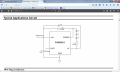
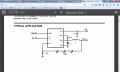
The diode provides a path for the inductor current during the intervals when the chip's internal switch (at the SW terminal) is in the OFF state. You'll see this arrangement on just about every buck switching regulator.
As the data sheet explains on p. 10,
Output Rectifier Diode
The output rectifier diode supplies the current to the inductor when the high-side switch is off. To reduce losses due to the diode’s forward voltage and recovery times, use a Schottky diode.
Often difficult to get you head round this! You need to visualize how the current flows.
Inside the IC there is a switch between Vin and SW. When this switch is ON, current flows from the supply, through the switch, through the inductor, LEDs and Rfb. The diode is reversed and does not conduct.
Inductors don't like the value of current flowing through them to change. Because the changing current produces a magnetic field that creates an EMF that induces a current in the opposite direction (Lenz's law). So while the switch is ON, the current builds up slowly.
After a while the current gets to a level where the voltage drop across Rfb causes the switch in the IC to open. But the current in the inductor cannot stop instantly (due to Lenze's law above). So the current keeps flowing. The inductor becomes a source of current flowing in the same direction as before. This current now causes the diode to conduct, completing the circuit and causing the LED remain lit. The inductor terminal connected to the diode is now negative.
After a while, the inductor current reduces and the cycle repeats. Hope that makes sense!
it's very difficult to get my simple mind around anything like this.
that makes perfect sense and exactly what i was looking for. i didn't know polarity changed on the inductor.
thank you very much.
This is in fact a classic "buck" switch-mode converter.
What you need to remember is that although the switch in the IC opens and closes, the current in the inductor never stops flowing.
When the switch is ON the inductor terminal connected to the diode is positive (at the supply voltage) and the current in the inductor is increasing.
When the switch is OFF, the inductor reverses polarity, the diode conducts and the current in the inductor is reducing (but still flowing in the same direction).
The inductor is an energy store. Charging up when the switch is ON and discharging when the switch is OFF. The energy is actually stored in the magnetic field.
The regulation (keeping the LEDs at the same average brightness even though the supply voltage changes) happens because the IC changes the switch ON time - the charging time. While the discharge time remains constant.
If you are able to visualize this then you are a proper electronics expert!
haha...very far from expert but i think i've got it now.
i'm an old mechanical type so i have to convert electrical properties to mechanical so i can understand.
bringing it down to my level sure helped.
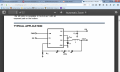
i used to think i understood the PAM2861 circuit but after this lesson, now i'm confused about it. Does the LX pin turn ground on and off?
thanks again.
Then one way of looking at capacitors and inductors is that they are sort of like flywheels in that they store energy.
In the case of capacitors, the capacitor voltage (and stored energy) is analogous to the angular momentum of the flywheel, and the current through the capacitor (acting to charge or discharge it) is analogous to the torque applied to the flywheel's shaft to speed it up or slow it down. A capacitor will resist any sudden change of voltage by sourcing or sinking current to/from whatever is trying to change its voltage; a flywheel will resist any sudden change in RPMs by applying a counter-torque against whatever is trying to speed it up or slow it down.
With inductors, the roles of current and voltage are interchanged, and an inductor will resist any sudden change in the current through it by inducing a voltage across its terminals that will tend to maintain that current.
The relevant equations are:
Capacitors: I = C * dV/dT
Inductors: V = L * dI/dT
i used to think i understood the PAM2861 circuit but after this lesson, now i'm confused about it. Does the LX pin turn ground on and off?
The PAM2861 circuit above works exactly the same way but is upside-down. So the LX pin switches to ground to charge up the inductor current. Because the whole circuit is the other way up, the polarity of the diode is reversed.
All the components are there, same as the first circuit: Rs, diode, LED, inductor. Switch to ground instead of V+.
The flywheel analogy is very good. Flywheels, inductors and capacitors are all energy storage devices.
A flywheel stores energy in its inertia.
An inductor stores energy in the magnetic field.
A capacitor stores energy in its electric field.
I think it's important to be able visualize whats going on. The maths comes later (if at all!).
Q: Is a hammer an energy storage device? How is it that it lets you push a nail into a piece of wood with your own hand?
going by your last lesson, when the PAM's LX turns off, the LX side of inductor changes to positive?
if that's right, how does Vin change to negative? now i'm confused again.
I like to view a capacitor as a spring.
The more voltage (force) you apply the more static energy is stored.
And you can view an inductor as a inertial mass.
It resists motion when a voltage (force) is applied but the longer you apply it, the more current (velocity) is reached and the more energy is stored
That way an spring in series with a mass is analogous to a capacitor in series with an inductor.
They both form a resonant system with a resonant frequency that depends upon their relative parameter values.

 Facebook
 Google
 GitHub
 Linkedin
 398.9 KB Views: 1