Motor wire current

Thread Starter

Track99

Joined Jun 30, 2022
90
Hello my friends, the picture of my motor is below. How do I calculate how much current is in each individual motor wire? It is a BLDC motor.
Thank you my friends.
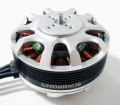
Kv (Motor Velocity Constant)185 RPM/V
Kt (Motor Torque Constant)0.0516 Nm/A
Km (Motor Constant)0.1924 Nm/√(W)
Maximum Continuous Current*50 A (180 s)
Maximum Continuous Power*2755 W (180 s)
Voltage Range22.2 V (6S LiPo) - 52.2 V (12S LiHV)
Io (@10v)0.6 A
Rm (Wind Resistance)0.072 Ω


1667489693517.png
 

Irving

Joined Jan 30, 2016
5,118
Maximum Power input 2755W @ max line volts 52.5

P = √3 VL IL so
IL= P/√3 VL
= 2755/(√3 52.5) = 30A
 

Thread Starter

Track99

Joined Jun 30, 2022
90
Maximum Power input 2755W @ max line volts 52.5

P = √3 VL IL so
IL= P/√3 VL
= 2755/(√3 52.5) = 30A
Thank you my friend. Is it 30A per each wire or is it 30/3 = 10 A per each wire? We can see, there are 3 wires to the motor. I want to calculate the current in each individual wire.

Also, why do we have 1.73 as the multiplying constant?
Thank you friend.
 
Last edited:

Irving

Joined Jan 30, 2016
5,118
Thank you my friend. Is it 30A per each wire or is it 30/3 = 10 A per each wire? We can see, there are 3 wires to the motor. I want to calculate the current in each individual wire.

Also, why do we have 1.73 as the multiplying constant?
Thank you friend.
IL is Line Current.. Its a 3-phase system so each wire carries part of the total at all times. Why do you need to know the individual wire current? And do you want the RMS, peak or peak-peak value?

The difficulty answering your question is we don't know how the operating voltage is spec'd. Its probably the DC input to the ESC so probably represents the peak phase voltage. Also the standard calculations assume a sine wave but with cheap hobby ESCs and motors that may not be true; it could be more like a trapezoidal waveform.

Assumig a sine wave, the RMS current per phase (line) is given by

\( I = P/(\sqrt3 V_{LL} .cos (\phi). \eta) \)​

where
P is input power in Watts
VLL is RMS line to line voltage
cos(Φ) is power factor - I'm using 1 here, but 0.9 would be typical
η is motor efficiency - I'm using 1 here, but 0.85 would be typical

Taking the 52v as peak phase voltage, then VLL is 63v RMS

So I = 2775/(√3 * 63) = 24.4A RMS = 36A peak.

Here's what it looks like graphically for VLL = 63v RMS equal to a phase (per line) voltage of 52v peak (37v RMS).

1667510466093.png
 
Top