I will being using two 12v DPDT Relays for the add motor to replace the two SPDT Relays instead of using 4 SPDT Relays for the added motor. Would that be OK!
If the motors will both be driving the same load (shafts connected together) then yes, you could do that.
So. by pressing S1 this will turn the two motors at the same time in the forward direction and when S2 is pressed the two motors will turn in the opposite direction is that, right!
The only part I'm not sure of is how is the second set of S3 and S4 is to be connected to the added relays.
I'm assumming the second set of S3 and S4 is to be connected to the added relays additional coils and the other side of the switches to ground,And not to the first coils as used for a one motor circuit. if that makes any sense.
If I'm wrong can you drawing a schematic so I connect this part of the circuit correctly.
You could actually drive two motors using the SPDT relays, just as I've drawn it. Connect the two motors in parallel from the relay COM (common) terminals.
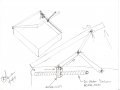
Sorry to barge in late.... I design a lot of machinery utilizing ACME Rod..... just couldn't help but to jump in....
for the screw lead, try utilizing some of the "simple" (Levers and Fulcrum points) machines into the design...
I attached a sketch as an example of what I am talking about.... with this type of setup, your motor will have to be stationary, and the rod supported on the other end with a cintered bronze bearing or similar, unless you do use the 2 motors then the rod can be driven on each end....
You could actually drive two motors using the SPDT relays, just as I've drawn it. Connect the two motors in parallel from the relay COM (common) terminals.
I was thinking of doing this tying the two motors together in parallel and then connecting the + and - leads to the relays COM (common) terminals. as this being the same as connecting one motor to the relay so they operate at the same time when S1 or S2 is pressed. could this also be done on a DPDT relay which i will be using.
But what happens to the circuit it self. Will the ciruit still function the same as having one motor in the circuit or will it change. I do know the voltage stays the same but the amperage will draw double the load in the circuit But I know my power supply could handle this. And i will be driving the same load for both motors there extactly the same motor.The shaft are not connected together as one, but the motors must turn at the same time in the forward direction as well in the oposite direction when S1 or when S2 is pressed and when the limit switches stop both motor in both directions..
I'm still not understanding as for connecting a second set of S3 and S4 to the circuit, will I still need that second set of S3-S4 limit switches no matter what relay i use for the added motor (DPDT) OR (SPDT) as indicated in your drawing.
Sarge. If you can.
Maybe a revised schematic with the added second motor and the second set of S3 AND S4 would make me understand this part of the circuit more.
I was thinking of doing this tying the two motors together in parallel and then connecting the + and - leads to the relays COM (common) terminals. as this being the same as connecting one motor to the relay so they operate at the same time when S1 or S2 is pressed. could this also be done on a DPDT relay which i will be using.
It depends on if you connect it up like I've shown, or not.
If you connect it up differently than I have shown in the schematic, it may not work.
I do know the voltage stays the same but the amperage will draw double the load in the circuit But I know my power supply could handle this. And i will be driving the same load for both motors there extactly the same motor.The shaft are not connected together as one, but the motors must turn at the same time in the forward direction as well in the oposite direction when S1 or when S2 is pressed and when the limit switches stop both motor in both directions..
Make certain that the relays, wiring, etc. are rated for your motors' total current draw. It is always a good idea to use parts that are rated for twice (or more) the current that you are expecting. This will help to ensure a long, trouble-free operating life.
I'm still not understanding as for connecting a second set of S3 and S4 to the circuit, will I still need that second set of S3-S4 limit switches no matter what relay i use for the added motor (DPDT) OR (SPDT) as indicated in your drawing.
Are both motors controlling the direction of the same thing? If so, you really only need the circuit I've posted, and connect the two motors in parallel.
Sarge. If you can.
Maybe a revised schematic with the added second motor and the second set of S3 AND S4 would make me understand this part of the circuit more.
One problem that may occur is that one motor may run and the other not run.
I don't know how you plan on physically connecting the motors. However, if the motor shafts are not mechanically coupled together, and you are using them at different areas of a lid that is being raised or lowered, you will warp the lid.
Quote:
But what happens to the circuit it self. Will the ciruit still function the same as having one motor in the circuit or will it change.
It depends on if you connect it up like I've shown, or not.
If you connect it up differently than I have shown in the schematic, it may not work.
Yes: the circuit will be connected as shown in the posted circuit. But using DPDT RELAYS . This is what I have available to me.
Quote:
I do know the voltage stays the same but the amperage will draw double the load in the circuit But I know my power supply could handle this. And i will be driving the same load for both motors there extactly the same motor.The shaft are not connected together as one, but the motors must turn at the same time in the forward direction as well in the oposite direction when S1 or when S2 is pressed and when the limit switches stop both motor in both directions..
Make certain that the relays, wiring, etc. are rated for your motors' total current draw. It is always a good idea to use parts that are rated for twice (or more) the current that you are expecting. This will help to ensure a long, trouble-free operating life.
Yes: And I did check the specs on the relays the current rating looks to be 4 times of the total motors current draw.so I know that the relays will handle the two motors current total. which is in the mA.
Quote:
I'm still not understanding as for connecting a second set of S3 and S4 to the circuit, will I still need that second set of S3-S4 limit switches no matter what relay i use for the added motor (DPDT) OR (SPDT) as indicated in your drawing.
Are both motors controlling the direction of the same thing? If so, you really only need the circuit I've posted, and connect the two motors in parallel.
Yes: Both motors are controlling to left the lid in the same direction.
Quote:
Sarge. If you can.
Maybe a revised schematic with the added second motor and the second set of S3 AND S4 would make me understand this part of the circuit more.
Is it really that complicated to you?
No: Its not really complicated, But when you stated in post #57 that i need to duplicate S3,RELAY1 RELAY2 and S4 for the second motor this is what confused me a bit. I'm asumming this would be the case if the motor is not connected in parallel. by using the exact circuit and connecting the motor in parallel then theres NO need to add S3-S4 CORRECT!
One problem that may occur is that one motor may run and the other not run.
I don't know how you plan on physically connecting the motors. However, if the motor shafts are not mechanically coupled together, and you are using them at different areas of a lid that is being raised or lowered, you will warp the lid.
The why that I plan to use the motors willbe positioned parallel or oposite to each other but the motor shafts are not mechanically or physically coupled together and NO, there not being used in different areas of the lid there in the same area they will need to left the lid at the same time when opening and closing the lid.
Ok. So 2nd motor in parallel to the first motor. Got it...
I was wondering something about a function or an action in this circuit maybe you can clarify this up for me.
If the two buttons S1 AND S2 were pressed at the same time or by accident, I assume that the motor would just ground and nothing happens because the motor is normally connected to ground.Correct me if I'm wrong.
But.. What would happen if i press either S1 or S2 continously by(holding down the button) what would happen when the lid reaches the limit switch will the limit switch stop the motor completely or would the motor still continuously run until S1 or S2 is released then the limit switch stops the motor. Any advise.
Ok. So 2nd motor in parallel to the first motor. Got it...
I was wondering something about a function or an action in this circuit maybe you can clarify this up for me.
If the two buttons S1 AND S2 were pressed at the same time or by accident, I assume that the motor would just ground and nothing happens because the motor is normally connected to ground.Correct me if I'm wrong.
If S1 and S2 were pressed at the same time, both relays would energize. This would connect both terminals of both motors to +12v, which would have the same effect as shorting both motor terminals together, or shorting them to ground; it would simply act as a brake, and the motors would quickly stop. It was designed to be goof-proof; providing you wire it exactly as shown.
But.. What would happen if I press either S1 or S2 continuously by(holding down the button) what would happen when the lid reaches the limit switch will the limit switch stop the motor completely or would the motor still continuously run until S1 or S2 is released then the limit switch stops the motor. Any advise.
If both S1 and S2 are pressed, the motors won't run.
If neither S1 nor S2 are pressed, the motors won't run.
If S1 is pressed alone, the motor will run in that direction until limit switch S3 gets depressed, which breaks the ground path for relay 1, stopping the motor. You could then push on S1 until hell froze over, and not a darn thing would happen except your thumb would be sore and very cold.
The only way to get the motors running the other way is to release S1 and press S2. Then the motors will continue to run as long as you hold down S2 and don't press S1 until limit switch S4 gets depressed, breaking the ground path for relay 2.
There are any number of ways to screw this up, and I absolutely refuse to go through all of them. I'm certain that you will find a few ways to wire it wrong. That won't be my fault.
If S1 and S2 were pressed at the same time, both relays would energize. This would connect both terminals of both motors to +12v, which would have the same effect as shorting both motor terminals together, or shorting them to ground; it would simply act as a brake, and the motors would quickly stop. It was designed to be goof-proof; providing you wire it exactly as shown.
Yes this is what I throught but not in so many words. Thanks
If both S1 and S2 are pressed, the motors won't run.
If neither S1 nor S2 are pressed, the motors won't run.
If S1 is pressed alone, the motor will run in that direction until limit switch S3 gets depressed, which breaks the ground path for relay 1, stopping the motor. You could then push on S1 until hell froze over, and not a darn thing would happen except your thumb would be sore and very cold.
The only way to get the motors running the other way is to release S1 and press S2. Then the motors will continue to run as long as you hold down S2 and don't press S1 until limit switch S4 gets depressed, breaking the ground path for relay 2.
Ok this is what I needed to know. But i don't think i would hold the button until hell froze over LOL.
There are any number of ways to screw this up, and I absolutely refuse to go through all of them. I'm certain that you will find a few ways to wire it wrong. That won't be my fault.
Don't take this the wrong way. But... Why are you so certain that i will find to wire it wrong! dose this circuit work. Yes or No.
The only way to screw this up if your circuit that you posted dose not work at all and as exactly shown in the first place. Then that would be your fault. Right!
But if your circuit as shown is groof proof as stated and i wire it as shown nothing would go wrong. If i wire it wrong which I don't think is going to happen the circuit as stated then Yes you're at no fault.
I wasn't asking how many ways to screw this up But if your circuit works as you suggested and i wire it as shown how would i srew it up.If you care to Explain that.

 Facebook
 Google
 GitHub
 Linkedin