mosfet

Thread Starter

nepdeep

Joined Sep 14, 2011
140
I added it to my previous post just now.
I had no library or symbols for opamp...i think i can use any buffer....and no trimmer as well

i looked at ltspice and some other sites...no hint on how it works..
ltspice has only txt file of that opamp under spice download

Untitled.png
 

Ron H

Joined Apr 14, 2005
7,063
I had no library or symbols for opamp...i think i can use any buffer....and no trimmer as well

i looked at ltspice and some other sites...no hint on how it works..
ltspice has only txt file of that opamp under spice download
View attachment 48298
Here are the files you need.
Since you have a function generator, you could take the pot out of the schematic and just vary the voltage on the source.
 

Attachments

Thread Starter

nepdeep

Joined Sep 14, 2011
140
OK, here's my design. It has the same topology as yours, but is optimized for transient response.
The discrete op amp gave me better transient response than any high speed op amp that I tried. The down side is the DC performance. You will either need to match Q2 and Q3 Vbe's to about 5mV or less, and also Q4 and Q5 Vbe's to about 5mV or less. Match betas to about 10%. Match Vbe's by connecting collector to base, then use your multimeter's diode test function.
The other option is to add a pot, and don't worry about matching. I can provide a schematic and adjustment procedure if you want to go that way.
I picked the MOSFET at random. If you choose another part number, you might have to change the value of C1 to optimize transient response.

You can change U1 to another part number, but it needs to have a slew rate of about 10V/usec or higher.
Hi ron I need some help
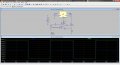
I tried to simulate the same kind of transient load....but with opamp and the regulator....as shown in the figure...should produce the same result...what is lacking...could you please help me?View attachment ask ron_Transient_similar.asc
transient.jpg
 

Ron H

Joined Apr 14, 2005
7,063
Hi ron I need some help
I tried to simulate the same kind of transient load....but with opamp and the regulator....as shown in the figure...should produce the same result...what is lacking...could you please help me?View attachment 48417
View attachment 48418
1. You have to right-click on the NMOS symbol and choose a suitable MOSFET.
2. Your input is 1V, and that is going across 3mΩ. You are trying to drive (1V/3mΩ)=333 Amps. You apparently still don't understand op amps and feedback. You need to study!
3. LT1963 can only supply 1.5 Amps.

Why are you doing this?
 

Thread Starter

nepdeep

Joined Sep 14, 2011
140
Thanks Ron...I didnot know about the regulators property...and 1 V is only in the linear file...when i simulated i have used 200 mv...which is also pretty big...200/3=66 A...
thanks...for the hint...I will come back...again if i have some question..
thanks..
 

Thread Starter

nepdeep

Joined Sep 14, 2011
140
Hi ron...basically there was the problem with the regulator...
When i used ideal source..it seemed quite fine...the only problem is....the current is not stable during first few miliseconds....any suggestion please...!!

transient.jpg
 

Ron H

Joined Apr 14, 2005
7,063
Hi ron...basically there was the problem with the regulator...
When i used ideal source..it seemed quite fine...the only problem is....the current is not stable during first few miliseconds....any suggestion please...!!

View attachment 48439
Do you know how much time I spent creating an optimized design for you?:mad:

You said,
i am looking forward to hearing from you...and yes!! eagerly...
Well, you heard from me.:rolleyes:
 

Ron H

Joined Apr 14, 2005
7,063
I tried numerous wideband op amps in your circuit, and most of them worked fine until I tried to get slower slew rates (which you said you wanted to control). Then the waveform looked bad. The rising edge of the current pulse would be very fast until it got up to a significant portion of full scale, and then it would slow down and follow the input pulse slew rate. The discrete op amp solved that problem.
I think the reason for this is that, at zero current, the MOSFET cuts off, breaking the feedback loop. The op amp saturates, or at least, Vgs goes to ≈0V. Then when the input begins to slew upward, the op amp output has to go up by several volts before the MOSFET begins to turn on. When the output finally does "catch up", the input has already gone significantly above the 0V which is on the sense resistor, so the voltage on the sense resistor "jumps" to catch up with the input (remember that the op amp is striving to keep both inputs equal). This causes the output current to also "jump" (slew very fast).
The discrete op amp mostly eliminated this because it recovers faster from saturation, and probably also slews faster whie it is striving to get up to the MOSFET's threshold voltage.
 
Last edited:
Top