Facebook
 Google
 GitHub
 Linkedin

Hello,
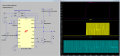
Currently trying to develop basically an analog switch with very low RDSon to switch a pulse up to 10V with a frequency of 20MHz. This 20MHz pulse will directly feed a load that can pull up to 1A. As you can tell RDSon needs to be very low <10mOhms for it to have virtually no impact on the signal being delivered. From my research there is no analog switches that are able to satisfy so I'm trying to do it with N Mosfet on the high side of the load. To test the circuit I use a PWM (Blue signal) to switch the low RDSon mosfet with a higher voltage.
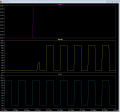
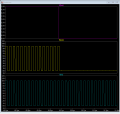
At MHz frequencies I start seeing spikes and weird behaviors whenever the mosfet is not conducting. Selection of the mosfet seems crucial here due to their body properties. I've been able to minimize those weird behaviors from less than 2V replicas of the signal to these spikes seen below. What else can I do to stop having this unwanted behavior? Is there a better topology for a circuit with this function?
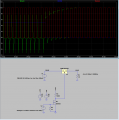
Currently trying to develop basically an analog switch with very low RDSon to switch a pulse up to 10V with a frequency of 20MHz. This 20MHz pulse will directly feed a load that can pull up to 1A. As you can tell RDSon needs to be very low <10mOhms for it to have virtually no impact on the signal being delivered. From my research there is no analog switches that are able to satisfy so I'm trying to do it with N Mosfet on the high side of the load. To test the circuit I use a PWM (Blue signal) to switch the low RDSon mosfet with a higher voltage.
At MHz frequencies I start seeing spikes and weird behaviors whenever the mosfet is not conducting. Selection of the mosfet seems crucial here due to their body properties. I've been able to minimize those weird behaviors from less than 2V replicas of the signal to these spikes seen below. What else can I do to stop having this unwanted behavior? Is there a better topology for a circuit with this function?