Switch for 12V strip LED using MOSFET

Thread Starter

000G

Joined Jan 23, 2026
17
Hi community, I'm new here, If the post is sharing wrong place sorry for now.
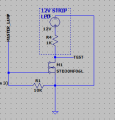
You can see my LTSpice design below, figure 1. Here is my logic: The MASTER_LAMP signal comes from my arduino through gate, and as the 5V is applied to the gate the TEST pin will 12V, and my strip LED will open as long as the 5V is applied to gate from arduino.
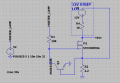
1769384252797.png
Figure 1: The LTSpice design.​
Below you can see the waveform of this circuit, figure 2.

1769384531904.png
Figure 2: The waveform of the circuit.
As you can see, it do the reverse thing, the LED lights as long as the 5V is applied, however I want exactly inverse of it, I reversed the applied MASTER_LAMP signal, now I'm scared to burn my MOSFET, because this will work during whole day.
 

dl324

Joined Mar 30, 2015
18,219
Welcome to AAC!
Here is my logic: The MASTER_LAMP signal comes from my arduino through gate, and as the 5V is applied to the gate the TEST pin will 12V, and my strip LED will open as long as the 5V is applied to gate from arduino.
What does it mean when the LED strip is "open". Does it mean off?

Do you want the LED to be on when the Arduino signal is LOW and off when it's HIGH? And you can't change the polarity of the Arduino signal?

BTW, Arduino is capitalized.

Your schematic is poorly drawn.
 

Thread Starter

000G

Joined Jan 23, 2026
17
Hi dl324,

I want the LEDs to light up, when the Arduino sends the 5V signal. However, in my case, as you can see, when the signal goes the LEDSs turn off. I solved the problem to invert the Arduino signal, figure 3, however, now I'm scared to burn my circuit because it will run during the whole day.


1769387326348.pngFigure 3: The inverted 5V signal.
 

Thread Starter

000G

Joined Jan 23, 2026
17
What are you afraid of burning up? What is the LED current?
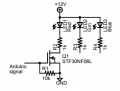
Good Morning, and thx for your reply. In your recommended design,figure 4a , the waveform like below, figure 4b, so when I apply 5V the LED strip will turn off. But what I want is that the LED strip should light up when I apply 5V.

1769428676223.png
Figure 4a: The circuit design.

1769428633538.png
Figure 4b: The waveform of the recommended design.


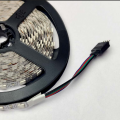
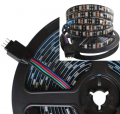
The used LED strip is at below, figure 5.
1769428844997.pngFigure 5: The LED strip.

The black one is 12V and what the other one is ground for the related colors; blue, red, green. What I dream is if I put the MOSFET between the 12V and color grounds, as long as I give 5V to the MOSFET the LED will light up.
 

dl324

Joined Mar 30, 2015
18,219
But what I want is that the LED strip should light up when I apply 5V.
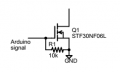
That's what it should be doing. When you apply 5V to the gate on the MOSFET, it turns on. That supplies ground to the LED.
1769430057808.png
The black one is 12V and what the other one is ground for the related colors; blue, red, green.
Black seems an odd color to use for 12V, but I'll take your word for it.
 

dl324

Joined Mar 30, 2015
18,219
Thanks for reply again, but in my above circuit, figure 4, the waveform shows that when we apply 5V, it will turn off, rather than lights up.
You aren't interpreting the simulation results correctly.

When 5V is applied to the gate of the N channel MOSFET, it turns on. Assuming 12V is being supplied to the LED string, the MOSFET will provide a ground path for that string and turn it on.

The "symbol" you're using for the LED strip doesn't make sense. You show a 12V supply internal to the strip with a ground and LED cathode connection (and there's no LED in the symbol).
 

Thread Starter

000G

Joined Jan 23, 2026
17
When 5V is applied to the gate of the N channel MOSFET, it turns on. Assuming 12V is being supplied to the LED string, the MOSFET will provide a ground path for that string and turn it on.
Oh, now I see, so what I understand is, the 12V still here but being 0 when the 5V is applied means that the 12V is grounded so the LED will lights up, am I right ?
Thanks a lot for your time.
 

dl324

Joined Mar 30, 2015
18,219
Oh, now I see, so what I understand is, the 12V still here but being 0 when the 5V is applied means that the 12V is grounded so the LED will lights up, am I right ?
Simulators are useless if you can't interpret the results correctly.

I'd suggest that you learn the basics before relying on simulators. I prefer to use the simulator between my ears because simulators like LTspice don't always give believable results. I gave up on it when I did some what-if simulations in LTspice and LTspice was very picky about the component values where the circuit would work. I breadboarded the versions of the circuit that LTspice indicated wouldn't work, and all worked.

There was a recent thread where a member was simulating a single supply circuit with an LM741. The input voltages to the opamp were outside of the common mode range and that simulator and LTspice both said it would work. It never had a chance, but the member using LTspice said his simulation agreed with the OP's simulation and that it must be a wiring issue. Both simulators were wrong. LM741 couldn't operate in that circuit and neither person picked up on that.

I used the simulator between my ears and it told me that a different opamp was required.
 

MisterBill2

Joined Jan 23, 2018
27,164
Simulators are useless if you can't interpret the results correctly.

I'd suggest that you learn the basics before relying on simulators. I prefer to use the simulator between my ears because simulators like LTspice don't always give believable results. I gave up on it when I did some what-if simulations in LTspice and LTspice was very picky about the component values where the circuit would work. I breadboarded the versions of the circuit that LTspice indicated wouldn't work, and all worked.

There was a recent thread where a member was simulating a single supply circuit with an LM741. The input voltages to the opamp were outside of the common mode range and that simulator and LTspice both said it would work. It never had a chance, but the member using LTspice said his simulation agreed with the OP's simulation and that it must be a wiring issue. Both simulators were wrong. LM741 couldn't operate in that circuit and neither person picked up on that.

I used the simulator between my ears and it told me that a different opamp was required.
DL324is certainly correct about at least some simulators! In addition, resistors never burn up or overheat in the simulator, and transistors do not fail from excess voltage or current, either.
AND, as the TS has seen, a simulator has no problem with short-circuiting a power supply.
 

panic mode

Joined Oct 10, 2011
4,864
The black one is 12V and what the other one is ground for the related colors; blue, red, green. What I dream is if I put the MOSFET between the 12V and color grounds, as long as I give 5V to the MOSFET the LED will light up.
instead of monitoring voltage at the output, look at current and you will see that what you are after is already there. output voltage goes high when LEDs draw no current (when they are off).
 

panic mode

Joined Oct 10, 2011
4,864
understood. black tends to be negative on battery clips, fans etc. though i'm not too picky. i would be ok with just about anything that is easy to identify - black included. and LED strip manufacturers seem to have standardized on using black as common even if it is positive in this case. oh well...
1770233844582.png
 
Last edited:

MisterBill2

Joined Jan 23, 2018
27,164
Given that the three colors feed wires are blue, green, and RED, it would certainly be confusing to also have the tape positive feed wire also be red. I have a similar roll of LED tape and it is marked +GRB,which is quite obvious. My tape does not have wire leads though.
 
Top