MOSFET operating zones

Thread Starter

PsySc0rpi0n

Joined Mar 4, 2014
1,786
A solder mask goes on a pcb but I think your solder mask goes on your face?
To keep the product you are soldering from catching Covid-19 from you?

Or maybe your soldering iron is cheap (from AliExpress) without a temperature control so it gets way too hot and incinerates the rosin in the solder making smoke?

The no-name-brand LEDs are very cheap with no detailed specs then they probably have very poor quality.
Do you also use your solder mask on your face? Maybe you also need it to protect the ones around you from your own Covid-19.
I have no idea what the hell you're trying to do with this part of this message but if you want to mock me or insult, I can go there too!

My soldering iron, which is a station is not from Aliexpress. And maybe you should ask what devices I have for the task instead of making stupid assumptions out of the blue!

How are you planning to mount these diodes?

Based on the datasheet presented above the diodes are typically 3.4v @ 60mA for rated intensity. Each diode will dissipate 3.4 * 0.06 = ~0.2W into the heatsink so 20 diodes co-located will dissipate around 4W in total. If a normal double-sided FR4 PCB with thermal vias is the heatsink, each diode will require a minimum PCB area of approx 12mm x 12mm to maintain a safe junction temperature.
Hum, ok, so I might need to rethink this. Either less UV leds or maybe go with THT components. I'm saying this because I have a few THT pcb boars laying around and I have no usage for them. So, if THT components will make the task a bit easier, I don't mind to go with THT components. Like, the mosfet I have here is THT, I also have plenty of THT resistors (despite the fact that I think they are all 0.25W rated) and also THT capacitors and etc.
 

Thread Starter

PsySc0rpi0n

Joined Mar 4, 2014
1,786
So, are THT components easier for this task or maybe not?

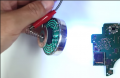
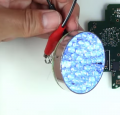
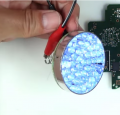
I wanted to do something like this:

1641328813325.png1641328852984.png

I know that this one has probably more than 20 Leds, but that was something similar I wanted.
 
Last edited:

BobTPH

Joined Jun 5, 2013
11,524
Isn't this thread about MOSFET operating zones. What does that have to do with that device. Why do you think it needs a MOSFET (unless you need to dim it by PWM, but I don't think you ever mentioned that?)

Bob
 

Thread Starter

PsySc0rpi0n

Joined Mar 4, 2014
1,786
Isn't this thread about MOSFET operating zones. What does that have to do with that device. Why do you think it needs a MOSFET (unless you need to dim it by PWM, but I don't think you ever mentioned that?)

Bob
Well, because the Mosfet would be to drive the leds. I know the shown image seems to use no transistors or so, but for such type of application, wouldn't it be reasonable to use mosfet to drive the leds? Or just through a bunch of them onto a THT PCB and it's done?
 

Thread Starter

PsySc0rpi0n

Joined Mar 4, 2014
1,786
why is this so hard? It's very simple and all the suggestions should have gotten you there already.
Because there was someone saying that current would burn leds out and because voltages wouldn't be equal to all leds, and leds wouldn't bright equally, etc, etc, etc!
 

Wolframore

Joined Jan 21, 2019
2,619
Because there was someone saying that current would burn leds out and because voltages wouldn't be equal to all leds, and leds wouldn't bright equally, etc, etc, etc!
All true as stated in previous posts, you should do more research if you don't agree or understand.
 

BobTPH

Joined Jun 5, 2013
11,524
What do you mean by “drive the LEDs?”

A MOSFET could be used for either PWM or for constant current, but you have given no indication that that is what you intend.

Bob
 

DickCappels

Joined Aug 21, 2008
10,661
1641376387564.png
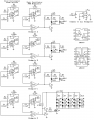
That array looks a typical arrangement of many LEDs with closely matched voltages (if done right). All that is needed is a voltage source of the right voltage.

THT? Wikipedia shows many uses for that acronym but I think you just invented a new one. For the benefit of me and some for whom English is not their first language, what is THT?
 

Jony130

Joined Feb 17, 2009
5,598
If you want to just light the LEDs and you don't need any electronic control ( PWM to dim the LED or to blink the LEDs) you do not need a MOSFET.
 

Irving

Joined Jan 30, 2016
5,134
View attachment 256900
That array looks a typical arrangement of many LEDs with closely matched voltages (if done right). All that is needed is a voltage source of the right voltage.

THT? Wikipedia shows many uses for that acronym but I think you just invented a new one. For the benefit of me and some for whom English is not their first language, what is THT?
THT = Through Hole Technology - as opposed to SMT - Surface Mount Technology. To be fair to the TS, its sometimes found on component search engines...

"What Are The Differences Between SMD, SMT and THT?"
 

Wendy

Joined Mar 24, 2008
23,798
The really bright LEDs are all surface mount for the most part and require heatsinking. All my projects are THT because i prototype them with protoboards like this.
0 Protoboard 63 columns.png
as for dimming LEDs
Chapter 12
0.png
 
Last edited:

Thread Starter

PsySc0rpi0n

Joined Mar 4, 2014
1,786
View attachment 256900
That array looks a typical arrangement of many LEDs with closely matched voltages (if done right). All that is needed is a voltage source of the right voltage.

THT? Wikipedia shows many uses for that acronym but I think you just invented a new one. For the benefit of me and some for whom English is not their first language, what is THT?
I didn't invent a new one. I see this short in KiCad! Through Hole Technology

If you want to just light the LEDs and you don't need any electronic control ( PWM to dim the LED or to blink the LEDs) you do not need a MOSFET.
Ok, so, to avoid problems with leds eventually burning out over time and different brightness, what could I do? If a MOSFET is of no help, what can I do to avoid/improve these 2 situations?

THT = Through Hole Technology - as opposed to SMT - Surface Mount Technology. To be fair to the TS, its sometimes found on component search engines...

"What Are The Differences Between SMD, SMT and THT?"
Tahnk you. It's exactly that!
 

crutschow

Joined Mar 14, 2008
38,526
Ok, so, to avoid problems with leds eventually burning out over time and different brightness, what could I do? If a MOSFET is of no help, what can I do to avoid/improve these 2 situations?
You add a series resistor or use a constant current source to limit the LED current so its below its maximum value.
For maximum life you probably want to operate them at no more that 50%-75% of their maximum current rating.
 
Top