Facebook
 Google
 GitHub
 Linkedin

Yesterday I spent about two hours trying to calculate the operating point of this circuit without success but I can't accept my defeat.
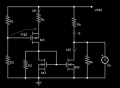
The exercise asks to:
1. "Complete" the operating point and calculate the value of \(R_1\).
(I don't know what "complete" means, at first I though that some of the parameters of the MOSFETs were already given but they aren't)
2. Calculate the value of \( K_{M3}\) when \( I_{D3} = 1.5mA\).
\(M_1\) is a PMOS while \(M_2\) and \(M_3\) are NMOS.
The given parameters are: Vdd = 20V, Vt = 1V, Km1 = 25\(\mu A/V^2\), Km2 = 15\(\mu A/V^2\), R2 = 800KOhm, R3 = 240KOhm, Rs = 17.5KOhm, Rk = 4.8KOhm, Ra = 2KOhm.
Usually, for the analysis of MOSFET circuits I start by supposing that they work in saturation region, I derive the parameters \(V_{GS}\) (or \(V_{SG}\)), \(V_{DS}\) (or \(V_{SD}\)) and \(I_{D}\) with network analysis and then verify the hypothesis (I don't work with software).
Out of desperation I wrote down every \(KVL\) and \(KCL\) and the only thing I could come up with was calculating the value of \(I_A\) using \( I_{D3} = 1.5mA\) (which I don't think it was legal to do) so that I could work with the \(KCL)\; \frac{V_{DD}}{R_1+R_2}+I_{D1}+I_A=0\) and the \(KVL)\; \frac{R_2}{R_1+R_2}V_{DD}+V_{SG1}+R_SI_{D1}=V_{DD}\) but the calculations became so messy that I couldn't go on.
Can anyone see a clean modus operandi?
The exercise asks to:
1. "Complete" the operating point and calculate the value of \(R_1\).
(I don't know what "complete" means, at first I though that some of the parameters of the MOSFETs were already given but they aren't)
2. Calculate the value of \( K_{M3}\) when \( I_{D3} = 1.5mA\).
\(M_1\) is a PMOS while \(M_2\) and \(M_3\) are NMOS.
The given parameters are: Vdd = 20V, Vt = 1V, Km1 = 25\(\mu A/V^2\), Km2 = 15\(\mu A/V^2\), R2 = 800KOhm, R3 = 240KOhm, Rs = 17.5KOhm, Rk = 4.8KOhm, Ra = 2KOhm.
Usually, for the analysis of MOSFET circuits I start by supposing that they work in saturation region, I derive the parameters \(V_{GS}\) (or \(V_{SG}\)), \(V_{DS}\) (or \(V_{SD}\)) and \(I_{D}\) with network analysis and then verify the hypothesis (I don't work with software).
Out of desperation I wrote down every \(KVL\) and \(KCL\) and the only thing I could come up with was calculating the value of \(I_A\) using \( I_{D3} = 1.5mA\) (which I don't think it was legal to do) so that I could work with the \(KCL)\; \frac{V_{DD}}{R_1+R_2}+I_{D1}+I_A=0\) and the \(KVL)\; \frac{R_2}{R_1+R_2}V_{DD}+V_{SG1}+R_SI_{D1}=V_{DD}\) but the calculations became so messy that I couldn't go on.
Can anyone see a clean modus operandi?