MOSFET operating zones

Irving

Joined Jan 30, 2016
5,132
And we can calculate the power dissipated in MOSFET.
Pd = ID^2 * Rds(on)

And for most modern MOSFETs in a TO-220 or similar through-hole package or a D-pack or similar SMD package if Pd < 1 - 1.5W , generally no heatsink is needed at ambient temperatures < 30degC, assuming the highlighted parameter in the datasheet <= 62degC/W.

1641154263514.png
 

Thread Starter

PsySc0rpi0n

Joined Mar 4, 2014
1,786
Why? This resistor is not needed.

Because the modern LEDs are more sensitive than the old LEDs. New LEDs need less current but they are shining very bright.
So we don't need to waste a current, and force 20mA through the LED.

For a power MOSFET 10V is a standard Vgs voltage to measure the rds(on) (when MOSFET is fully Turned-ON).
For a login level MOSFE, it will be around 5V.
https://www.infineon.com/dgdl/irlz44npbf.pdf?fileId=5546d462533600a40153567217c32725

When the MOSFET is fully Turned-ON (Triode region) the channel resistance is very low. And it's specified in the datasheet as a Rds(on) (MOSFET behaves like a resistance that is small compared with the load).
Therefore in switching application drain to source voltage is defined as Vds = ID * Rds(on).
And we can calculate the power dissipated in MOSFET.
Pd = ID^2 * Rds(on)
Ok, point taken about the 10mA current.

However, about R_DS_on, you didn't even considered it when you calculated the 680Ω resistor. Isn't it because it is too small to be considered? Shouldn't this voltage be something around 0.2V or so? I understand we need it to calculate dissipated power, but I don't understand why we didn't use it to calculate the load resistance.

And for most modern MOSFETs in a TO-220 or similar through-hole package or a D-pack or similar SMD package if Pd < 1 - 1.5W , generally no heatsink is needed at ambient temperatures < 30degC, assuming the highlighted parameter in the datasheet <= 62degC/W.

View attachment 256669
Yes, I'm aware of the heating and the need of heat sinks for values over 1W or so. Thanks
 

crutschow

Joined Mar 14, 2008
38,526
about R_DS_on, you didn't even considered it when you calculated the 680Ω resistor. Isn't it because it is too small to be considered? Shouldn't this voltage be something around 0.2V or so? I understand we need it to calculate dissipated power, but I don't understand why we didn't use it to calculate the load resistance.
No, the ON voltage drop is determined solely by the on-resistance of the MOSFET.
It's not like a BJT where the saturation on voltage is typically around 0.1-0.2V.

And yes, the on-resistance is often so low (a few tens of milliohms for many power types) that it can be neglected when calculating the series resistor to control a small LED current.
 

Jony130

Joined Feb 17, 2009
5,598
Isn't it because it is too small to be considered?
Exactly this is the case. In this case Id <1A we do not need to bother about it.

Shouldn't this voltage be something around 0.2V or so?
Why? If you connect the gate to 9V the Rds(on) will be around 0.15Ω so the Vds ≈ 10mA*0.15Ω = 1.5mV.
MOSFET is not a BJT's And in triode mode, it will behave just like a resistor, whose resistance is equal to Rds(on).
 

Thread Starter

PsySc0rpi0n

Joined Mar 4, 2014
1,786
Ok. I know this is not like BJTs. So, this is common practice that we don't consider it to calculate the load resistance but then we consider it to calculate dissipated power.

Now, the resistor we put at the gate is also for safety, right? To prevent that if something goes wrong with the mosfet, the device providing the voltage to the gate don't take any spike current, right?

Another question I have is for driving a set of leds, what is better or most common practice? Put the leds in series or in parallel? And what changes should I consider, comparing to driving a single led? Should I use a mosfet for each led? or a single mosfet is suffice?
 

Irving

Joined Jan 30, 2016
5,132
The resistor on the gate is to limit instantaneous gate current and minimise oscillatory transients in high-speed switching circuits. Its pretty irrelevant in low speed, low power DC switching circuits.

Anything 10 - 1k generally ok,100ohm typical. The 10k to ground isn't really needed if the MOSFET driven by an active push-pull output, though some like to include it when drving relays or other active circuits to avoid switch-on transients. Its not really needed if driving just LEDs.

For multiple LED off 1 MOSFET. In series if high enough voltage available, eg 4 x 2v LED, in series = 8v, driven off 10v @ 10mA = (10-8)/0.01 = 200ohm series resistor.

Else in parallel, each LED needs own resistor. For example: 2 x 2v LED @ 15mA + 2 x 3v LED @ 10mA all from 5v. Each 2v LED needs (5-2)/0.015= 200ohm, Each 3v LED needs (5-3)/0.01 = 300ohm, Total current = 2 x 0.015 + 2 x 0.01 = 0.05A

For a MOSFET with Rds(on) = 0.015ohm, drain current can be up to 8A so almost any # of LED in parallel!
 
Last edited:

Jony130

Joined Feb 17, 2009
5,598
Now, the resistor we put at the gate is also for safety, right?
The MOSFET gate behaves just like a "small" capacitor (nF) between the gate and the source. Thus, the series resistor with the gate will limit the inrush current.
And pull-down resistor helps discharge this capacitance when the gate is disconnected from the rest of the circuit. But as mentioned by Irving it is not mandatory in low-speed circuits.

Another question I have is for driving a set of leds, what is better or most common practice? Put the leds in series or in parallel?
For a 20 UV LEDs and 9V supply, I would go for 10 X 2 in series. And one power MOSFET will do the job.
 

Audioguru again

Joined Oct 21, 2019
6,826
Each Led has its own forward voltage shown as a range on its datasheet. 1.8V to 2.2V for red and 2.8V to 3.6V for bright green, blue and white. If you connect a bunch of LEDs in parallel, even if they have the same part number then the one with the lowest forward voltage will light very brightly and the other LEDs will not light until the first LED quickly burns out caused by too much current. Then the LED with the next lowest voltage quickly burns out, then the next then the next.

I have a flashlight with 60 LEDs, all in parallel and they all have the same forward voltage and same brightness. The factory must have paid somebody to measure the forward voltage of thousands of LEDs and group them into piles, each pile with its own forward voltage. Do you want to do that? In series, the LEDs all have the same current.
 

Thread Starter

PsySc0rpi0n

Joined Mar 4, 2014
1,786
The resistor on the gate is to limit instantaneous gate current and minimise oscillatory transients in high-speed switching circuits. Its pretty irrelevant in low speed, low power DC switching circuits.

Anything 10 - 1k generally ok,100ohm typical. The 10k to ground isn't really needed if the MOSFET driven by an active push-pull output, though some like to include it when drving relays or other active circuits to avoid switch-on transients. Its not really needed if driving just LEDs.

For multiple LED off 1 MOSFET. In series if high enough voltage available, eg 4 x 2v LED, in series = 8v, driven off 10v @ 10mA = (10-8)/0.01 = 200ohm series resistor.

Else in parallel, each LED needs own resistor. For example: 2 x 2v LED @ 15mA + 2 x 3v LED @ 10mA all from 5v. Each 2v LED needs (5-2)/0.015= 200ohm, Each 3v LED needs (5-3)/0.01 = 300ohm, Total current = 2 x 0.015 + 2 x 0.01 = 0.05A

For a MOSFET with Rds(on) = 0.015ohm, drain current can be up to 8A so almost any # of LED in parallel!
Thank you for the thorough walkthrough. However, you are giving me examples an values that I'm not intended to use. I want to make this out of a 9V battery or, if needed, from one of my power supplies. But the goal was to have this set of leds fed by a 9V battery.
Also, I'm targetting for something between 15 and 20 UV leds. I'm not sure I can do this with a 9V battery, but if I can't, I'll just use the power supply.

The MOSFET gate behaves just like a "small" capacitor (nF) between the gate and the source. Thus, the series resistor with the gate will limit the inrush current.

And pull-down resistor helps discharge this capacitance when the gate is disconnected from the rest of the circuit. But as mentioned by Irving it is not mandatory in low-speed circuits.


For a 20 UV LEDs and 9V supply, I would go for 10 X 2 in series. And one power MOSFET will do the job.
Hum, ok. So that means 10 leds in series and then in paralel with another 10 leds in series, right?

Something like:

VDD -- Resistor -- LED -- LED -- LED -- LED -- LED -- LED -- LED -- LED -- LED -- LED -- Drain


Each Led has its own forward voltage shown as a range on its datasheet. 1.8V to 2.2V for red and 2.8V to 3.6V for bright green, blue and white. If you connect a bunch of LEDs in parallel, even if they have the same part number then the one with the lowest forward voltage will light very brightly and the other LEDs will not light until the first LED quickly burns out caused by too much current. Then the LED with the next lowest voltage quickly burns out, then the next then the next.

I have a flashlight with 60 LEDs, all in parallel and they all have the same forward voltage and same brightness. The factory must have paid somebody to measure the forward voltage of thousands of LEDs and group them into piles, each pile with its own forward voltage. Do you want to do that? In series, the LEDs all have the same current.
I don't understand what you said.
First you said that if I connect them in parallel, I'll have problems, but then you say that you have a flash light with 60 leds all in parallel... I'm confused with what you're trying to say! Is it good or bad to connect them in parallel?
 

Jony130

Joined Feb 17, 2009
5,598
Something like:

VDD -- Resistor -- LED -- LED -- LED -- LED -- LED -- LED -- LED -- LED -- LED -- LED -- Drain
No, 9V is way too low for this type of connection.

Something like:
VDD -- Resistor -- LED -- LED -- Drain
 

Audioguru again

Joined Oct 21, 2019
6,826
Don't forget that a 9V battery drops down to 5V or 6V when an "ordinary" 10V Mosfet will work poorly so use a Logic-Level Mosfet works perfectly with a Vgs of 5V to 12V.

I said that unmeasured LEDs all have different forward voltages and they will all quickly burn out one after the other in parallel.
My flashlight manufacturer probably paid somebody to measure the forward voltage of thousands of LEDs and put them into piles where all the LEDs in each pile have exactly the same forward voltage so that it is safe to parallel them.
Will you buy hundreds of LEDs and measure the forward voltage of each one (it might take one week to do it) and pile them into groups that all have exactly the same forward voltage? Then throw away the hundreds that do not match?
 

Thread Starter

PsySc0rpi0n

Joined Mar 4, 2014
1,786
No, 9V is way too low for this type of connection.

Something like:
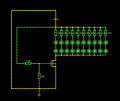
VDD -- Resistor -- LED -- LED -- Drain
I knew I would mess up with my interpretation... :)

So, to fit 20 leds or so, that would be that design times 2, right?
Like this:
1641165075700.png

Don't forget that a 9V battery drops down to 5V or 6V when an "ordinary" 10V Mosfet will work poorly so use a Logic-Level Mosfet works perfectly with a Vgs of 5V to 12V.

I said that unmeasured LEDs all have different forward voltages and they will all quickly burn out one after the other in parallel.
My flashlight manufacturer probably paid somebody to measure the forward voltage of thousands of LEDs and put them into piles where all the LEDs in each pile have exactly the same forward voltage so that it is safe to parallel them.
Will you buy hundreds of LEDs and measure the forward voltage of each one (it might take one week to do it) and pile them into groups that all have exactly the same forward voltage? Then throw away the hundreds that do not match?
Ok, I got the point. Obviously I'm not going to do that!
And the best I can do, is buy like 50 leds, and measure them all and pick up the ones with the closest voltages. What else can I do? And for this application, maybe that's not a big deal. I'm not going to use the absolute max current the leds can take. I'll play on the safe side and use like 80% or 75% of their max current. Or even less voltage drops differences are higher!

Edited;
I used 220Ω on that simulation, but I can use even 330Ω for safer results for the leds.
 
Last edited:

Thread Starter

PsySc0rpi0n

Joined Mar 4, 2014
1,786
Ok. When I have this done, it will mostly be used to dry out solder mask. So, this will be ON only for a couple of minutes each time. Even if I need more time, I'll just use external power supply!

I'm thinking about buying this UV Leds:
https://pt.aliexpress.com/item/33008854742.html
(fixed link)

Unless you guys tell me they aren't suited for drying solder mask, I'll use those. How can I know the current they need? What manufacturers there are so that I can check some datasheets?
 
Last edited:

Irving

Joined Jan 30, 2016
5,132
How are you planning to mount these diodes?

Based on the datasheet presented above the diodes are typically 3.4v @ 60mA for rated intensity. Each diode will dissipate 3.4 * 0.06 = ~0.2W into the heatsink so 20 diodes co-located will dissipate around 4W in total. If a normal double-sided FR4 PCB with thermal vias is the heatsink, each diode will require a minimum PCB area of approx 12mm x 12mm to maintain a safe junction temperature.
 
Top