That's not a true assumption.
An analog comparator is often used in analog circuits to give an external indication of a voltage level or modify the circuit behavior based upon the comparator relative input voltage,
I've use analog comparators in many all analog circuits with no digital circuits in sight.
- Ok, true, but for me, after I read some explanations and talking here with you guys, I draw that conclusion as of 'the best practice' or 'best used for' or 'destined' or 'designed for'. I'm not saying you can't go to the moon using it, that's for everybody to experiment with. It depends on the output I need to obtain, linear or binary 0/1. That's how I think about it now.
- And of course I might be very wrong, because in the end, everything resumes to practice, and how much time you use it and how helpful it was along time. Me? 0 time!!! I'm at the beginnings of experience with it. Brand baby new. But I have to draw a line where I should use it and where I don't.
- Also part of experience is reading about this device, not only making circuits. Both to be more exact, are walking hand in hand. And I didnt do too much reading on it either, I only collected a few impressions here and there from the fence, here in forums and quickies from www. In time I will read more about it. I promise solemnly, with my hand over my hearth. hehehe.
- And on the other hand I think it is very tricky from you to test me here to see if I really get it's true meaning! I think its way to soon for such test! I know you ...hehehe. I know that YOU know its meaning and usage very well. Remember that I'm young with comparators and this might be interpreted as 'derailing'. In the end it all resumes to 'how much can I trust you' ! Pravilnii tovarisci?
You posted a definition of a device that was not accurate.
How is it "tricky" for me to correct your incorrect definition?
If you prefer I let you believe something that's inaccurate, than I will not further comment on your statements, and let you muddle along in your ignorance.
Variation of term abbreviation do not change term itself.
Using non-standard abbreviation opamp instead standard OA not changes term "Operational Amplifier".
This is part3.
And finally, I make it work correctly ! I made some mistakes along the road, because I was focused on something (I still am), but I literally had to tweak everything else around the mosfet to get it behave the correct way. What a journey ! Now, I'm happy !
- Also I am asking a question in the movie, see if you can think of something to help me out with it; its about that power resistor and the mosfet, in the end of the movie ! Thank you!
I am asking a question in the movie, see if you can think of something to help me out with it; its about that power resistor and the mosfet, in the end of the movie
You're missing the point of using a PWM circuit to drive the MOSFET. The point is to be able to test the MOSFET at a "high" current while not having to worry about excessive power dissipation requiring a heat sink. So little dissipation in the MOSFET and most dissipation in the load resistor. I use a load resistor value that makes calculating current mentally easier. 10V and 3 ohms is 3.3A. 10V and 3.3 ohms gives 3A. 10V and 2 ohms gives 5A.
What you're doing with the 470 ohm resistor is severely limiting the current in the MOSFET. I haven't kept track of the output voltage from the bridge rectifier. I think it was on the order of 10V (pulsating DC). With a filter cap on the output (I think you said everything was in series in the video; that can't be right), you should have around 15V. With a 470 ohm resistor, you're only getting 30mA (15V/0.5k) in the MOSFET. The resistor shouldn't be getting warm because it's only dissipating half a watt.
I've also mentioned that changing the 10k resistor to the pot wiper would let you get a lower duty cycle (because I had to do that).
I'm working on a current source circuit for power testing P channel MOSFETs. I'm planning to still use an LM358. Since the output can't get closer than a couple volts from the power supply, I'll need to use 2.
When I speak of operational amplifiers, I say opamp. When I write, I write like I'd speak...
Literature, even from the 1970's, is full of references to "op amp" and "op-amp". It's normal in the English language to hyphenate "new" words/terms. The hyphen is dropped when they're considered to have become mainstream; hence opamp.
I don't recall having seen the OA acronym used very often. Maybe it's the newbies trying to act like they know something. I recently had to ask a member what CRD meant. It was Current Regulator Diode. They're used so infrequently that the association didn't even occur to me. I would have just called it a current regulating diode...
- I find this mistake I made today, way after I published the video and Itried to repair it somehow and I couldnt. I left a comment there in the video about it that no one will read it. I will have to live the shame. I will correct it in the next video.
- But in the same time, proves you've been paying attention - and not mindlessly watching it. hehehe...
You're missing the point of using a PWM circuit to drive the MOSFET. The point is to be able to test the MOSFET at a "high" current while not having to worry about excessive power dissipation requiring a heat sink. So little dissipation in the MOSFET and most dissipation in the load resistor.
- I get all that, not missing anything. But I want to push it to the limit and I dont know how. I also dont know whats the 'normal' way of working either. That's why I want the limit so bad, to draw my conclusion what's normal after that. And I dont want to drive it continuously either. I want it in pulse driving to the max. Get me? Hehehe.
Yes, you're totally get it, even though I didn't mention it too clearly this part, that indeed I dumb it down with the current using this 470R. I choose this value as a reaction after I tested with 100R5W and that started to get warm slowly.
- My conclusion after all this is that the power must fall on the Load (resistor or whatever is loaded there) and have enough resistivity to maintain a smooth input voltage from the source. If the resistance of the load is too low, the input source will start oscilate !!! Thats very unusual for me and probably for you as well. We are used with smooth continuous power all the time, but what I tried here is an extreme. I personally find it fascinating ! Im not sure how fascinating it resulted from the video.
- THe biggest problem is how to rotate the power, instead of falling on the Load resistor, to fall on the mosfet, all the power ! Or a very big chunk of it, like 80% for example. I already have an idea...or two maybe...
- I have no idea what you have tested in your side. Ive seen you tested that AO3401 SMD mosfet on the green comercial TPAD. And is way smarter than my mosfet testing, because its a small package that can get very quickly overpowered and overheated, compared to my thicker IRFZ44N. And using LM358 opamp and {4049 inverter(for Pch and Nch)}. And that you manage to conduct 3A through the mosfet, with a 3.3 ohm load resistor. Now...fresh after my experiments, I am very surprised your source is not oscilating (Pulsed DC), because you are using a very small Load resistor, very close to my 1R. Please explain more clearly for me what did you tried to accomplish with your circuit. I mean I understood something, but not the end deal of it.
You can increase the duty cycle (transistor on time), but calculating power still won't be straightforward. You need to know the duty cycle, current in the MOSFET, it's on resistance (or the voltage drop across it which is harder to measure on P channel devices). Since you're not using my CD4049 buffer modification, you might also want to know how hard you were driving the device because gate voltage changes with duty cycle.
I tested what I stated when we first started talking about the PWM circuit. Current capacity without needing to worry about heat sinking and getting an estimate of on resistance. Besides, AO3401 are only rated for 1.4W (at an ambient temperature of 25C).
Now...fresh after my experiments, I am very surprised your source is not oscilating (Pulsed DC), because you are using a very small Load resistor, very close to my 1R. Please explain more clearly for me what did you tried to accomplish with your circuit.
My power supply does make noise. I'm not concerned about it. Apparently, it's just something switching power supplies do (my Velleman also sings). I'd prefer that they didn't, but it's not something I can do anything about.
As I keep saying, and you keep saying you get, I want to test the devices at "high" current without needing to worry about heat sinking and also get an idea of on resistance. If I wanted to test power dissipation, I'd use a more appropriate test setup.
ok, thanks for the explanations. So your target with mosfet is to make it conduct as much current without a heatsink.
And the power is consuming is just very hard to obtain because the switching is complicating the calculations. Yes.... ok !
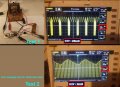
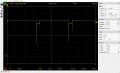
I am concerned about it. Please repeat my experiment on your side, put your osc probes directly on the supply wires, while they ar powering the Load line through the switching mosfet. If you see an oscilogram close enough to mine, then your PSU is switched/influenced by the mosfet. It is never a good thing. See if you catch something similar with my oscilogram. Depends on the horisontal knob, so you'll have to play it a bit to get it. I am curious if you will get close to mine also. Also a very possible situation is not to catch all those vertical spikes to 0V, but only the DC sinewave! This picture here is one of the best from a pile of "wtf"'s. This is not an AC current, this is a positive pulsing DC, to be clear. And is a very strange thing I never encounter, this is the first time for me. So do this quick experiment for me and for you as well.
This is not an AC current, this is a positive pulsing DC, to be clear. And is a very strange thing I never encounter, this is the first time for me. So do this quick experiment for me and for you as well.
The problem is that you're using a very weak power source for the MOSFET. At best, it might be capable of supplying 1-2A. With a 1 ohm load resistor, you're trying to draw more like 10A. That's not going to happen (I've also said this several times). You have the ~1kHz pulses on top of the 100hz pulsing DC. Whatever filter cap you have on the output of the bridge rectifier isn't sufficient. Even when you had 3300uF, that wasn't enough by half.
If you see an oscilogram close enough to mine, then your PSU is switched/influenced by the mosfet. It is never a good thing. See if you catch something similar with my oscilogram.
I already showed you the sagging from my power supply due to power lead resistance.
My later scope screen shots are better after I figured out how to calibrate the scope...
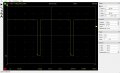
your waveform here is quite straight, not as sinusoidal as I had it. Probably a little bit over 1R resistance, does make a difference ...hmmm...very interesting.
I dont think you are pulsing your transistor "hard" enough. Look on my pulses that are going from +7V down to 0V rail and back again to +7V, in a very nice square wave. Yours in comparison are going from +5V to +4.5V and with a big spike to +1.8V due to switching is my guess...
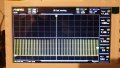
I have no idea what you probed here. The Gate or the Drain ? That 1.358kHz seems reasonable... although this cct is probably calibrated to my 2kHz. I did observed different fv readings in my osc as well, and I solved this problem from the Horisontal knob. I believe you are too zoomed in now, and the fv is not really the true one. Try get out a bit, to see a train of pulses and tell me whats the fv then. It matters to compare drain pulses with gate pulses to check if there are losses in your drain this way. Is my experience talking here.
I stay all day today to modify that wrong circuit with the correct one.
It is looking more crazy now than it already was, but I corrected it and now Im happy.
You have no idea how much work got into making this correction...ohohoa... Im very released that I finish it.
Ive updated the original post of the movie with this new updated movie. THe other one with the mistake cct in it I delete it.
You dont have to re-watch it. Im only updating you here.
This is the corrected cct that I also patch it in the movie:
-This is the biggest reason I like more the public forum version than the private one on this website. The private threads has a very stupid 10 minutes limit. WHY? This public forum thread you can update your posts even after a couple of months if need be. With important updates ofcourse, not to screw things up, and this is a big issue but you can catch the wrong do-er very quickly if its a serious problem. Is my very subjective impression, of course. But I wanted to point this little detail that is very important in my subjective book. Suggestion for the future is to make the private forum the same as the public one, without that annoying and absolute nonsense and unreasonable 10min limit.
your waveform here is quite straight, not as sinusoidal as I had it. Probably a little bit over 1R resistance, does make a difference ...hmmm...very interesting.
I dont think you are pulsing your transistor "hard" enough. Look on my pulses that are going from +7V down to 0V rail and back again to +7V, in a very nice square wave. Yours in comparison are going from +5V to +4.5V and with a big spike to +1.8V due to switching is my guess...
I was probing the supply voltage (on the high side of the load resistor). This was when I was telling you that in addition to lead inductance causing your "boost converter effect", the resistance was causing voltage drops that affect current and on resistance calculations.
You're seeing a sinusoidal waveform because that transformer can't supply much current and the filter cap is far too small.
I have 2 test circuits. One when I started the movie with, presenting this (corrected) cct here.
And another - later - with the mosfet.
Because with this brutal cct I had to find out the real issue why the supply is giving me that pulsed DC - AFTER - the rectification !
And the answer was a bigger resistor. The 100R and then the 470R that remained. I will actually come back to the 100R for ease of calculations, but in later experiments. I always hunted for the full power over the mosfet, that's why I got so many issues with this very basic circuit AC to DC rectification, filtering and loading, and in the end the switching.
Clear as mud now? Hehe.
That transformer is too small to do "high" current testing. You should just put it back in your pile of stuff and use that 12V supply to power the PWM and your variable supply to power the MOSFET.
You're not going to hurt your power supply. If it's rated for 30V/6A, it should be able to provide 6A for a reasonable amount of time. My Wanptek 30V/6A supplies have fans, but they've never turned on. When I first got them, I tested them at 30V at 6A. They couldn't do it at first because they ship with the line voltage switch set to 240VAC and I didn't read the little manual saying to check the setting...
You are saying this because #1 rule for you is to drive a lot of current through the mosfet, yes?
Hmmmm.... We will make some nice welding sticks and probably even current arching from those mosfet legs, at the current you propose.
I do want to protect my variable PSU because is the only one I have and if I damage it, thats it, game over for me. Better to be over precautions than courageous.
I will try to find a bigger current isolation transformer. (specifically)
Aaaaah... I just remembered, I have a microwave transformer that I convert it into a powerful spot welder that I never use it. But Im not comfortable working with that. But if you think that will be perfect, I will start considering it. Maybe buying another one from a repair shop that I got the first one from.
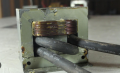
My spot welding transformer I made is looking very similar with this one in the picture here. I put in it very thick welding cables. Almost 1inch/2cm diameter cable for the secondary !
I do want to protect my variable PSU because is the only one I have and if I damage it, thats it, game over for me. Better to be over precautions than courageous.

 Facebook
 Google
 GitHub
 Linkedin