Mosfet open discussion

Thread Starter

q12x

Joined Sep 25, 2015
2,227
- Ha, well, I am sure somewhere in this world "my invented word" is a common abbreviation in normal literature and one should adapt and not hang out on the word. But... my intention here is not to antagonize anyone, especially mister @dl324, as hard as it comes to me to re-adapt to new 'requests' I will bend to the will of my friend after all, because I need his good advice. This doesn't mean I'm wrong at every step as he is somewhat believing about me and I can sense that.
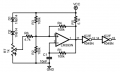
- A very short update, I am currently playing with a very basic temperature sensor using a NTC thermistor, an LM393 digital comparator (now that I learned it's true intention and people should name it like this all the time!!), and all SMD components. I am playing with some VERY strange error that is clouding this circuit and if I can pinpoint its true cause, Im 'game'. Wish me luck because this is hard. Hopefully it will be a very cheap but efficient replacement and more like a warning advertisment than a display for detailed or stepByStep data. I really like the idea of it. We'll see how it will go.
 

crutschow

Joined Mar 14, 2008
38,522
an LM393 digital comparator (now that I learned it's true intention and people should name it like this all the time!!
No, the LM393 is not a digital comparator and should not be named as such!!

A digital comparator compares two digital words and gives a digital output (an example is the CD4063 which compares 4-bit word A with 4-bit word B, and has 1-bit A>B, A=B, and A>B outputs).

The LM393 is an analog comparator which compares two analog voltage inputs and gives a one-bit digital output as to which voltage is higher.
 

dl324

Joined Mar 30, 2015
18,333
Ha, well, I am sure somewhere in this world "my invented word" is a common abbreviation in normal literature and one should adapt and not hang out on the word. But... my intention here is not to antagonize anyone
Neither you, nor I, have the stature in this field to be making up our own terminology. It isn't necessary and it isn't useful.

The previously mentioned usage of DuCy and the like carries no sway with me. I don't know the credibility of the sources and, even then, I wouldn't pay any attention to them. There is no need to make up new terms for existing, accepted terminology. I don't consider StackExchange or some random document on the internet to be valid reasoning to use new terms instead of existing terminology. Just because it's on the internet, or in a document, doesn't make it right.

an LM393 digital comparator (now that I learned it's true intention and people should name it like this all the time!!),
This is no more correct than saying an opamp can't be used as a comparator. A comparator compares two analog voltages and gives a HIGH or LOW output, but that isn't the only use for comparators (because they can also be used as slow opamps). An opamp makes a slow comparator, but sometimes slow is good enough.

Just call it a comparator and leave it at that.

This doesn't mean I'm wrong at every step as he is somewhat believing about me and I can sense that.
You have this tendency to get sidetracked, ignore what people are trying to tell you, and keep repeating the same mistakes. It's getting frustrating and annoying.

When you first started using that transformer, you were told by no fewer than 2 members that you needed to put a filter capacitor on the output of the bridge rectifier. Then you reconfigure the bridge rectifier and make the same mistake. This was after I tried to point out the fallacy of trying to use the transformer.

If you're not going to listen to what you're being told, I'm not going to keep pointing out your mistakes and misunderstandings.
 
Last edited:

dl324

Joined Mar 30, 2015
18,333
And why the waveform is sinusoidal ? ~~~ It should have be a straight line.
I put 15VGS. The tr never got warm. Only 1R got hot.
It isn't clear to me whether you have a filter cap on the output of the bridge rectifier, or how large it is.

Assuming you're still trying to use the transformer to power the MOSFET. With no filter capacitor, or one that isn't large enough, you aren't providing a DC voltage. It's some sort of pulsating DC.

Assuming your meter is giving some sort of RMS voltage for the rectified DC, the peak voltage would be around 19.6V. Assuming you were driving the gate hard, that would give a drop of 19.6V across the 1 ohm resistor. It would be dissipating more than 300W. Obviously the transformer you're using can't supply more than an amp or 2. But, also obviously, enough for the resistor to get hot. Assuming the MOSFET was on hard, it would be dissipating very little power. That was the main purpose of using a PWM to turn it on.

What you're seeing on the scope is the inverse of the PWM waveform superimposed on the pulsating DC from the bridge rectifier.

I have told you several times now that using that transformer to power the MOSFET is pointless because it can't provide enough current.

Put the transformer back in your pile of stuff, power the PWM with the 12V supply you were using, and use your big power supply to power the MOSFET.

When we get around to testing P channel MOSFETs, using two separate supplies won't be an option. I've already modified my setup to test IRF4905, IRF9540, and AO3401.

EDIT: My modified PWM circuit that addresses output voltage changing with duty cycle. Now I set Vcc to the gate voltage I want:
1722822436391.png
I use the output from the second inverter to drive N channel devices and the output of the first inverter for P channel devices.
 
Last edited:

dl324

Joined Mar 30, 2015
18,333
That's interesting.
It surprised me that CD4049 can't source much current. I had always thought they were buffers which tend to have high source/sink currents:
1722865129996.png
1722865145749.png
So I'll be paralleling the unused inverters with the second inverter. You can only parallel gates from the same package because matching is sufficient within the same package.
 

Thread Starter

q12x

Joined Sep 25, 2015
2,227
If Im reading right, what that list is saying :
#_Sourcing (when 4049 output pin is +) at 25*C will give a Typical of -2.6mA DC @ 10v
#___Sinking (when 4049 output pin is -) at 25*C will take a Typical of 16mA DC @ 10v
This means you have that Sourcing (as an option) and is for signal processing, and not for power handling.
For power handling it looks it is designed to Sink. So +10V to LED/Load to pin to gnd. Thats the proper cct for this 4049.
A solution, is to put a NPN transistor when you source from the output pin.
Its how I see it and my 2cents . Interesting detail nevertheless.
 
Last edited:

sarahMCML

Joined May 11, 2019
697
It surprised me that CD4049 can't source much current. I had always thought they were buffers which tend to have high source/sink currents:
View attachment 328605
View attachment 328606
So I'll be paralleling the unused inverters with the second inverter. You can only parallel gates from the same package because matching is sufficient within the same package.
The only high current one of the series is/was the CD40107, which is open drain, but can sink up to 136mA! So you could use a low value pull-up.
 

MrAl

Joined Jun 17, 2014
13,708
Okay. But I think you are misstating the problem. It is not whether it is driven continuously or pulsed. It is whether it is used as a switch, or used to drop a voltage. In the case of a continuous current source, it must drop a voltage.

Just to make things confusing, that mode of operation is called the linear region on a BJT and the saturated region on a MOSFET. The two names are reversed in meaning!

There are MOSFETs that work well in saturated mode and others that do not.
Hi,

I would think you could create a current source and then turn it on or off at will. Using a MOSFET and some control circuitry, the MOSFET would be in constant current mode (linear) until it is switch off. When switched back on, it would go back into constant current mode.
One use I can see for this offhand is for battery testing were we want to test the battery under pulsed conditions. That's a typical test for batteries. It is pulsed and the discharge time is recorded over the entire test. That's almost the same as the continuous charge test. The difference is the pulsed test shows how the battery lasts under pulsed conditions. The pulse current levels are often changed from lower current pulses to higher current pulses. In most cases the pulsed current levels, even though the same average level as the continuous pulse tests, the battery lasts longer. That's one of the characteristics of batteries under load. We can also pulse it at say 50 percent duty cycle for two times longer than with constant current and compare the discharge times. This tells us something about one of the characteristics.
 

MrAl

Joined Jun 17, 2014
13,708
I see. Ok.
One of the things you want to be able to do is communicate effectively with your peers. That means agreeing to certain conventions. There are very good reasons for 'inventing' new terms, but if it just says the same thing as the old term it isn't such a good idea.

There are of course exceptions to every rule and your example is one of them. The comparator (like the LM393) is actually referred to as a 1 bit device in some applications, like one of the Analog to Digital converters. It can be referred to as a 1 bit ADC.

A 1 bit comparator though usually is a device that compares 1 bit to another 1 bit, and provides an output that is either greater then, equal to, or less than, which means there could be three different 1 bit outputs for such a device.

I guess we can also say that all comparators are digital, so we don't really have to say 'digital'.
We might as well say, "giggity" :)
 

crutschow

Joined Mar 14, 2008
38,522
I guess we can also say that all comparators are digital,
That's too general.
As I noted in post #142 there are digital comparators with digit inputs and outputs, and there are analog comparators with analog inputs and a 1-bit digital output.
I think the distinction between the two should be maintained.
 

dl324

Joined Mar 30, 2015
18,333
A solution, is to put a NPN transistor when you source from the output pin.
I needed two inverters. One for P channel devices, and 2 for N channel devices. I chose to use integrated inverters for wiring convenience and not having to worry about base currents.

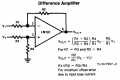
When testing P channel devices, I used a 10V supply. I found that it was difficult to measure the MOSFET on voltage, so I used a difference amplifier to sort of invert the signal. I added a zener diode clamping circuit to workaround the limitations of DSO's not working when their inputs are overdriven. I divided the drain and supply voltages by 2 and subtracted the drain voltage from the supply voltage. I amplified by 10 because the on voltage was around 0.1V for two of the devices.

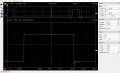
This is the drain voltage on AO3401 (edit: at about 3A, 3.3 ohm load resistor) with a 10V supply (difficult to resolve the on voltage):
AO3401-drain.jpg
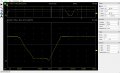
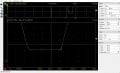
This is the difference amplifier output before I added the clamping circuit:
AO3401-difAmp.jpg
The sloped edges are due to slew rate limiting of the LM358. The maximum voltage is about 9V (instead of 50V) because the output saturated. The on voltage of 0.2V (overall multiplication is 5) can be measured more accurately.

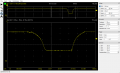
This is after clamping (note that I could now use a sensitivity of 500mV/div):
AO3401-difAmpClamped.png

EDIT: AO3401 at about 3.3A and the clamp circuit not triggering current limiting in the opamp:
AO3401-3v3DifAmp.jpg

The difference amplifier is from National Semiconductor AN-31:
1722873674355.png
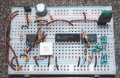
pwmPdifferenceAmp.jpg
 
Last edited:

Thread Starter

q12x

Joined Sep 25, 2015
2,227
I didn't think I said something new there. The mosfet and the transformer are working without getting hot, only 1R is hot in less than 10sec. Im closing the test with that pulsing circuit. I will concentrate on something else.
 

dl324

Joined Mar 30, 2015
18,333
The mosfet and the transformer are working without getting hot, only 1R is hot in less than 10sec.
The MOSFET shouldn't get hot. That's why we're using PWM.

This is my latest data:
1722909913416.png

Even at 3-4.5A, the MOSFETs aren't dissipating much power. The resistors aren't dissipating very much power either.

AO3400 and AO3401 were tested near their maximum continuous current ratings.
 
Last edited:

MrAl

Joined Jun 17, 2014
13,708
That's too general.
As I noted in post #142 there are digital comparators with digit inputs and outputs, and there are analog comparators with analog inputs and a 1-bit digital output.
I think the distinction between the two should be maintained.
Yes I have to mostly agree, and the correct way to look at the type we might be talking about here would be called a "borderline analog/digital" device, at least back in the day. Now they might just refer to this as a "mixed signal" device.
Also, then "comparator" is also too general ... what kind is it.

I did mention the 1 bit purely digital type comparator to show the distinction. It actually has two inputs and up to three outputs, although there is one type that has two (1 bit) inputs and just one (1 bit) output for equality, which would be similar to a simple XOR gate. Do we call this last type an "XOR gate" or a "1 bit digital comparator".
 
Last edited:

Thread Starter

q12x

Joined Sep 25, 2015
2,227
The LM393 is an analog comparator which compares two analog voltage inputs and gives a one-bit digital output as to which voltage is higher.
When I said it should be called 'digital comparator', I was referring to it's designation, or field of use. Usually, an opamp is used in analog circuits, where a comparator is used specifically in digital circuits, thus the name 'digital comparator'. I thought it is obvious. Hmm... not that much I guess.

The comparator (like the LM393) is actually referred as 1 bit ADC (analog to digital).
Its a very interesting view and I never have thought of it like that ! My first encounter with this side of it. Fascinating indeed.
Thanks for pointing it out !
 

dl324

Joined Mar 30, 2015
18,333
I didn't think I said something new there.
You made some comment about your DVM and scope giving different measurements. That's to be expected with pulsating DC.

Your DVM will give an RMS (or maybe average) reading on DC ranges when the input is pulsating DC. When you use a bridge rectifier and measure the output without a filter cap, you'll likely get an RMS reading. If you measure the same voltage with a scope, it will give you peak readings (and maybe also RMS).

The relationship between RMS and peak is peak will be 1.414 times higher. If you take the voltage your DVM gave and multiply by 1.414, you should get what the scope is giving you.

If your DVM was giving you an average value for the pulsating DC, the result on the scope will be more than 1.414 times the DVM reading.
 
Top