Modifying “fairy lights”

Thread Starter

djsfantasi

Joined Apr 11, 2010
9,237
I’m likely to use “fairy lights”, a string of small LEDs used to light craft projects, in a theatrical prop I am building. The prop is a cake, with several working candle effects.

An Arduino Nano will create the effect.

We have a string of fairy lights. I want to use the LEDs individually driven by PWM IO ports in the Nano.

Since the original string uses the internal resistance of two CR2032 batteries, I needed to know the internal resistance to calculate dropping resistors when using the LEDs as I intended.


I found this reference. Therein is a chart from which I estimated the internal resistance to be 10-15 ohms. Two batteries would be 20-30 ohms.
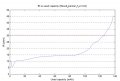
CC76F863-17D1-46D6-B261-36374ACB624D.jpeg

I checked for typical characteristics of a white LED. I don’t know yet the actual specs, but used typical values in my calcs.

So, based on the following:
  • Supply 5V
  • CR2032 internal resistance of 10-15Ω
  • Vf = 2.8V
  • I(led) = 0.018mA

Then, I did the following calculations.

(5-2.8)=2.2v

R = 2.2/0.018 = 122 ohms

Looking at this another way, ten LEDs in parallel need 180-216 mA. That current draw over 20-30 ohms produces a voltage drop of 3.6-4.3 volts.

Something is amiss and I’m confusing myself. Is my approach correct? I don’t have the string yet. I’m tempted to wire up one LED from the string with a 100 ohm resistor and see what happens. Of course, if I can do that I will then have the string and can measure current and forward voltage directly.

Help!
 

sghioto

Joined Dec 31, 2017
8,634
Generally white LEDs require 3 volts, 2.8 volts is probably minimum but your calculation of 122 ohms is close.
I would try a 120 ohm resistor and just measure the current.
SG
 

Audioguru

Joined Dec 20, 2007
11,248
Instead of guessing, you need the range of forward voltage from the datasheet that is not available or buy a string and test each LED for its forward voltage at the brightness you want.
 

Thread Starter

djsfantasi

Joined Apr 11, 2010
9,237
Instead of guessing, you need the range of forward voltage from the datasheet that is not available or buy a string and test each LED for its forward voltage at the brightness you want.
I knew that was the correct answer. I am a planner, and was trying to get a feel for what I’d need. In part, I feel obligated to use the fairy string lights, because the Director told me that’s what he had. Personally, I’d rather use discrete LEDs that I had the specs for.
 

Bernard

Joined Aug 7, 2008
5,784
I bought a string of 30 parallel wired fairy lights, 3 AA alk., 6 hour & 24 hour timers just to confirm the power draw, 56 mA .Earlier I had modified a 50 led string for a throbbing spider costume with a note listing average drain of 36 mA which I started to doubt.
LEDs fairly bright & uniform. Brighter from the front, but visable 360 deg.
V at the end of the line is 2.7 V, just checked.
 
Last edited:

ian field

Joined Oct 27, 2012
6,536
By the way, the strings illuminate on 3V. Just very bright in 6.
most of the small strings I've seen have either internal resistors or other current limiting and are quite happy on 3V There are increasingly white & blue LED that seem to work OK on 3V - not so far found any data sheets.

One company having spent £millions on trying to perfect a realistic candle effect - found that a melody chip does very nicely. should be possible to do the same with your board if it has PWM audio outputs.
 

Thread Starter

djsfantasi

Joined Apr 11, 2010
9,237
most of the small strings I've seen have either internal resistors or other current limiting and are quite happy on 3V There are increasingly white & blue LED that seem to work OK on 3V - not so far found any data sheets.

One company having spent £millions on trying to perfect a realistic candle effect - found that a melody chip does very nicely. should be possible to do the same with your board if it has PWM audio outputs.
The strings that I have do not have internal resistors. Unless there’s a 2mm LED with an internal resistor in the same die.

Not worried about the candle effect. I have six PWM pins on the Nano and randomly generating the pulse width, duration and direction for each produces an acceptable effect. There are many sketches online to do this and other methods.

Back in the day of transistor radios, talk stations fed into a grain of rice bulb, was used for fire effects.
 

Thread Starter

djsfantasi

Joined Apr 11, 2010
9,237
I gave up on the fairy string. I only had three yellow LEDs left, so I ordered a kit of various color and size LEDs. I’ll have them from Amazon before I’d get the fairy string, anyway. Thanks for your comments!

Pop the batteries out and put your ammeter in-line with the circuit (use new batteries) and see what the draw is.
Done that. Draw is 156mA.

I’m using them in another project. An ATTiny85 with a 2N7000 drives three separate strings.
 

Thread Starter

djsfantasi

Joined Apr 11, 2010
9,237
Oh! I had forgotten that. With the following specs, I should be able to calculate everything I need.
  • 156mA total draw
  • 16mA per LED
  • 3V forward voltage
  • 5V supply voltage
...and the rest falls into place!

125Ω current limiting resistor. Damn close to the previously calculated value of 122ξ!
 

Audioguru

Joined Dec 20, 2007
11,248
Chinese wages are very low so they hire somebody to test and sort thousands of LEDs into groups that have the same forward voltage then they can be paralleled. My 24 LEDs Chinese flashlight had that done.
 
Top